
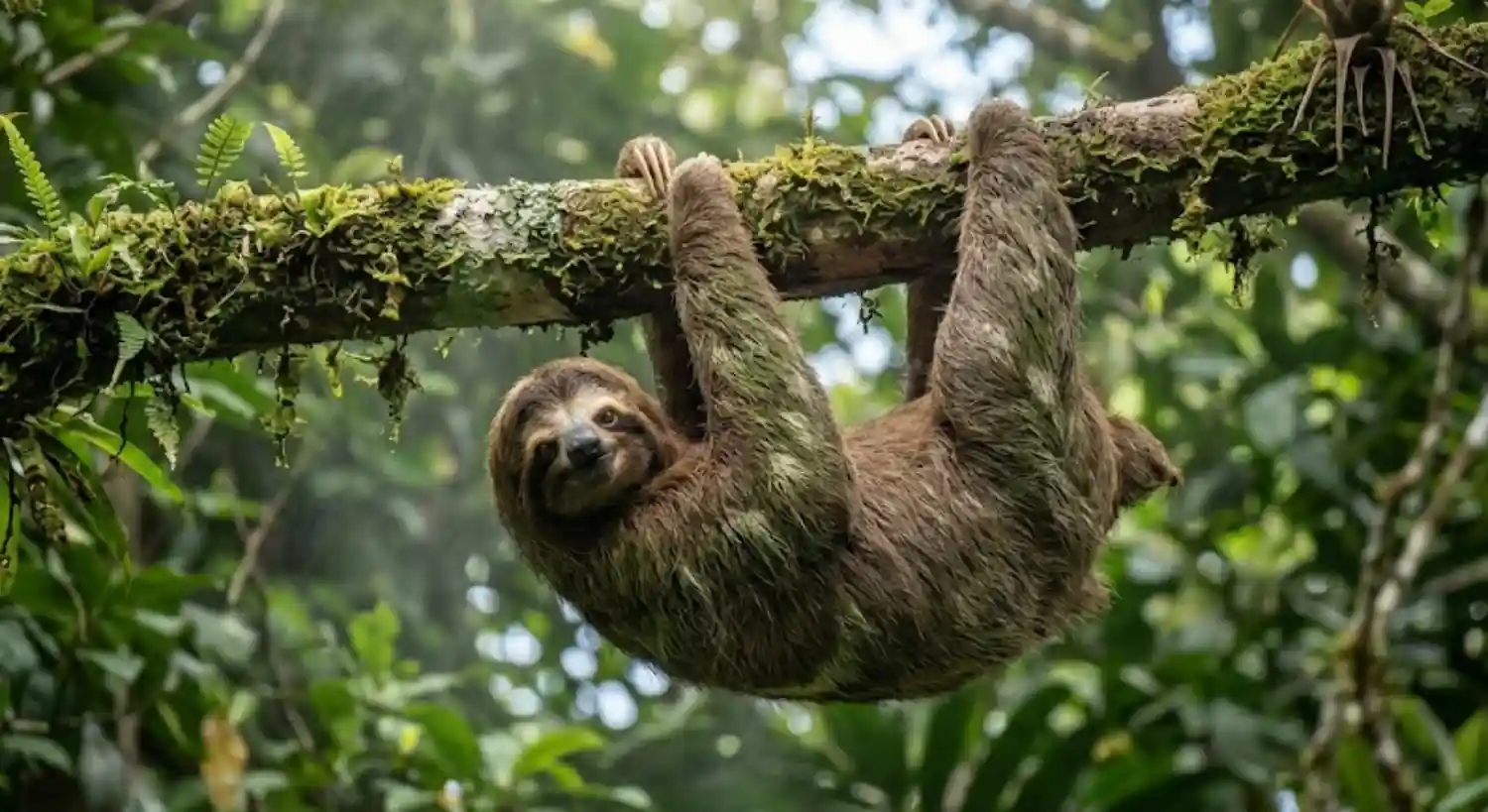
An uncommon anatomical detail defines life high in the canopy for one of the most emblematic animals of the American continent. The stomach of a sloth can account for up to a third of its total body weight, hosting a voluminous ecosystem of symbiotic bacteria devoted to breaking down the tough cellular fibers of its food. Unlike most vertebrates we know, that digestive process is astonishingly slow: a single meal made of a handful of leaves can take up to a full month to be completely processed, and that pace dictates absolutely every other biological function of the animal.
The slowest metabolism in the tropical forest
The characteristic slowness of this canopy dweller is not laziness in the human sense of the word, but the result of an evolutionary adaptation pushed to its ultimate consequences. According to research focused on animal physiology, the sloth has the slowest metabolism of any mammal on the American continent. To survive on a diet made exclusively of leaves with extremely low nutritional value and packed with toxins, its body had to slow down drastically, turning energy conservation into the rule that governs every instant of its existence.
That saving shows up in every aspect of the animal’s life. Its body temperature, for instance, is not held constant the way it is in dogs, cats or humans. The body of this peculiar mammal works almost like that of a reptile, undergoing significant swings depending on the temperature of its surroundings. During the cold predawn hours of the forest, its internal temperature drops and cuts energy expenditure even further. When the sun rises, it is common to see these individuals at the top of the trees with their arms spread open, absorbing solar heat to warm up and reactivate their organic functions, a behavior that makes the most of the scarce energy drawn from its restricted leafy diet.
The complex, drawn-out digestion of leaves
A leaf-based diet imposes enormous challenges that evolution solved with mastery. Many plants of the Amazon rainforest develop powerful chemical defenses to discourage herbivory. To cope with that toxicity, the mammal’s compartmentalized stomach acts as a genuine slow-fermentation chamber. Studies indicate that the microorganisms present in the digestive tract gradually neutralize the toxins while breaking down the resistant cellulose, a silent labor that stretches across weeks rather than hours.
That process consumes a great deal of energy, leaving very little to spare for vigorous physical activity. If the animal tried to move at the same speed as a monkey, it would quickly exhaust its vital reserves and die of exhaustion even on a full stomach. That is why every movement is calculated and carried out with impressive deliberation. The skeletal musculature amounts to only a quarter of the total body weight, a far smaller proportion than that seen in other mammals of similar size. This muscular reduction means there is less tissue to feed and oxygenate, an added saving inside a body engineered to spend as little as possible.
A walking ecosystem with algae in its fur
The adaptation to the environment is not limited to the internal organs. This animal’s coat harbors a true microcosm and works as an extension of its survival system. The hairs have microscopic cracks that absorb the constant humidity of the Amazonian air, creating the perfect environment for the growth of green algae and fungi. That symbiotic relationship provides a crucial camouflage advantage: the greenish tone the strands take on lets the individual blend into the surrounding foliage and become almost invisible to formidable aerial predators such as the harpy eagle (Harpia harpyja).
Beyond camouflage, some scientific lines of thought suggest the algae may supply additional nutrients. Because the animal tends to lick itself to groom its coat, it ends up ingesting these lipid-rich algae, gaining a vital caloric supplement that leaves alone cannot provide. Brazil’s environmental agency, IBAMA, frequently stresses the importance of understanding these complex networks of biological interaction in order to design efficient strategies for preserving native species.
The dangerous journey to the ground to defecate
Although they spend the overwhelming majority of their time in the safety of the highest branches, there is a moment of extreme vulnerability in their routine. About once a week, the animal begins a slow and perilous descent to the base of its host tree with a single goal: to defecate and urinate. That trip to the forest floor defies the logic of safety, because it exposes the sloth to fierce ground predators such as jaguars and ocelots.
The reason for this risky behavior has intrigued naturalists for centuries. The most widely accepted scientific explanation involves a cycle of mutualism with specific species of moths that live exclusively in the animal’s fur. When the sloth comes down to the ground, the female moths seize the chance to lay their eggs in the fresh droppings. The larvae feed on those feces, transform into adult moths and fly upward to colonize the fur of other sloths. Those moths die among the hairs, decompose and fertilize the green algae that are essential to the mammal’s camouflage and nutrition, closing a perfect cycle of mutual dependence.
The invisible strength of claws and tendons
The ability to hang upside down without spending energy is another spectacular evolutionary triumph. The tendons of the hands and feet work through an automatic locking mechanism. When the animal grips a branch, the claws close firmly and stay locked without the need for continuous muscular contraction. This means that holding on to the tree requires literally zero active effort. The mammal can even sleep deeply or, in sad cases observed in the wild, die and remain hanging from the branch for a long time. The skeletal structure has also undergone remarkable modifications: some species have extra ribs to support the heavy stomach when they are suspended, and an unusual number of cervical vertebrae lets them turn their heads up to two hundred and seventy degrees, widening their field of vision without moving the body.
Modern challenges and habitat preservation
The slowness that secured the survival of the species for thousands of years becomes an enormous disadvantage in the face of the rapid changes caused by human activity. Habitat fragmentation due to deforestation isolates populations in the canopies of remaining patches. When trees are felled or separated by artificial clearings, these animals are forced to crawl across the vulnerable ground to reach new food sources, the very moment when they become easy targets for domestic dogs or victims of collisions on the roads that cut through the forest.
Respected institutions, such as the National Institute for Amazonian Research, carry out fundamental monitoring to understand the impact of climate change on these sensitive animals. Because they depend on external thermal regulation, extreme droughts and prolonged heat waves in the Amazon can cause severe physiological stress. In addition, climatic changes directly affect the growth of the plants they feed on and the humidity needed to keep the algae garden alive in their coat, compromising both their food and their camouflage at once.
Respecting the pace of nature
Studying this biology teaches us profound lessons about the different rhythms of existence and about the creative ways life finds to thrive under severe limitations. Nature does not reward only the fastest or the most aggressive; it also makes room for those that build strategies grounded in patience, economy and the forging of delicate partnerships with other organisms.
Protecting these vast forest areas is not only about saving trees, but about preserving essential sanctuaries where these masterpieces of evolution can go on existing at their own tempo. We would do well to rethink our frantic pace of consumption and to actively support rigorous public policies that fight illegal deforestation, choosing to back the organizations and initiatives that work daily to keep the rich tapestry of the tropical forest alive and safe for future generations.
Reporting: Anne Silva / Amazonia Mag. Source: Revista Amazônia.

Editor, English Edition — Amazonia Mag
Anne Silva is the editor of Amazonia Mag, the English-language edition of Revista Amazônia. She curates, translates and adapts the outlet's science and environment coverage for an international audience, reporting on Amazon wildlife, flora, rivers, climate and research. Every story she edits is grounded in peer-reviewed studies, official data and on-the-ground reporting from the Revista Amazônia newsroom in Belém, Pará, Brazil. More by Anne Silva →