
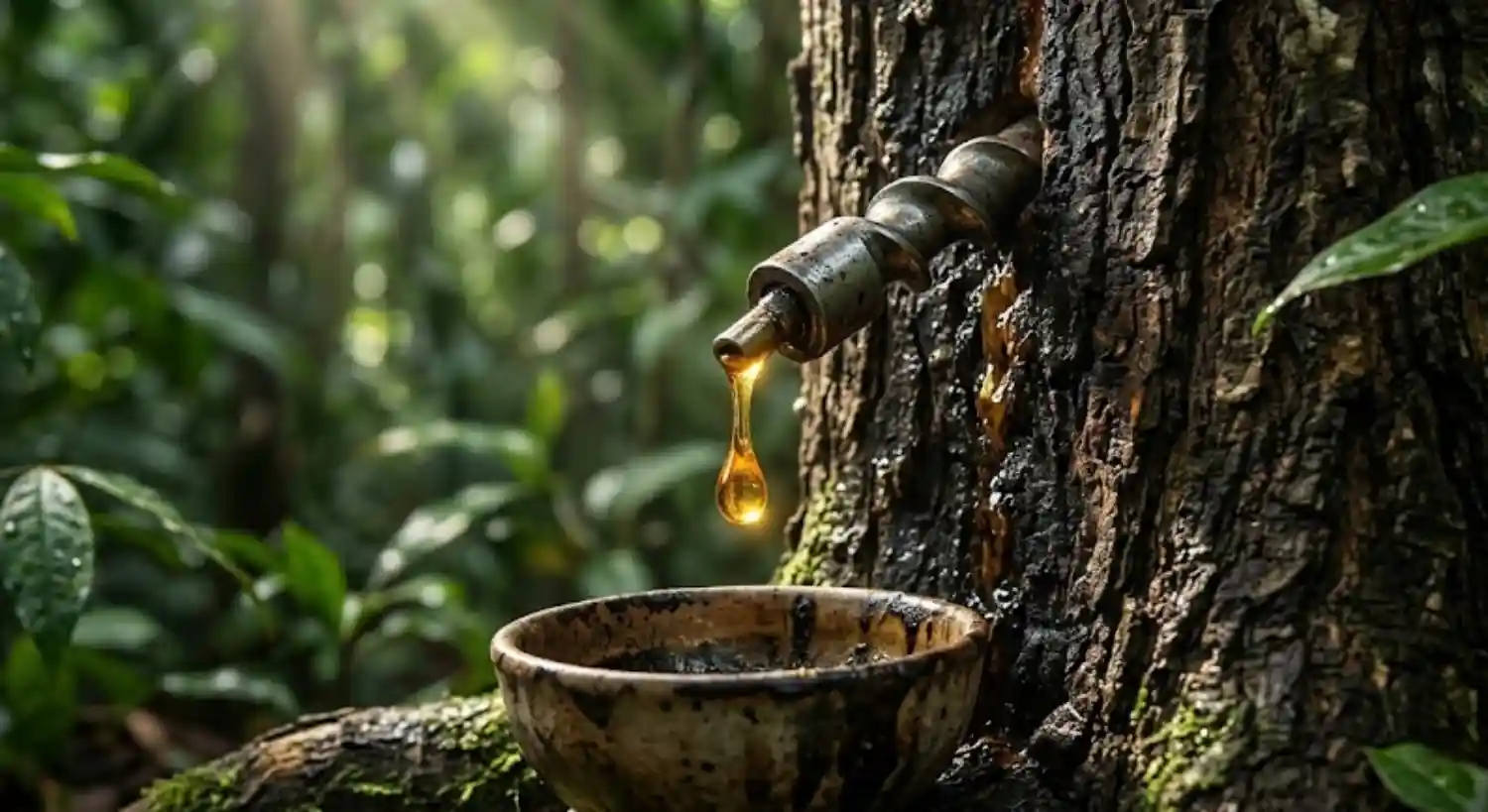
In the heart of the Amazon rainforest, giants that can rise more than thirty meters tall hold a truly singular circulatory system. Unlike the ordinary sap that carries nutrients, the copaiba produces a thick oleoresin inside long excretory canals lodged within its wood. That substance evolved as a defense mechanism against fungi and insects. When the trunk is pierced, the tree releases the golden liquid to heal its own wound, an ingenious biological process that allows the resource to be tapped continuously for decades without killing the specimen, as long as harvesters strictly respect the biology of the plant.
The Complex Biology Behind the Balsam of the Forest
Trees of the botanical genus Copaifera are regarded as true living treasures of the Amazon biome. The liquid that is collected is not sap but a complex blend of essential oils and resins. That oleoresin builds up in small cavities and canals in the heartwood as the plant develops. The internal pressure inside the trunk can be surprisingly high. In some situations deep in the closed forest, traditional accounts hold that the sound of the wood cracking signals the abundance of liquid stored inside the tree.
The output of this substance is highly variable and depends on countless environmental factors, such as the type of soil, the amount of light, the volume of rainfall and the age of the tree itself. According to research, the exact chemical composition of the oil changes according to the species, yet it generally shows a rich concentration of compounds known as diterpenes and sesquiterpenes, which give the liquid its world famous properties. That biological complexity turns the copaiba into a natural chemical factory that is impossible to replicate perfectly in a laboratory.
The Ancestral Technique That Keeps the Tree Intact
The knowledge of how to reach this wealth without destroying the source is a valuable inheritance from the original peoples and the traditional communities of the Amazon. Modern sustainable management refined those age old techniques and set rigorous standards backed by agricultural research institutions. The essential tool for the activity is the auger, a kind of manual drill that pierces the trunk without causing extensive damage to the structure of the tree, reaching the center where the secretory canals are located.
The harvester makes a small hole about one meter above the ground. If the tree is mature and loaded, the oil begins to flow at once, running down a small channel into a clean container. The amount taken from each individual varies considerably, ranging from a few drops to several liters. The secret of preservation lies in the final step of the process. After collection, the hole is carefully sealed with a plug of wood or clay, which blocks parasites from entering and allows the tree to heal completely on its own.
The Resting Period and the Vitality of the Trunk
The difference between predatory extraction and sustainable management lies in respect for biological cycles. Studies indicate that the resting period after an extraction should last at least three years, so that the plant can rebuild its oleoresin reserves without suffering severe physiological stress. During that interval, the tree keeps growing, carries out photosynthesis, provides shade and shelter for local wildlife and locks carbon out of the atmosphere, performing ecological services that reach far beyond the commercial product.
That rest turns the copaiba into a living savings account for future generations. A single tree, when handled with the correct techniques and adequate repose, can supply oil for more than half a century. It is a form of land use that challenges the traditional logic of rapid exploitation and shows that patience and careful observation of nature yield results that are more lasting and more secure for the environment than short term intensive harvesting.
The Economic Backbone of Riverside Communities
The social dimension of copaiba management is as impressive as its biology. For thousands of families living in the depths of the Amazon, tapping the oil is one of the few viable sources of income that do not require deforestation. The concept of bioeconomy finds in the copaiba one of its most perfect examples. Instead of selling the timber once for a low price, the communities keep the tree alive and profit cyclically from its oil, season after season.
That almost invisible economy strengthens the presence of these populations in their home territories. With a stable source of income, young people have fewer reasons to migrate to urban centers in search of work, and the communities become the main guardians of the forest. As they patrol their harvesting areas, the extractivists help protect the territory against invaders, illegal loggers and gold miners, providing an invaluable environmental service that benefits the entire planet.
A Natural Revolution in the Cosmetics Chain
The journey of copaiba oil does not end in the Amazonian rivers. Its destination is increasingly the research and development laboratories of major global brands. The cosmetics industry is going through a deep transformation driven by consumers who demand transparency, sustainability and natural ingredients in their everyday products. In that scenario, the balsam of the Amazon stands out as an ingredient of excellence with strong commercial appeal.
Its applications are vast. The oil works as an excellent natural fixative for perfumes, replacing synthetic compounds that can be harmful to the environment. In addition, its emollient and soothing properties make it a coveted additive for moisturizing creams, liquid soaps, aftershave lotions and hair care products. The appeal of a product that carries the purity of the Amazon and also helps keep the forest standing is enormous, and it moves millions in the global economy each year.
The Shift Toward Conscious and Ethical Consumption
The current challenge for the beauty industry is to ensure that the value added by the final consumer actually reaches the hands of those at the base of the production chain. Governmental and non governmental organizations have worked to certify the origin of copaiba oil and to secure fair trade practices. According to research focused on forest traceability, the use of monitoring technologies helps confirm that the product bought by companies comes from authorized management areas, not from invaded reserves or protected zones exploited illegally.
The demand for natural ingredients also calls for corporate responsibility. It is not enough to swap a chemical component for copaiba oil if excessive demand ends up pressuring the trees and the harvesters. The most advanced companies in the sector sign long term contracts with local cooperatives, guarantee fair prices and respect the seasonality and the volumes that nature can supply without running dry. That ethical commercial relationship is the foundation of a genuinely sustainable supply chain.
Valuable Timber Against the Lasting Value of the Oil
Despite all the benefits of oil extraction, the copaiba faces constant threats. The wood of this tree is of excellent quality, highly resistant and sought after by the construction and furniture industries. Historically, many century old copaiba trees were felled for their timber, which abruptly interrupted resin production cycles that could have lasted for centuries.
The economic equation needs to weigh in favor of the living forest. Studies indicate that, over the long run, the financial value obtained from sustainable resin extraction far exceeds the quick profit from selling the timber of a felled tree. Yet for that logic to prevail in practice, it is essential to strengthen environmental enforcement and to keep valuing the non timber product on the international market.
The Pillars for the Future of Sustainable Extraction
Climate change represents the new great test for the survival of copaiba management. Shifts in the Amazon rainfall regime, with more intense and prolonged droughts, directly affect the physiology of the tree and, as a result, its capacity to produce the golden resin. Sustaining that virtuous cycle will depend on our ability to slow global warming and to protect the vast stretches of forest that regulate the regional climate.
Protecting the copaiba means protecting much more than a raw material for perfumes or creams. It means securing the survival of a fair economy and the well being of communities that understand the subtle rhythms of nature. When we choose products that value correct management, we use our power of decision to finance conservation. When we recognize the worth of traditional knowledge allied with modern science, we turn the act of consuming into a genuine manifesto for the living forest, proving that economic development and respect for biodiversity must travel the same road to safeguard the future of the planet.
Reporting: Anne Silva / Amazonia Mag. Source: revistaamazonia.com.br

Editor, English Edition — Amazonia Mag
Anne Silva is the editor of Amazonia Mag, the English-language edition of Revista Amazônia. She curates, translates and adapts the outlet's science and environment coverage for an international audience, reporting on Amazon wildlife, flora, rivers, climate and research. Every story she edits is grounded in peer-reviewed studies, official data and on-the-ground reporting from the Revista Amazônia newsroom in Belém, Pará, Brazil. More by Anne Silva →