
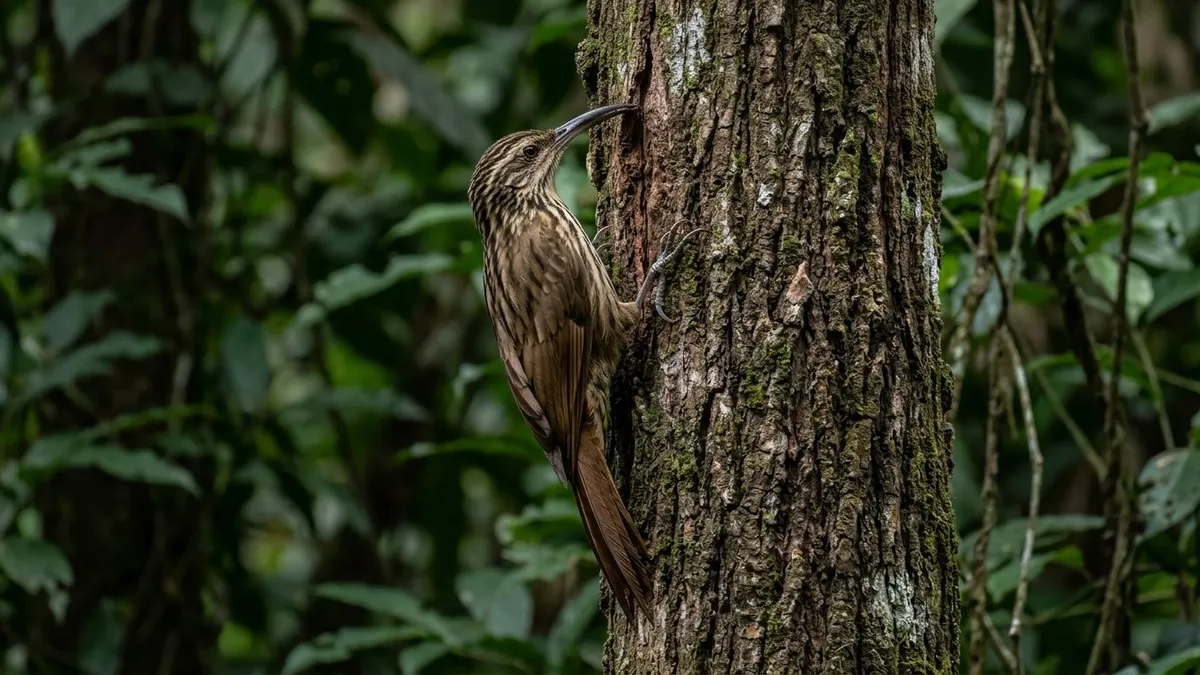
The woodcreeper, known in Brazil as arapaçu, turns its own tail into a third point of support so it can climb a trunk without slipping. The tail feathers have reinforced shafts and are pressed against the bark, bearing part of the body weight while the legs carry the bird upward. This system allows a continuous climb instead of disorderly hops, and it keeps the bill free to look for food.
As it advances, the bird follows a spiral route from the foot of the tree to the upper parts of the trunk. Its curved bill probes crevices in the bark for prey, and the bird can also accompany mixed-species flocks and army ants. The result is a combination of mechanical support, precise searching and use of the movement of other animals in the forest.
How the tail holds the body against the trunk
A woodcreeper’s tail feathers do not work only as a steering surface in flight. With reinforced shafts, they withstand pressure when the bird leans its tail against the tree. The contact creates a point of support behind the body, while the toes and claws keep their grip in front. The weight is shared among the legs, the trunk and the tail.
This support is especially useful because the bird moves along a vertical surface, where gravity tends to pull the body down. The tail steadies the animal at every step and reduces the need to carry all the weight on the legs alone.
For it to work, the feathers must stay aligned and resist friction with the bark. The mechanism does not remove muscular effort, but it makes the climb more controlled.
The curved bill turns bark into a search area
While braced against the trunk, the woodcreeper uses its curved bill to investigate small openings in the bark. The curve lets it reach crevices and pull out prey hidden in spaces where a straight bill would have less reach. The bird brings its head close to the surface, slips the tip into the opening and examines the inside before taking the food.
Body position helps with this task. Because the tail and legs hold the bird to the tree, it can concentrate its movements in the neck and bill. Each probe happens at a different point of the trunk, following the irregularities of the bark and possible hiding places.
Climbing is therefore not just a way of getting around. It organizes a sequence of inspections along a surface that holds insects and other small animals.
Why the climb follows a spiral
By climbing in a spiral, the woodcreeper widens the area it examines around the trunk. Instead of repeating a single vertical strip, the bird alternates the side of the tree it is watching. That path favors a search of crevices spread across different positions and keeps the search from being limited to one narrow line of bark.
The movement also combines stability and exploration. The bird advances gradually, bracing its tail and repositioning its legs before probing another spot. The trunk offers a continuous but uneven surface, with grooves, plates and patches of different texture. The spiral route lets the bird follow those changes without giving up its support.
For the woodcreeper, climbing means moving the body and, at the same time, covering a wide band of possible hiding places for prey.
When the technique meets hidden food
The bird puts this set of movements to work while hunting for food on the trunk. Prey can stay hidden in crevices, beneath pieces of bark or in small cavities. Because it is not exposed on the surface, the bird depends on close contact with the tree and on its ability to reach narrow spaces with the bill.
The stiff tail lets the search go on even when the body has to lean to follow an opening. The legs hold the front of the body, while the tail feathers act as a rear brace. That posture lowers the risk of losing balance during the probe.
The woodcreeper can then examine the bark step by step, drawing on a mix of bracing strength and the precision of its curved bill.
How it uses army ants
The woodcreeper also takes part in mixed flocks that follow army ants. These insects move across the forest floor and flush small animals trying to escape the advancing front. The activity of the ants temporarily changes how prey behaves and creates opportunities for birds that stay close to the area of advance.
In this setting, the climb gains a collective dimension. While the flock moves through the woods, the bird can inspect nearby trunks and take advantage of animals exposed or driven out by the movement of the ants. The tail support is still needed for the climb, but the presence of the flock makes the search more efficient.
The association does not mean the bird depends on a single tree or a single spot. It ties its foraging technique to the movement of other species.
The role of this search in the forest
By removing prey hidden in the bark, the woodcreeper takes part in the flow of energy among trees, insects and birds. Its foraging explores a space that not every animal reaches in the same way. The bird travels the vertical surface, investigates crevices and follows changes in how prey is distributed along the trunk.
This specialization also contributes to the division of resources inside mixed flocks. Different birds can look for food at varied heights, on varied surfaces or in varied positions, which reduces direct overlap as the group moves. The woodcreeper adds to the group a strategy based on climbing and probing bark.
In a forest where food is spread in layers, turning the tail into a support means making better use of the vertical dimension of the habitat. The woodcreeper technique shows that a tree can be a path, a shelter and a hunting ground all at once.
The stiff tail holds the body in place, the curved bill reaches what stays hidden and the spiral climb widens the search. When the bird follows army ants, its strategy also connects to the collective movement of the forest.
To watch that route is to understand that survival does not depend only on strength or speed, but on the precise fit between anatomy, surface and opportunity. On a trunk, every point of support turns a physical difficulty into access to food.
Reporting: Natália Santos / Amazonia Mag

Editor · Amazonia Mag
Anne Silva is the editor of Amazonia Mag, the English-language edition of Revista Amazônia. She curates, translates and adapts the outlet's science and environment coverage for an international audience, reporting on Amazon wildlife, flora, rivers, climate and research. Every story she edits is grounded in peer-reviewed studies, official data and on-the-ground reporting from the Revista Amazônia newsroom in Belém, Pará, Brazil. More by Anne Silva →