
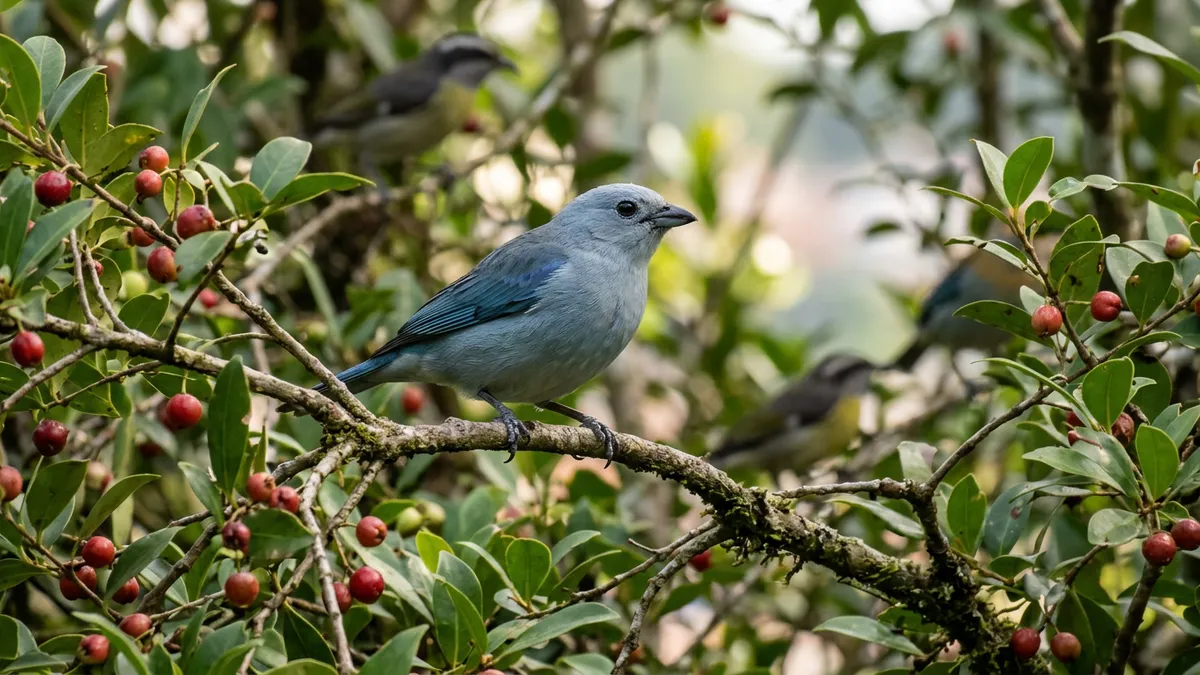
The sanhaço, a tanager common around Brazilian towns and forest edges, can join mixed-species flocks and respond to alarm calls given by other species when a threat approaches. Instead of relying only on its own watchfulness, the bird makes use of a network of signals produced by companions of different sizes, habits and positions in the vegetation. This behavior widens the lookout while the group searches for fruit, flowers and other resources along forest edges, backyards and urban areas.
The association also has an ecological role that goes beyond immediate protection. As a fruit eater, the sanhaço swallows small fruits and can carry their seeds to another spot before dropping them. By moving among trees, shrubs and altered spaces, it links patches of vegetation and takes part in the renewal of plants that depend on birds to reach new places.
How the flock shares the lookout
Mixed flocks bring together birds of different species that move through the same area during part of the day. The makeup is not fixed at every moment, and individuals can come closer or drift away depending on the supply of food, the structure of the vegetation and the risk from predators. The sanhaço usually explores the vegetation for fruit, while other birds may examine leaves, branches, trunks or the space above the canopy. This use of varied positions creates wider visual and sound coverage than a single bird could achieve.
Sharing the lookout does not mean that each species is given a rigid job, as in an organized team. The gain comes from adding up many simultaneous observations. A bird that detects a silhouette among the branches, a quick movement or the approach of a predator can give an alarm call. The sanhaço, hearing the call and noticing the agitation of the group, stops feeding, looks for cover or changes direction. The risk can thus be noticed before it directly reaches the individual that was busy with a piece of fruit.
What the sanhaço picks up from alarm calls
Alarm calls are sound signals tied to the presence of a threat or a dangerous situation. The response of the sanhaço does not depend only on recognizing a sound with an exact meaning. The intensity of the call, its repetition, the direction of the sound, the behavior of nearby birds and the type of environment all help form the picture that guides the reaction. In areas with many branches and leaves, where sight is interrupted, sound can be especially useful for signaling that something has changed nearby.
When a bird suddenly leaves its food, stays still, looks for a sheltered position or flies into the vegetation, that movement can also work as a clue for its companions. The sanhaço combines these signals with its own sight and hearing. It does not have to locate the predator at once to reduce its exposure. It is enough to change its behavior for a few moments, keep away from an open area or follow the flock as it withdraws. The reaction can save time and lower the chance of an attack during feeding.
The sanhaço has a body suited to moving among twigs, foliage and fruit-bearing trees. The bill lets it pick and handle plant food, while the legs and feet help it perch on branches of different thickness. Sight identifies colors, shapes and movement, and hearing picks up calls that travel through the environment. None of these traits works alone. The advantage appears when the bird alternates the search for food with pauses to watch, listen and follow the behavior of the individuals around it.
In a mixed flock, the number of calls can look confusing to a human observer, but the members live inside a soundscape of their own. The sanhaço may be able to tell the general agitation of the group from a calm feeding situation. That judgment does not have to produce the same answer every time. A call tied to close danger can lead to immediate flight, while a distant signal can result in freezing, moving to a more sheltered branch or simply changing route. Flexibility avoids a needless waste of energy and keeps the bird ready to return to feeding.
Why the behavior helps survival
Searching for fruit demands concentrated attention. The bird has to find resources, judge how ripe they are, land safely and keep track of individuals that compete for the same food. This focus can reduce the time given to spotting predators. By moving in a mixed flock, the sanhaço benefits from the vigilance of birds that watch other sectors of the environment. The group can also be harder to surprise than a bird on its own, because sudden movements and calls reveal changes more quickly.
The association does not remove the costs. Many individuals gathered together can compete for fruit, draw the attention of predators and require constant adjustments of distance. Even so, the benefit of shared information can outweigh those drawbacks in certain places and at certain times. Responding to alarms makes it possible to stop a risky activity before the predator gets too close. After the threat passes, the sanhaço can resume its search for food. This mix of caution and continuity helps explain why mixed flocks are used by birds that live in environments with varied vegetation.
The role of other species in the signal network
The companions of the sanhaço are not only sources of alarm. Each species watches the environment from its own body size, feeding height and set of movements. Birds that spend more time in the foliage may notice changes among the leaves, while others detect movement on exposed branches or on the ground. When these individuals travel close to one another, information produced at different points can spread through the flock. The sanhaço takes advantage of this network without having to occupy every sector at once.
The relationship also calls for care not to mistake just any call for a warning. Contact calls, disputes over food and communication between partners can provoke reactions different from those caused by a predator. Context is decisive. If several birds become tense, silent or agitated at the same time, the likelihood of danger rises. If only one bird calls while the others keep feeding, the sanhaço may assess the situation before fleeing. Information from other species, therefore, does not replace the bird’s own judgment. It widens the data available for a quick decision.
From the urban edge to seed dispersal
The sanhaço often occurs in edge environments, open areas with trees, gardens, leafy backyards and urban spaces that keep fruit-producing plants. These places mix native vegetation, cultivated species and built structures, creating a landscape where the presence of flocks can change with the supply of food. The edge also has its own risks, such as the movement of people, domestic animals, vehicles and the loss of cover. Collective vigilance helps the bird explore these environments without staying exposed for long.
By eating small fruits, the sanhaço can carry seeds in its digestive tract and release them at another point during its movements. The distance covered and the destination of the seed vary with the behavior of the individual and the distribution of resources, but the process contributes to the movement of plants across the landscape. A seed deposited under another tree, in a backyard or in a strip of vegetation can take part in local regeneration if it finds suitable conditions. The mixed flock, in this case, protects a bird that also acts as a link between green patches.
Watching a sanhaço among other birds shows that survival does not depend only on strength, speed or individual camouflage. It can also come from the ability to listen, to interpret changes and to stay close to partners of other species. In cities and along forest edges, each fruit tree supports more than a single visitor: it offers food, temporary shelter, warning signals and a chance to carry life beyond the place where it began. Preserving this web of small encounters means recognizing that biodiversity is kept up both in large continuous areas and in the green paths that still cross everyday human life.
Reporting: Natália Santos / Amazonia Mag

Editor · Amazonia Mag
Anne Silva is the editor of Amazonia Mag, the English-language edition of Revista Amazônia. She curates, translates and adapts the outlet's science and environment coverage for an international audience, reporting on Amazon wildlife, flora, rivers, climate and research. Every story she edits is grounded in peer-reviewed studies, official data and on-the-ground reporting from the Revista Amazônia newsroom in Belém, Pará, Brazil. More by Anne Silva →