
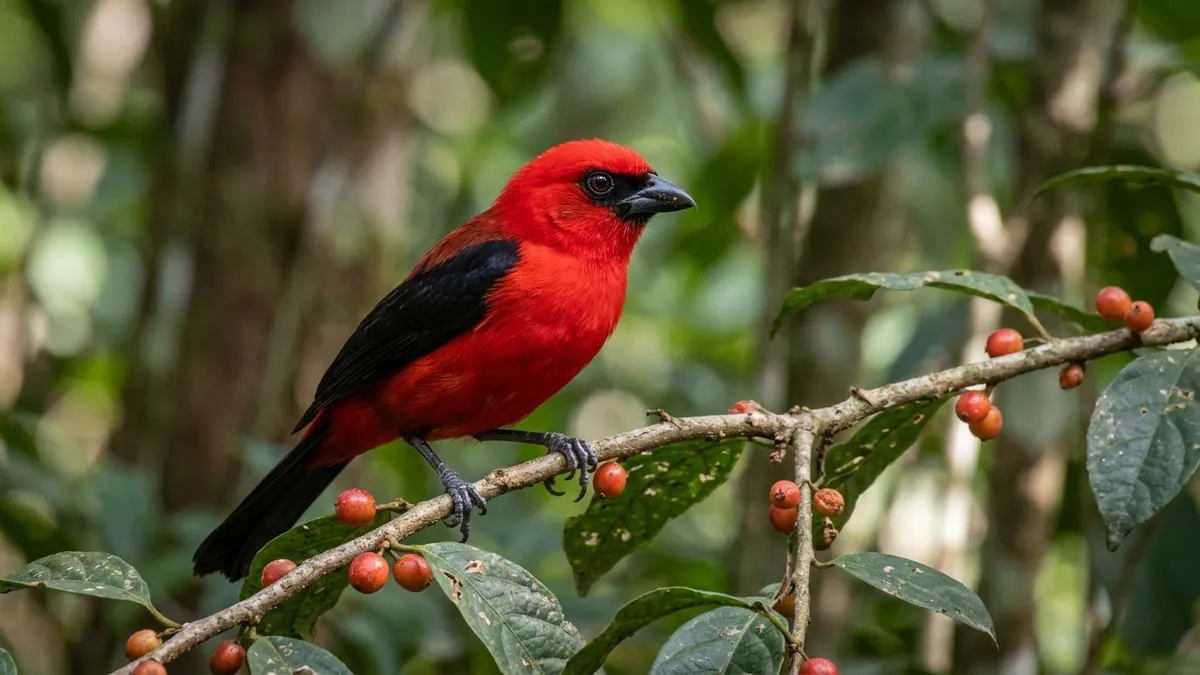
The Brazilian tanager, called tiê-sangue in Portuguese, is not born with the red plumage that marks the species. As it grows, the male goes through changes in plumage and takes up carotenoid pigments from its food, mainly fruit. The result appears only in adulthood, when the feathers take on their characteristic intense red.
Before that stage, the young bird looks much like the female, with less contrasting colors. This transformation combines age, feather replacement and diet, creating a visual difference tied to the maturity of the individual. In the Atlantic Forest, the pattern also helps observers recognize the adult male among the other plumages found in the same vegetation.
The pigment travels from the fruit to the feather
Carotenoids are pigments found in plant tissues, including the fruit eaten by many birds. The Brazilian tanager obtains these substances from its diet and can direct them into the growth of new feathers. Birds do not manufacture carotenoids the way they make other compounds in the body, so food takes a direct part in the color that appears when the plumage is renewed.
The color does not appear because a finished feather changes after the fact. It is set while the feather grows and receives its structural and pigment components. When the new plumage replaces the old, the adult male displays larger and more intense red areas. The look of the bird is therefore the outcome of a gradual biological process, tied to development and to the replacement of feathers.
Age changes the pattern seen in the field
The young Brazilian tanager has plumage similar to the female’s. This pattern narrows the visual gap between immature birds and adults, which makes identification by color alone harder. As the male grows and passes through new stages of molt, the red becomes more evident, until it reaches the typical look of the adult.
Such a sequence is common among birds whose adult plumage appears after the juvenile period. An observer can find, in the same area, red males, young birds in discreet colors and females, all of them belonging to the same species. The variation does not necessarily point to different species. It can reflect age, sex and the stage of feather renewal.
In the Brazilian tanager, the intense red coloration is linked to the adult male. Females and young birds keep tones that are closer to each other, without the visual contrast of the mature male. This difference between the sexes in plumage is called sexual dimorphism, and it allows observers to tell individuals apart.
The color also works as a visual signal produced by the animal’s own development. The red does not appear independently of age, and it is not the same at every stage of life. To recognize an adult male, one has to consider the whole plumage and the behavior of the bird, because lighting, distance and the position of the feathers can change how colors are perceived.
The plumage depends on the food available
By linking fruit and pigmentation, the Brazilian tanager reveals a connection between diet and appearance. The carotenoids it eats do not remain tied only to the food that was consumed. They can take part in the coloring of body structures, including growing feathers. That is why diet is one piece of the mechanism that lets the male develop its characteristic red.
This does not mean that any fruit will immediately cause a change of color. Plumage is built in cycles, during growth and molt, and the coloration depends on the material available during that process. The look of the adult is the accumulated result of development, feather renewal and the intake of pigments from food. It is not a temporary paint applied over the feathers.
Why a feather keeps a record of its own making
A feather is a dead structure once it is fully grown. It cannot take up pigment from the bird’s body or change its color, which is why the timing matters so much. The pigments have to be available while the feather is still forming, and the amount and kind of material delivered at that moment help define the result. Each new feather therefore records the conditions in which it was made.
This is also why the transformation of a male does not happen overnight. Feathers are replaced in sequence, and a bird in transition may carry old and new plumage at the same time. An observer who watches the same area over time can see that variation as the visible trace of a process that unfolds across molts, not as a sign of a different species or a different bird.
The forest supplies the ingredients
The Brazilian tanager is associated with the Atlantic Forest, where the vegetation offers fruit, shelter and places to move through. The coloring mechanism connects that environment to the look of the animal: the forest provides the food resources that contribute to the formation of the plumage during growth.
Seeing different color patterns in the same area can help observers read the age and sex composition of a population. The red of the adult male is only the most visible part of a cycle that starts with food and passes through the renewal of feathers. In the landscape, each individual carries one phase of that process, a reminder that biodiversity also shows itself in the changes that take place within a single species.
The best-known color of the Brazilian tanager is not a condition present from birth, but the result of a trajectory. The young bird begins discreetly, food supplies the pigments and maturity reorganizes its appearance through the replacement of feathers. This path turns the plumage into a visible record of age and diet. For anyone who watches the birds of the Atlantic Forest, a red male and a plain-colored companion are not just two different birds, but two different stages of life sharing the same trees.
Reporting: Natália Santos / Amazonia Mag

Editor · Amazonia Mag
Anne Silva is the editor of Amazonia Mag, the English-language edition of Revista Amazônia. She curates, translates and adapts the outlet's science and environment coverage for an international audience, reporting on Amazon wildlife, flora, rivers, climate and research. Every story she edits is grounded in peer-reviewed studies, official data and on-the-ground reporting from the Revista Amazônia newsroom in Belém, Pará, Brazil. More by Anne Silva →