
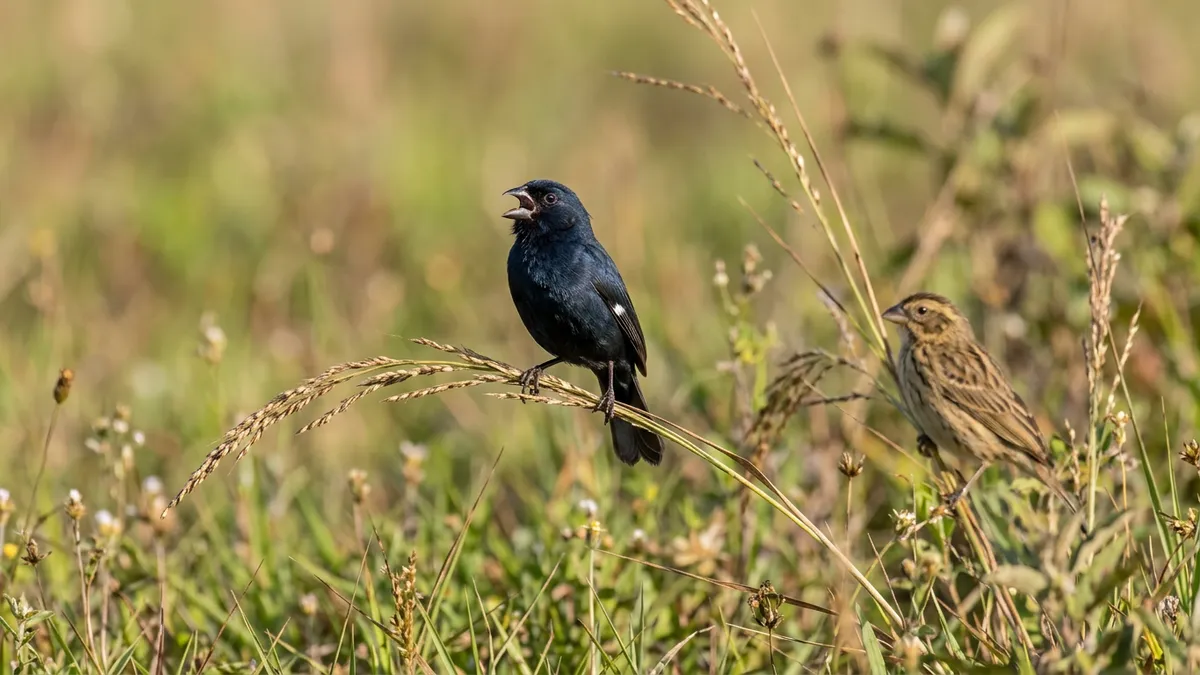
In an open stretch of grass, the male blue-black grassquit stops what he is doing on the ground, shoots straight up and turns his own body into a visual signal. He climbs in a vertical leap, sings when he reaches the highest point and drops back to the spot he left. The scene repeats many times over the course of a day, always within a small area that the male tries to keep under his control.
The female, with her brown plumage, takes part in this scene without sharing the male’s black, high-contrast look. What the observer sees is a courtship display combined with territorial defense, not just a short hop between two perches.
The leap happens in front of the female
The blue-black grassquit is a small songbird known scientifically as Volatinia jacarina. The adult male, black, stands out against low vegetation and bare ground, while the brown female blends into her surroundings. That difference in plumage helps make the visual signal stand out during the performance.
The song delivered at the top of the leap adds a sound component to the gesture. The display therefore brings together movement, position and voice in one short sequence. From a distance it can look repetitive, but each leap occupies a specific point in space and reinforces the male’s presence to potential mates and rivals.
The song marks the highest point
What sets this bird apart is the timing between the leap and the voice. The male does not sing at just any moment of the movement. He makes the ascent and vocalizes at the highest point, when his body is most visible above the vegetation.
Then he comes down and takes up the position he started from, getting ready for another performance. That pattern leaves an easily noticed mark on the landscape, because the sound coincides with the brief instant when the bird appears above the grass. Repeated many times a day, an individual action becomes a prolonged activity organized around one small display space.
The behavior also shows that the grassquit communicates through more than one channel. The male’s black plumage offers contrast, the leap changes his position in the visual field and the song adds information that spreads across the area. These elements should not be mistaken for acrobatics with no clear purpose: they are part of a courtship display and a dispute over territory. How often the display happens can vary with the stage of the breeding season, the presence of females and the approach of other males.
A small territory concentrates the contest
The male intensely defends a small territory, and it is within that boundary that the display works best. By always returning to the same point after each leap, he ties his song and movement to a concrete patch of ground. Defense can involve repeating his own signal and reacting to the presence of other males, which keeps the contest concentrated within a few yards (a few meters).
For the female, that regularity makes it possible to recognize the individual and judge his activity on the site. For a rival, the sequence works as a warning that the space is already taken. The behavior combines attraction and competition without requiring long movements.
The small scale of the territory also helps explain why the male can repeat the performance so many times. He does not need to cross a large area to find food, return to the display spot or answer another bird. He works in a limited area, with access to the ground and to low vegetation.
Even so, it would be wrong to say that every leap triggers an immediate reaction from the female, or that every repetition ends in mating. The display is one signal inside a broader reproductive process that includes approach, choice, defense of space and the right conditions for a pair to form.
Grass seeds sustain the routine
Diet helps tie the behavior to its usual habitat. The species eats grass seeds, a resource found in areas of tall grass and open vegetation. The male can alternate periods on the ground, where he looks for food, with the leaps used in the display.
That combination makes the low landscape important for two different needs: feeding and breeding. The same small territory that serves as a stage must also offer conditions for finding seeds. When the bird returns to its display spot, it keeps up a routine that links the available resource, the presence of a possible mate and the defense of space.
What a scene a few yards wide can teach
The key point lies in the concrete combination of a black male, a brown female, a vertical leap, a song at the highest point, a small territory and a diet of grass seeds. Following this bird, the observer sees that an apparently modest space can hold a complete contest over presence, food and reproduction.
In open areas of Brazil, this mechanism brings everyday experience close to behavioral ecology. The blue-black grassquit does not need a grand structure to make its presence obvious. It uses a few yards (a few meters) of ground, a repeated leap and a synchronized call to announce that it is active in that place.
The scene is a reminder that biodiversity also shows itself in brief actions, which can go unnoticed when the eye is looking only for large animals or untouched landscapes. The value of the behavior lies precisely in the precision of the sequence. The male rises, sings at the peak, drops and starts again, while the brown female and the rivals read signals produced within the same small territory.
To watch that cycle closely is to recognize that, in nature, repetition does not mean waste but language. A patch of grass, a seed and a leap are enough to sustain one of the most visible forms of courtship among the birds of open fields.
Reporting: Natália Santos / Amazonia Mag

Editor · Amazonia Mag
Anne Silva is the editor of Amazonia Mag, the English-language edition of Revista Amazônia. She curates, translates and adapts the outlet's science and environment coverage for an international audience, reporting on Amazon wildlife, flora, rivers, climate and research. Every story she edits is grounded in peer-reviewed studies, official data and on-the-ground reporting from the Revista Amazônia newsroom in Belém, Pará, Brazil. More by Anne Silva →