
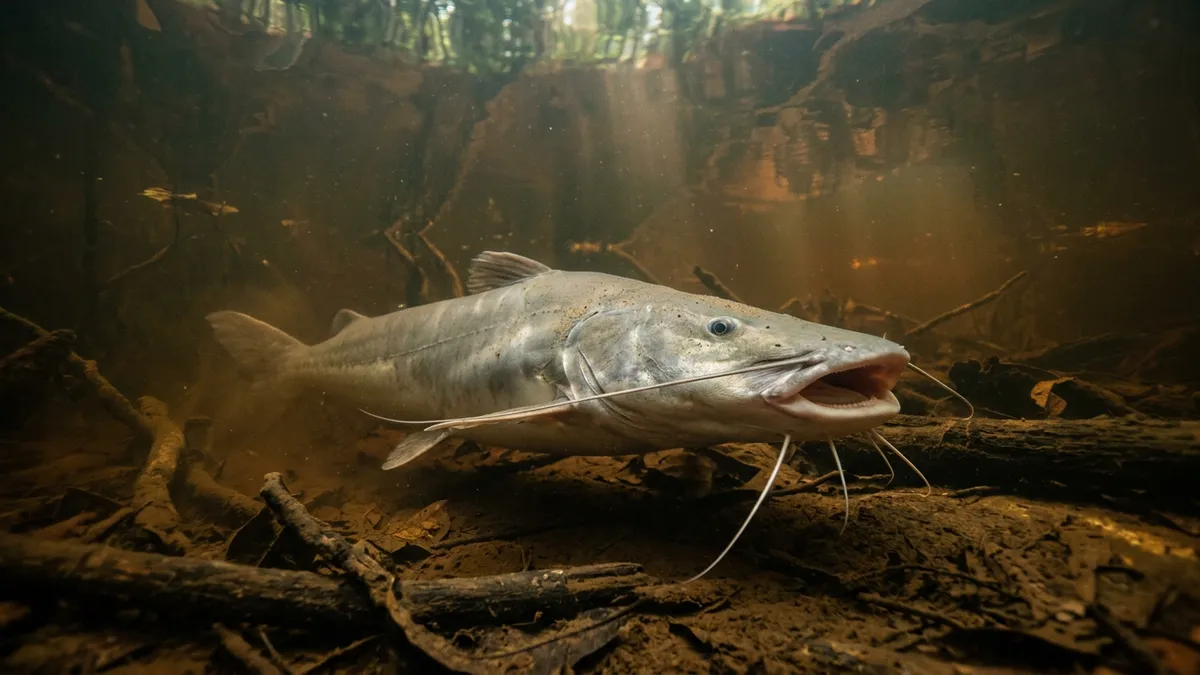
A fish more than 6.5 feet (2 meters) long can vanish prey in a single motion, opening its mouth wide and sucking an animal in whole. That is the behavior tied to the piraíba, the largest catfish in the Amazon basin, a species that occupies rivers of great length and moves through different environments over its life.
Its elongated body, broad head and a mouth able to form a wide opening help explain why the animal entered the imagination of riverside communities as a river monster. The popular image, however, does not replace biological observation. What is known is a large aquatic predator adapted to catching and swallowing prey without having to break it into pieces.
A fish that fits inside its own legend
The piraíba does not need a visible chase at the surface to reveal its strategy. In turbid, deep water, an approach can end within moments, leaving only a displaced current as a sign.
The species is known by the scientific name Brachyplatystoma filamentosum and belongs to the group of large migratory catfish of the Amazon. Its exceptional dimension lies not only in length but in the combination of strength, a wide mouth and the ability to cover long distances. The piraíba uses river channels as routes and can be found in different stretches of the basin, from the estuary to the headwater regions.
That range helps separate the real animal from the creature built by old accounts. The fish does not have to be treated as a supernatural threat to hold an important place in Amazon wildlife. Its own anatomy already produces a scene that seems out of scale with the fish people see every day along the riverbanks. It is at this point that popular knowledge and scientific description meet, without one account being automatically turned into proof of the other.
A mouth that turns an encounter into a capture
The capture begins with the wide opening of the mouth. Instead of depending only on visible teeth or a prolonged bite, the catfish can produce a suction movement that pulls the prey inward. Water and target enter the mouth cavity together, shortening the time between approach and ingestion. This mechanism fits a large fish that catches animals small enough to be swallowed without being divided. Whole prey is not a figure of speech about the species but a description of how its mouth works during feeding. As with other predatory fish, the behavior depends on the relative size of hunter and target, on the chance of an encounter and on conditions in the environment.
Suction also helps explain the outsized reputation the animal earned in river tales. For someone watching from a canoe or from the bank, a quick capture may not reveal the exact position of the fish, the size of the prey or the full sequence of the movement. What remains is a story focused on the final instant, when something disappears beneath the surface. Even so, a wide mouth does not mean that the piraíba can swallow any animal or attack indiscriminately. The mechanism has physical limits tied to the size of the mouth opening and of the prey. The safest description is a predator that combines approach and suction to take in food whole when it fits in its mouth. The distinction matters because it replaces a vague fear with a concrete observation of the fish’s anatomy and behavior.
From the mouth of the river to its headwaters
The piraíba is not tied to a single stretch of the Amazon system. Its long-distance migration links the estuary, where the river meets coastal waters, to the headwaters, areas in the higher and more distant parts of the basin. This movement puts the fish in contact with very different landscapes and shows that the life cycle of the species depends on the continuity of rivers. The route should not be pictured as a simple straight trip, because the Amazon environment brings together main channels, tributaries and seasonal changes in water volume. The core fact is that the piraíba travels a very long way between the lower and the upper parts of the basin.
Migrations also change how the piraíba is perceived. A fish seen in an estuary can be linked to a place far away when it reappears in a story about the headwaters, feeding the impression that there are different animals or creatures that turn up in several rivers. The biological explanation is more direct: this is a species able to cover long distances inside the Amazon basin. That movement requires connected waterways, because interrupted passages can limit the travel of migratory fish. The link between estuary and headwaters ties the story of the piraíba to a concrete environmental question, keeping rivers connected. In Brazil, where most of the Amazon basin lies, understanding these routes helps people see the river system as a continuous network and not as isolated stretches on a map.
Where the account ends and the evidence begins
The piraíba is large, predatory and able to swallow prey whole, but those traits do not establish that it attacks people. They do not support the claim that the fish treats humans as food or goes looking for boats. The confusion with a river monster comes from the mix of unusual scale, water with poor visibility, the quick disappearance of prey and oral retelling of episodes that are hard to verify.
It helps to keep three layers apart: the observed biological fact, the popular interpretation and the claim that has not been confirmed. Here, the first layer is solid, the second is part of the cultural history of the Amazon and the third remains without scientific support.
What can be checked is the established description of the species. The largest catfish in the Amazon basin is more than 6.5 feet (2 meters) long, uses the suction produced by the wide opening of its mouth to capture food and makes long migrations between the estuary and the headwaters. Its fame does not need monsters to be explained. The piraíba remains an animal of dimensions outside everyday experience and of continental movement within the basin, and sometimes knowing how a fish works makes the story of the river more precise without making it smaller.
Reporting: Natália Santos / Amazonia Mag

Editor · Amazonia Mag
Anne Silva is the editor of Amazonia Mag, the English-language edition of Revista Amazônia. She curates, translates and adapts the outlet's science and environment coverage for an international audience, reporting on Amazon wildlife, flora, rivers, climate and research. Every story she edits is grounded in peer-reviewed studies, official data and on-the-ground reporting from the Revista Amazônia newsroom in Belém, Pará, Brazil. More by Anne Silva →