
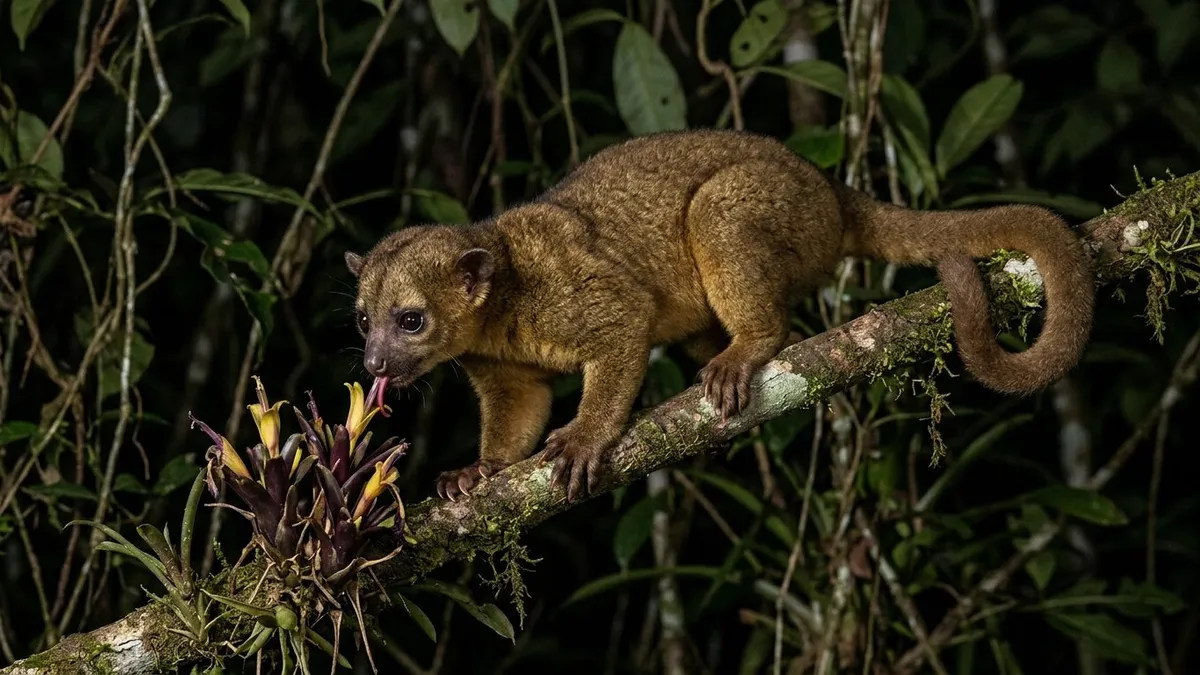
In the dark of the forest, the kinkajou brings its snout close to a flower and extends a tongue that can reach 5.1 inches (13 centimeters), touching the nectar deep inside the bloom. The same organ helps the mammal pull food out of beehives, where a narrow tongue can explore spaces that the mouth alone could not enter.
The scene sums up an adaptation tied to life in the trees, where flowers, fruit, honey and other resources turn up at different points of the canopy. The kinkajou does not need to knock down the flower or open the whole structure to get the sugary liquid. It combines reach and mobility while it stays braced on branches, often in positions that would be hard for a ground-dwelling animal.
A tongue that reaches hidden food
The kinkajou, known by the scientific name Potos flavus, is a nocturnal, tree-dwelling mammal found in tropical forests of the Americas, including areas of the Brazilian Amazon. Although it superficially resembles a small carnivore, its diet is varied and includes plant foods.
The long tongue should not be seen as an isolated trait but as part of a set formed by the snout, the teeth, the paws and the tail. Each element takes part in finding or retrieving food. In a flower, the length of the tongue reaches the nectar. In a beehive, it helps lick up the contents that are available. The behavior takes place mostly when the forest is already dim.
The prehensile tail works as a fifth limb
While it looks for food, the kinkajou can wrap its prehensile tail around branches and keep its body fastened to the vegetation. The tail works like a fifth limb, supporting the animal when its paws have to reach for a flower, a fruit or another surface. This extra support is especially useful when moving through the canopy, where branches vary in thickness and position and where a fall can cut a foraging trip short.
The tail is not just a visual feature, and it does not serve only to balance the body. Its ability to grip gives stability and leaves the paws free for different tasks, such as holding food or changing direction.
Combining a prehensile tail with a long tongue also explains why the kinkajou can use resources that sit far from the trunk or at the tip of a branch. The animal can anchor itself with the tail, adjust its paws to the support available and lean its body without giving up the safety of the tree. Then it extends the tongue to reach the nectar or the food inside a hive. No exceptional acrobatics need to be imagined. It is a sequence of coordinated actions repeated in a nightly routine: the tail holds the body, the paws regulate the position and the tongue makes the final reach. The result is an efficient way to use the architecture of the forest to its advantage.
Visits to flowers carry pollen from one plant to another
When it visits flowers to drink nectar, the kinkajou can brush its snout and tongue against the reproductive parts of the plant. Pollen stuck to its body can be carried to another flower as the animal moves through the canopy, contributing to pollination. This service depends on the behavior of the animal and on the characteristics of the plant species it visits. Not every visit necessarily moves pollen, and the kinkajou does not replace all the other pollinators of the forest. Even so, a nocturnal mammal that travels through trees in search of nectar widens the group of animals involved in plant reproduction.
Pollination by animals usually depends on repeated encounters between compatible flowers, the transport of pollen and contact with the receptive part of the plant. In the kinkajou’s case, nighttime activity is an important component, because many flowers release scent or nectar at hours when other visitors are less active. The animal can leave in search of food, visit different points of the canopy and return to the same supports or routes through the forest. This movement creates chances for contact between plants, but its strength varies with the plant species, the supply of flowers and the presence of other visitors. The kinkajou should therefore be described as a participant in pollination, not as the only one responsible for it.
What the night changes in the kinkajou’s routine
The kinkajou starts its activity when the light fades and spends much of the night moving among branches. Night hours reduce exposure to heat and coincide with resources that can be explored by smell and touch. Instead of looking for food on the ground, the animal stays tied to the canopy, where its prehensile tail gives support and its paws let it move along narrow twigs. A tongue of up to 5.1 inches (13 centimeters) adds reach to that movement, so a resource that seems far away can be touched without the whole body having to advance to the end of the branch. The behavior comes from the combination of activity time, environment and anatomy.
Limits of the tongue, the tail and the canopy
Life in the trees also sets limits. Branches can break, flowers can be empty and beehives can pose a risk to the animal. The long tongue does not let the kinkajou reach just any food, and the tail does not remove the need to pick sturdy supports. Tongue length can vary from one individual to another, forest conditions change and how often flowers are visited depends on how much nectar is on offer. The contribution of the kinkajou to pollination should be judged plant by plant and place by place, without giving the animal a bigger role than the evidence allows.
The species depends on continuous vegetation to move, rest and find resources in different trees. When the forest loses the connection between crowns, the problem is not only fewer trees but the break in the pathways used by a mammal adapted to living above the ground. In Brazil, this ties the anatomy of the kinkajou to a practical conservation question: keeping the forest standing also preserves the routes along which it looks for flowers, fruit and hives.
What stays clear is the relationship between form and function. A very long tongue reaches protected food, a tail that coils holds up the body and nighttime activity puts the mammal in touch with flowers that need visitors. In the canopy, survival does not rest on a single skill but on the precise combination of several.
Reporting: Natália Santos / Amazonia Mag

Editor · Amazonia Mag
Anne Silva is the editor of Amazonia Mag, the English-language edition of Revista Amazônia. She curates, translates and adapts the outlet's science and environment coverage for an international audience, reporting on Amazon wildlife, flora, rivers, climate and research. Every story she edits is grounded in peer-reviewed studies, official data and on-the-ground reporting from the Revista Amazônia newsroom in Belém, Pará, Brazil. More by Anne Silva →