
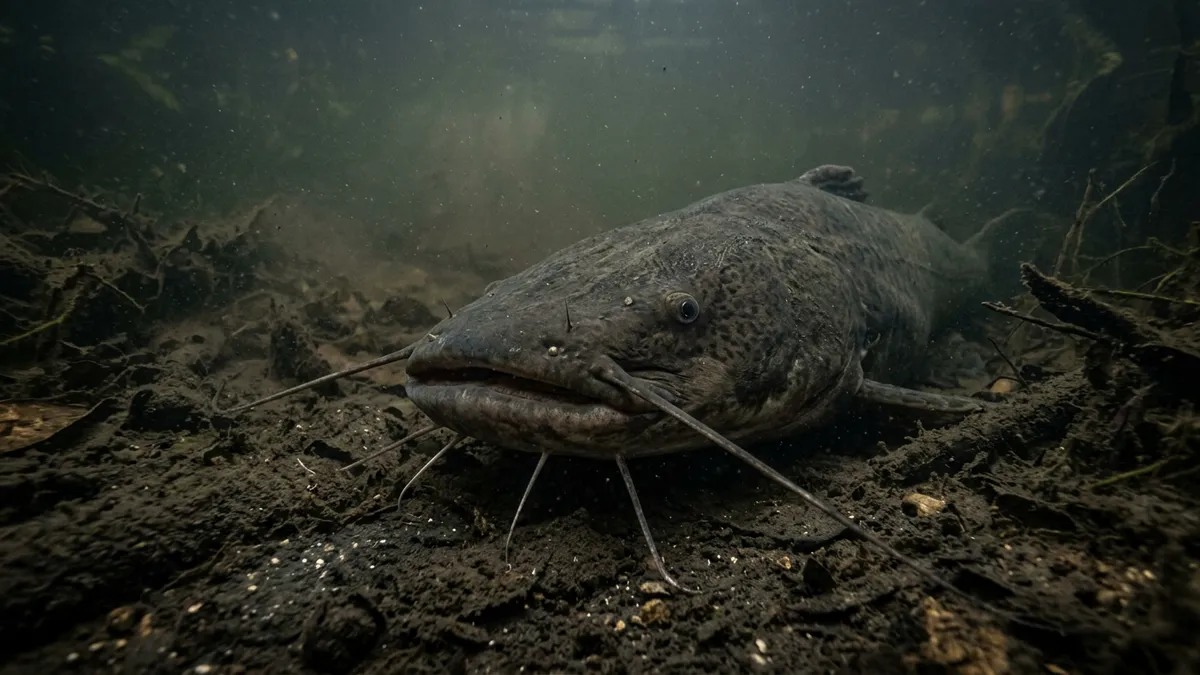
During the bright hours, the jaú catfish can stay buried on the river bottom, leaving only part of its body blended into the surroundings. When the water darkens, the fish gives up that waiting posture and rises to look for food. The change does not depend on a visible chase at the surface. It happens in a zone where there is less light, where the bottom concentrates chemical signals and where a wide mouth can capture prey by suction.
That cycle defines the jaú as a benthic and nocturnal fish. Benthic describes an animal tied to the bottom of an aquatic environment, while nocturnal means most active once the day ends. The scene combines two phases: first the catfish stays hidden on the riverbed, then it moves up to hunt.
The catfish disappears into the bottom before the hunt begins
The jaú is one of the largest freshwater catfish in Brazil. Its body is tied to rivers where the bottom takes part directly in the life of the fish, both as a place to stay and as a space to look for food. The strategy avoids depending only on sight, especially at the time of day when the water loses its brightness.
Instead of giving away its presence by moving at the surface, the animal uses sensitive structures around the mouth to interpret what is happening near it. The jaú does not need to be described as a fast predator for its mechanism to be clear. The combination of shelter on the bottom, nighttime activity and a wide mouth offers an efficient way to work the water column without giving up the link to the riverbed.
Barbels turn the water into a map of signals
The barbels of the jaú carry chemical receptors. These structures help the fish detect substances dissolved in the water, forming a sensory reference in an environment where sight may be of little use. This does not mean the animal sees through the dark, and it does not mean the barbels work as distance sensors. They pick up chemical signals and help locate feeding opportunities nearby. By touching and moving these structures in the water, the fish gathers information about its surroundings before it opens its mouth.
For an animal that spends the day buried and becomes active as the water darkens, this perception matters a great deal. The barbels add another channel of information to the repertoire of the jaú and help guide nighttime activity close to the bottom.
When it finds an opportunity, the jaú relies on a wide mouth able to produce suction. Opening the mouth moves the water and carries food inside, instead of requiring the fish to grab each item with a narrow bite. This feature suits a search in low-light conditions, because it lessens the need for a precise visual capture. The fish can move in, read the chemical signals with its barbels and open its mouth at the right moment. The wide mouth is therefore not just a matter of appearance but part of the feeding mechanism.
From a daytime hideout to the climb upriver
The daily timeline is marked by a transition: the jaú spends the day buried, stays tied to the bottom and rises to hunt when the water darkens. This rise is a change of position within the river, linked to nighttime feeding.
At another point in its life cycle, the fish makes a reproductive migration upriver. Movement upstream has a different purpose from leaving the bottom at dusk. A feeding trip belongs to the daily routine, while the reproductive migration is tied to breeding and involves travel along the watercourse. When the fish travels, how far it goes and whether every individual moves at the same time are questions for field observation, and the general description does not settle them.
The upriver migration also broadens how we read the ecology of the jaú. The fish is not just a motionless resident of the bottom, even though it uses that space during the day. At a given moment, it combines shelter, feeding and reproductive travel across the river system. That mobility connects different stretches of the river and shows why the continuity of the aquatic environment matters for migratory species. It does not mean the jaú travels through every river in Brazil, or that its migration is the same length in every basin. The safest reading is behavioral: the jaú alternates between staying on the bottom and traveling for different needs, using the river both as a hunting ground and as a breeding route.
What the mechanism reveals about Brazilian rivers
The jaú brings together traits that fit an environment of little light on the river bottom. Its benthic habit gives it a period of staying close to the bed. Its nighttime activity concentrates the search for the hours when the water darkens. Barbels with chemical receptors widen its perception, and a wide mouth allows suction. None of these elements alone explains the whole behavior. The strategy shows up in how they work together. The fish does not have to depend only on sight to find food, although that does not mean it ignores its other senses. As for size, the jaú is counted among the largest freshwater catfish in Brazil.
For Brazil, the connection lies in the very environment where the jaú lives and in the importance of rivers for freshwater fauna. The species expresses a direct relationship among the riverbed, the quality of the signals in the water and the possibility of moving upriver. It is more useful to keep that reading than to turn the fish into an abstract symbol: its structures have concrete functions, and its routine depends on different parts of the river system.
At nightfall, the jaú shows that the life of a river goes on away from the surface, guided by signals that human eyes can barely follow.
Reporting: Natália Santos / Amazonia Mag

Editor · Amazonia Mag
Anne Silva is the editor of Amazonia Mag, the English-language edition of Revista Amazônia. She curates, translates and adapts the outlet's science and environment coverage for an international audience, reporting on Amazon wildlife, flora, rivers, climate and research. Every story she edits is grounded in peer-reviewed studies, official data and on-the-ground reporting from the Revista Amazônia newsroom in Belém, Pará, Brazil. More by Anne Silva →