
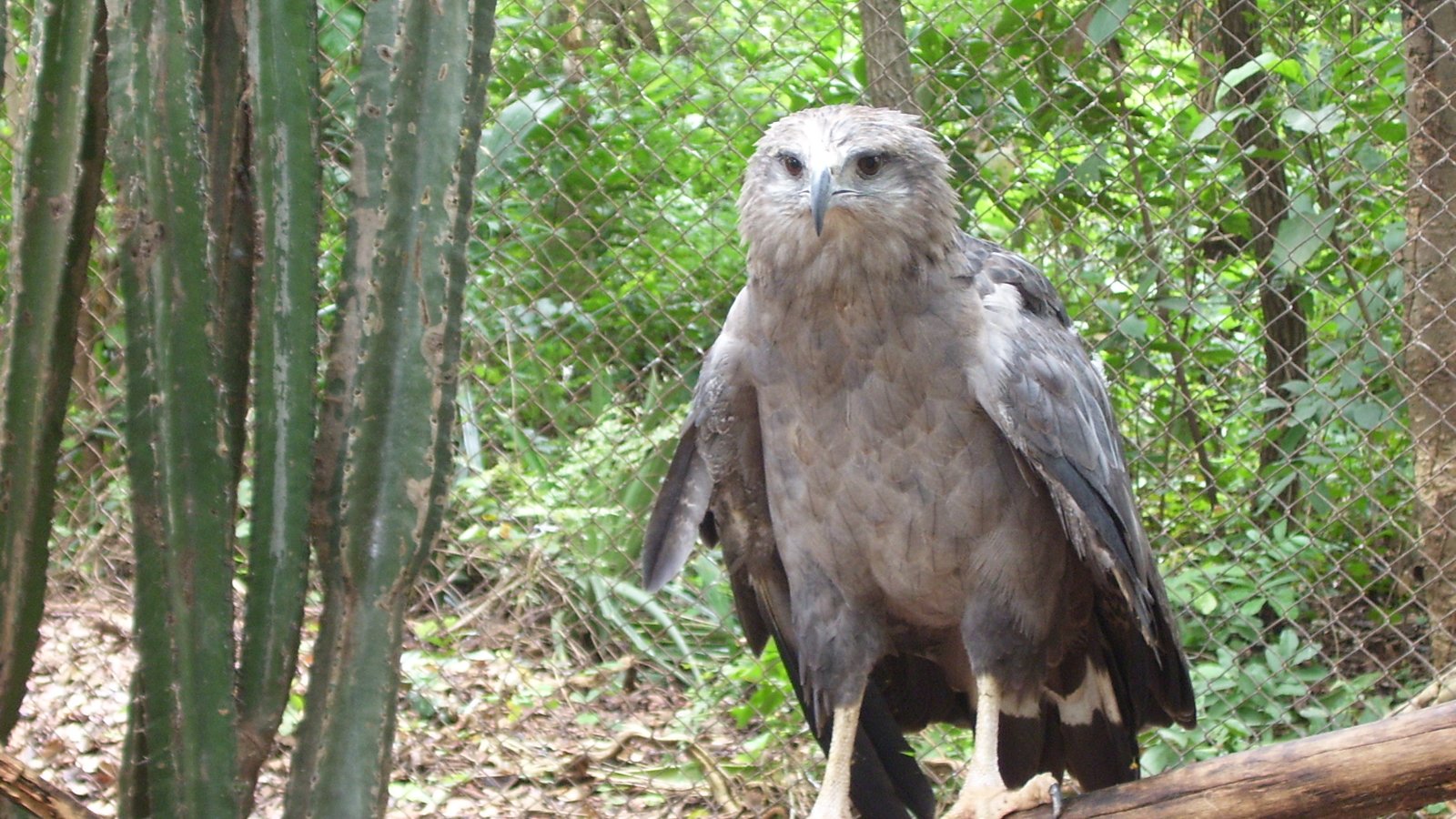
It has gray feathers, a crest on its head and a wingspan that can exceed 1.7 meters (about 5.6 feet) from tip to tip. The Chaco eagle, known in Brazil as águia-cinzenta, is one of the largest birds of prey in the country and also one of the rarest. Official estimates point to only a few hundred to about a thousand adult birds left in Brazil, and almost nobody has ever seen one in the wild.
Where it lives
Contrary to what many people imagine, the águia-cinzenta is not an Amazon bird. It lives in open and semi-open landscapes of central and southern South America. In Brazil it occurs in the Cerrado, the Caatinga and the Pampa, from São Paulo and Minas Gerais to Rio Grande do Sul, and it is also found in Argentina, Paraguay and Bolivia.
The current scientific name is Urubitinga coronata, but the species was previously called Harpyhaliaetus coronatus. It hunts armadillos, snakes, lizards, birds and small mammals, often from a high perch, from which it watches the countryside.
That way of hunting says something about where it needs to live. A bird that scans the ground from a perch needs open ground to see its prey and tall places to watch from. When the landscape changes, either by turning into crops or by being covered with dense, invasive vegetation, the hunting method stops working.
Endangered
The águia-cinzenta is classified as endangered in Brazil, according to the assessment by ICMBio, Brazil’s federal biodiversity agency. Based on about 300 locations with records, the minimum estimate is 600 to 1,000 mature individuals, and other passages of the same assessment suggest an even smaller number. Even in the largest areas where it still appears, no population is expected to exceed 250 adults.
This leaves the species divided into small, vulnerable groups. Small and scattered populations have little margin: a bad season, a fire or a wave of persecution in one region can wipe out a local group, and there may be no neighboring population close enough to replace it.
The species is also listed as endangered in the international assessment of the IUCN, so the concern is not only a Brazilian one. Because it lives at very low densities, even in good habitat an encounter is rare, which is one reason why so few people can say they have seen one.
As a large predator at the top of its food chain, the eagle also says something about the health of the whole grassland. Where it persists, there is still enough open land, enough prey and enough tolerance from the people who share the landscape.
The threats
Several pressures act at the same time, and they feed one another.
Habitat loss, mainly through the expansion of agriculture over the Cerrado and the Pampa.
Persecution, because the bird is seen as a threat to livestock.
Capture for the wildlife trade, which removes individuals from a population that cannot afford to lose them.
Pesticide contamination, which reaches the eagle through the food chain. Because the eagle sits near the top, whatever accumulates in its prey ends up in the bird.
Fires, planted exotic trees in grassland areas and invasive grasses, which change the environment where it hunts.
Electrocution on power lines is also pointed to as a probable cause of death, although systematic studies of the size of the problem are still lacking.
Like other large eagles, the águia-cinzenta reproduces slowly: the pair usually raises one chick at a time, and the chick depends on its parents for a long time. This means every adult lost is a heavy blow, and the population takes a long time to recover.
It is a different arithmetic from that of a small bird that raises several broods a year. When losses are replaced slowly, even a modest and steady pressure, such as the occasional shooting of a bird seen near a farm, can add up to a decline.
The plan to save it
ICMBio, through the National Center for Research and Conservation of Wild Birds, coordinates a conservation plan for the águia-cinzenta for the period 2023 to 2028. The actions include research on where the species still lives, protection of the areas where it occurs, combating hunting and trafficking, and working with rural producers to reduce conflicts.
The last point matters more than it might seem. Since persecution is one of the threats, the future of the eagle depends in part on the people who live and work in the countryside, and on whether an eagle seen near the livestock is treated as a neighbor or as a problem.
How to help
People who live in the countryside and spot an águia-cinzenta can record the sighting on citizen science platforms such as WikiAves, which helps researchers map the species. And one should never shoot, capture or keep birds of prey in captivity: besides being an environmental crime, every individual counts for the future of the species.
Frequently asked questions
Does the águia-cinzenta live in the Amazon? No. It lives in the Cerrado, the Caatinga and the Pampa, and in neighboring countries of southern South America.
How many águias-cinzentas are there in Brazil? ICMBio’s minimum estimate is 600 to 1,000 adults.
Reporting: Revista Amazônia newsroom / Amazonia Mag

Editor · Amazonia Mag
Anne Silva is the editor of Amazonia Mag, the English-language edition of Revista Amazônia. She curates, translates and adapts the outlet's science and environment coverage for an international audience, reporting on Amazon wildlife, flora, rivers, climate and research. Every story she edits is grounded in peer-reviewed studies, official data and on-the-ground reporting from the Revista Amazônia newsroom in Belém, Pará, Brazil. More by Anne Silva →