
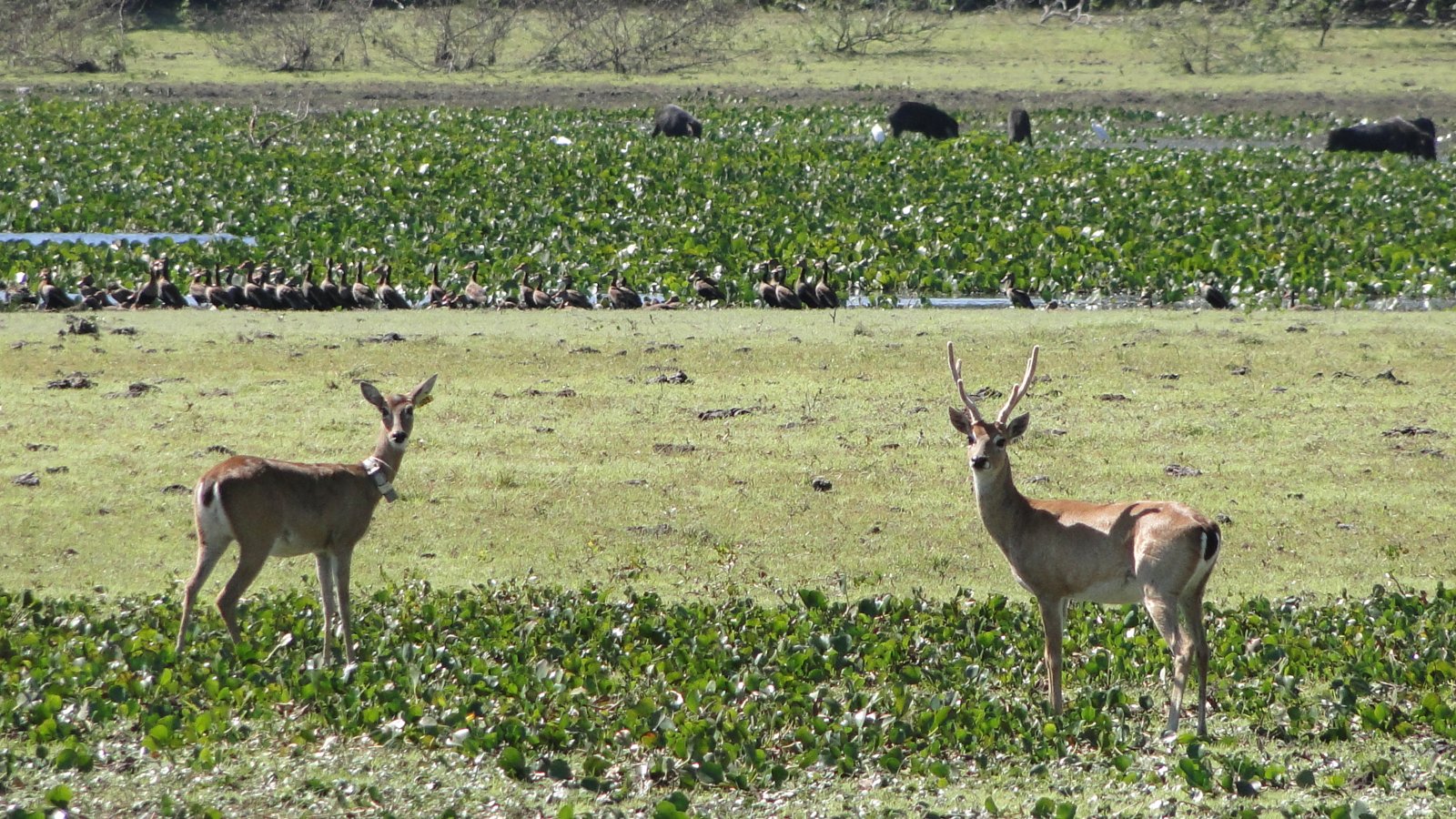
In the middle of the green and gold of the Pantanal grasslands, a pampas deer (Ozotoceros bezoarticus), known in Brazil as veado-campeiro, was recorded with a coat that is completely white. The image circulated on social media. According to the description of the record, the animal has albinism, a rare genetic alteration. It is also a young animal that has been seen more than once, which says something about how it has fared so far.
A deer built not to be seen
The pampas deer is a species of open grasslands and transition areas. Its normal coat is a reddish brown that lets the animal disappear into the grass. A deer of that color can stand still in a field and, to a predator scanning from a distance, become part of the landscape.
The white individual is the exact opposite. Against green and golden vegetation, it stands out from far away. What evolution tuned for concealment, a chance genetic change has switched off.
Albinism or leucism?
White animals in nature can have two different conditions, and the two are often confused. In albinism, melanin is missing throughout the whole body, including the eyes, which look pale or reddish. In leucism, the loss of pigment is only partial: hair or feathers turn white, but the eyes keep their normal color. Specialists often use eye color as a clue to tell the two apart. The clue is practical: pale or reddish eyes on a white animal point to albinism, while normally colored eyes point to leucism.
Melanin is the pigment that gives color to skin, hair and eyes. In the case of this deer, the description of the record points to albinism, a rare genetic alteration that prevents the body from producing that pigment.
Albinism is hereditary and recessive. In simple terms, that means it usually appears only when both parents carry the altered gene. A parent can carry the gene and show no sign of it, because the normal copy of the gene masks the altered one. Only when a young animal receives the altered copy from both sides does the pigment fail to form.
In small or isolated populations, where relatives mate with each other more often, the chance of this happening goes up a little. Even so, it remains rare. That rarity is why every record of a white wild animal draws attention, and why a white deer is so unusual to see in a field.
Beautiful, but risky
In the wild, the lack of pigment comes at a price. A white animal is easier for predators such as jaguars and pumas to spot. It is also more sensitive to sunlight, with a higher risk of skin and vision problems. These are the same traits that make albino animals striking to photograph and difficult to keep alive.
For a species that already faces pressure, the danger adds up. The pampas deer has lost a large part of the native grassland where it lived in Brazil, now converted to crops and pasture. It also faces illegal hunting, roadkill and diseases transmitted by cattle. The Pantanal, with its vast floodable grasslands, is one of the most important refuges for the species in the country.
The fact that the young white deer has been seen repeatedly suggests that, so far, it has managed to escape the risks its color imposes. For people who follow the wildlife of the region, this is an indication that the combination of preserved areas and careful wildlife-watching tourism works as a shield for animals like this one.
This does not mean the animal is safe. A single deer that has survived its first stretch of life is one data point, not a guarantee. It does show that, in this landscape, there is still enough cover, space and calm for even a very conspicuous animal to carry on.
How to watch without disturbing
Records of rare animals attract curious visitors, and that attention can turn into a threat. The guidance for those who visit the Pantanal is to keep a distance and not chase animals with vehicles. Visitors should also avoid flying drones over them and refrain from sharing the exact location of very rare animals, so as not to attract hunters and harassment.
Good wildlife-watching depends on patience. The same open landscape that makes a white deer visible to a photographer makes it visible to anyone with bad intentions, which is why discretion matters as much as the picture.
Questions and answers
Are there white deer in Brazil? Yes, but they are extremely rare. Cases of albinism or leucism have been recorded in different deer species, such as the pampas deer photographed in the Pantanal.
What is the difference between albinism and leucism? In albinism, melanin is missing in the whole body, including the eyes. In leucism, only hair or feathers turn white and the eyes keep their normal color.
Is the white deer a different species? No. It is the same species, Ozotoceros bezoarticus, and only its coat color differs from that of other pampas deer.
Why is a white deer at risk? Because it is more visible to predators such as jaguars and pumas and more sensitive to sunlight, with a greater chance of skin and vision problems.
Reporting: Revista Amazônia newsroom / Amazonia Mag

Editor · Amazonia Mag
Anne Silva is the editor of Amazonia Mag, the English-language edition of Revista Amazônia. She curates, translates and adapts the outlet's science and environment coverage for an international audience, reporting on Amazon wildlife, flora, rivers, climate and research. Every story she edits is grounded in peer-reviewed studies, official data and on-the-ground reporting from the Revista Amazônia newsroom in Belém, Pará, Brazil. More by Anne Silva →