
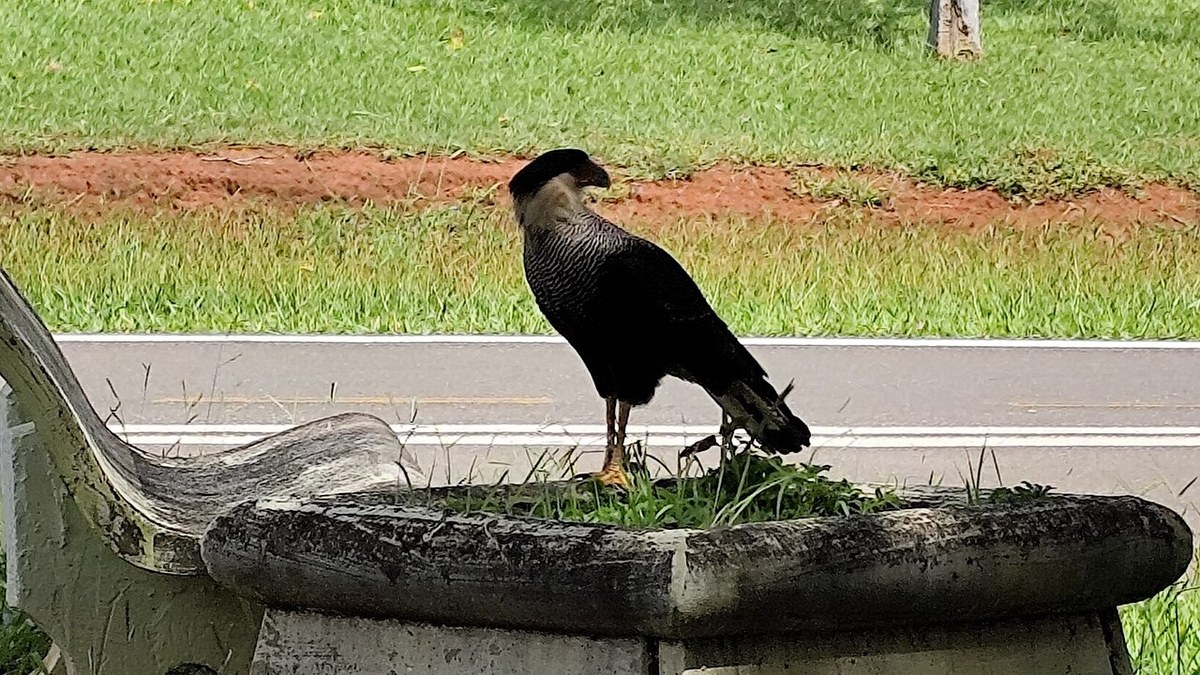
The southern crested caracara (Caracara plancus), known in Brazil as carcará, is a bird of prey common in the fields and pastures of the country, and it has become a city dweller. Videos of pairs raising chicks in planters and on apartment balconies have circulated on social media, and scientists and environmental agencies have already recorded nests on an office building and even near the top of a cell phone tower.
The São Paulo city government sums up the reason: the caracara “adapts well to urban environments.” It eats almost anything, does not depend on closed forest and makes use of structures built by people.
A nest on a building and on a cell tower
In October 2020, the Porto Alegre city government advised residents about a pair of caracaras that built a nest on the exterior of an office building on Goethe Avenue, with two chicks. The pair was banded: it had been removed from Salgado Filho Airport, came back and settled in the city.
Researchers from Pernambuco described in 2022, in the Journal of Raptor Research, the first report of a caracara nest made of human materials. It was near the top of a cell phone tower and mixed twigs with steel and iron wire, copper wire, nylon thread, plastic and fabric. The nest was kept in the Bird Collection of the Federal University of Pernambuco (UFPE).
Both cases show the same thing. The bird looks for a high, open perch with a good view of the surroundings, which a tower or a building ledge provides, and it is willing to build with whatever material is within reach.
What the caracara eats
The menu explains much of its success. According to the São Paulo city government, the caracara prefers dead vertebrates, but it also eats fruits, pods, small lizards, snakes, amphibians, snails, insects and worms. Because it feeds on carcasses, it plays a sanitary role in cities.
WikiAves, the Brazilian bird-watching platform, describes the species as omnivorous and opportunistic. It hunts lizards, snakes, frogs and larvae, follows tractors to catch the animals that flee from the plow, steals heron chicks and shares carcasses with vultures on roads and in dumps.
It also eats fruit. A study published in 2021 in the Brazilian Journal of Biology recorded caracaras eating pequi and spreading its seeds, which makes the bird an occasional disperser of this Cerrado tree.
In 2024, a survey published in the journal PLoS One analyzed 1,555 photographs of caracaras feeding across the Americas. Reptiles appear more often in the north of the species’ range and birds more often in the south. Fish and invertebrates gain ground near the equator. The pattern shows a bird whose diet shifts with what each region offers, which is exactly what a species needs to move into a new habitat such as a city.
From the pastures of Pará to the capitals
The caracara ranges from Argentina to the southern United States. In Brazil, the largest populations are in the Southeast and the Northeast, according to WikiAves, but the bird also lives in the Amazon. In eastern Pará, the opening of pastures favored the species, which prefers open areas. It appears on the list of birds of the Belém metropolitan region in a master’s research project by the Federal University of Pará (UFPA) with the Museu Paraense Emílio Goeldi.
The bird measures 50 to 60 centimeters (20 to 24 inches) and has a wingspan of about 1.23 meters (4 feet). Females are slightly heavier than males: about 950 grams (2.1 pounds), against a little over 830 grams (1.8 pounds).
How long the chicks stay in the nest
The female lays 2 to 3 eggs, rarely 4, and the pair take turns incubating them, a process that lasts about 28 days, according to the São Paulo city government.
The chicks leave the nest at up to three months and still depend on their parents for a while afterward, according to the wildlife team of the Porto Alegre city government. That long period of care is why a nest on a building is not a short episode: the pair may stay in the same spot for weeks.
A pair nested on my building. Now what?
The advice from environmental agencies is not to touch it. Under Brazil’s Environmental Crimes Law (Law 9,605/1998), anyone who modifies, damages or destroys the nest of a wild animal is subject to detention of 6 months to 1 year, plus a fine. The caracara is not threatened with extinction, being listed as Least Concern by the IUCN, but it is wild fauna and is protected all the same.
The Instituto Água e Terra, in Paraná, points out that tampering with eggs or moving the nest is an environmental crime. In Porto Alegre, the city government asked that the nest on the building be kept so the parents could continue caring for the chicks. If a chick falls or is hurt, the way to proceed is to call the municipal or state environmental agency, without offering water or food on your own.
Frequently asked questions
Is the caracara threatened with extinction? No. It is in the Least Concern category of the IUCN, but it is wild fauna protected by law.
Can I remove a caracara nest from my building? No. Destroying or removing the nest of a wild bird is an environmental crime.
Does the caracara eat fruit? Yes. There are scientific records of caracaras eating pequi and oil palm fruit.
Reporting: Revista Amazônia newsroom / Amazonia Mag

Editor · Amazonia Mag
Anne Silva is the editor of Amazonia Mag, the English-language edition of Revista Amazônia. She curates, translates and adapts the outlet's science and environment coverage for an international audience, reporting on Amazon wildlife, flora, rivers, climate and research. Every story she edits is grounded in peer-reviewed studies, official data and on-the-ground reporting from the Revista Amazônia newsroom in Belém, Pará, Brazil. More by Anne Silva →