
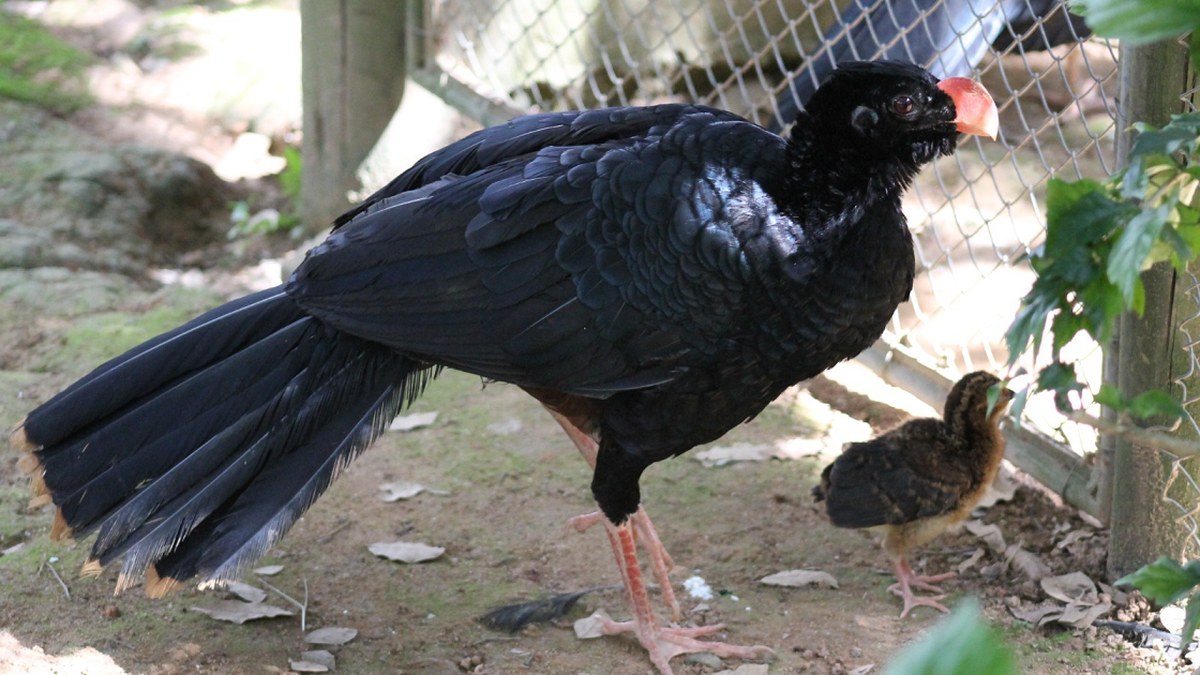
The Alagoas curassow (Mitu mitu), known in Brazil as mutum-de-alagoas, is a large, dark bird that once lived in the coastal forests of Alagoas and Pernambuco, in northeastern Brazil. It vanished from the wild about 40 years ago. The species escaped total extinction only because a small group was kept in captivity, and the entire population alive today descends from that tiny founding stock.
After decades of controlled breeding, pairs are going back to the forest. According to the Public Prosecutor’s Office of Alagoas (MPAL), three more pairs arrived in April 2026 at a reserve in the south of the state, where they are meant to live free.
How a forest bird disappeared
The Alagoas curassow belonged to the Atlantic Forest of the Northeast, one of the most heavily cleared stretches of that biome. Forest was cut down to make room for sugarcane, and hunting did the rest. Together, these pressures wiped out the wild populations.
The last records in the wild date from the end of the twentieth century, and the species came to be considered extinct in the wild. That is a specific and grim category: the animal still exists, but only under human care, with no self-sustaining population living in its natural habitat.
A genetic bottleneck managed pair by pair
The rescue came from a conservation breeding facility that gathered the last birds. Felipe Coutinho, the veterinarian technically responsible for the Crax conservation breeding facility, explained in a statement from MPAL that the species went through a severe genetic bottleneck. Careful management was needed, he said, with genetic control and planned crosses, to guarantee variability and a viable population.
The logic is easy to grasp. When every living bird descends from a handful of ancestors, they are all closely related, and genetic variation is scarce. With so little variation, each pairing has to be planned to avoid health and fertility problems in the chicks. The result is a population that has to be managed with great care, one pairing at a time. This slow work allowed the number of birds to grow little by little and created the conditions for reintroduction.
In January 2026, the city government of Belo Horizonte announced the birth of an Alagoas curassow chick at the Belo Horizonte Zoo, one of the institutions that has managed to breed the species. Every chick hatched in captivity strengthens the group that may, in the future, be taken back to the wild.
Back to the forest
The first releases took place in Atlantic Forest areas of Alagoas starting in 2019. In April 2026, six birds, three pairs, arrived from Minas Gerais at the Usina Coruripe Private Natural Heritage Reserve (RPPN), in the south of Alagoas. They went through an adaptation period in aviaries before the definitive release, which was planned for May.
The effort is part of a program coordinated by MPAL together with the Alagoas Environment Institute, the Environmental Police Battalion, the Atlantic Forest Preservation Institute, the University of São Paulo and the private sector. Coutinho called the work a milestone: bringing back a species that had been extinct in the wild for about 40 years, he said, is a landmark for world conservation and the result of decades of dedication and cooperation between institutions.
Why a fruit-eating bird matters, and what is still missing
Large birds that eat fruit, such as curassows, help spread seeds through the forest. When they disappear, the forest loses part of the animals that replant it. The process resembles what happened in Rio de Janeiro’s Tijuca Forest before toucans returned there.
Lavínia Fragoso, the state prosecutor at MPAL, put the goal in plain terms: the region needs to turn its now silent forests into living, pulsing environments again. A forest without its large seed-dispersing birds can look intact from the outside and still be missing part of its machinery.
The species remains classified as extinct in the wild. For that to change, researchers must confirm that the released birds survive, form pairs and breed on their own in the forest, without human help. The release areas also have to be protected from hunting and deforestation, the same two forces that emptied the forest in the first place.
For now, each step is a test. Birds raised in captivity must learn, or relearn, to live in the wild, and the first reproduction without human support will be the clearest sign that the project is working.
Questions and answers
Is the Alagoas curassow extinct? It is extinct in the wild, but it survives in captivity and is being reintroduced into forests in Alagoas.
Where are the birds being released? In Atlantic Forest areas of Alagoas, including the Usina Coruripe reserve in the south of the state.
Why is the curassow important for the forest? Because it eats fruit and spreads seeds, helping the forest regenerate.
When did the releases begin? The first releases took place in Atlantic Forest areas of Alagoas starting in 2019. In April 2026, six birds, three pairs, arrived from Minas Gerais at the Usina Coruripe reserve.
Why is breeding so carefully planned? Because the population descends from very few birds, and each pairing must be chosen to protect the health and fertility of the chicks.
Reporting: Revista Amazônia newsroom / Amazonia Mag

Editor · Amazonia Mag
Anne Silva is the editor of Amazonia Mag, the English-language edition of Revista Amazônia. She curates, translates and adapts the outlet's science and environment coverage for an international audience, reporting on Amazon wildlife, flora, rivers, climate and research. Every story she edits is grounded in peer-reviewed studies, official data and on-the-ground reporting from the Revista Amazônia newsroom in Belém, Pará, Brazil. More by Anne Silva →