
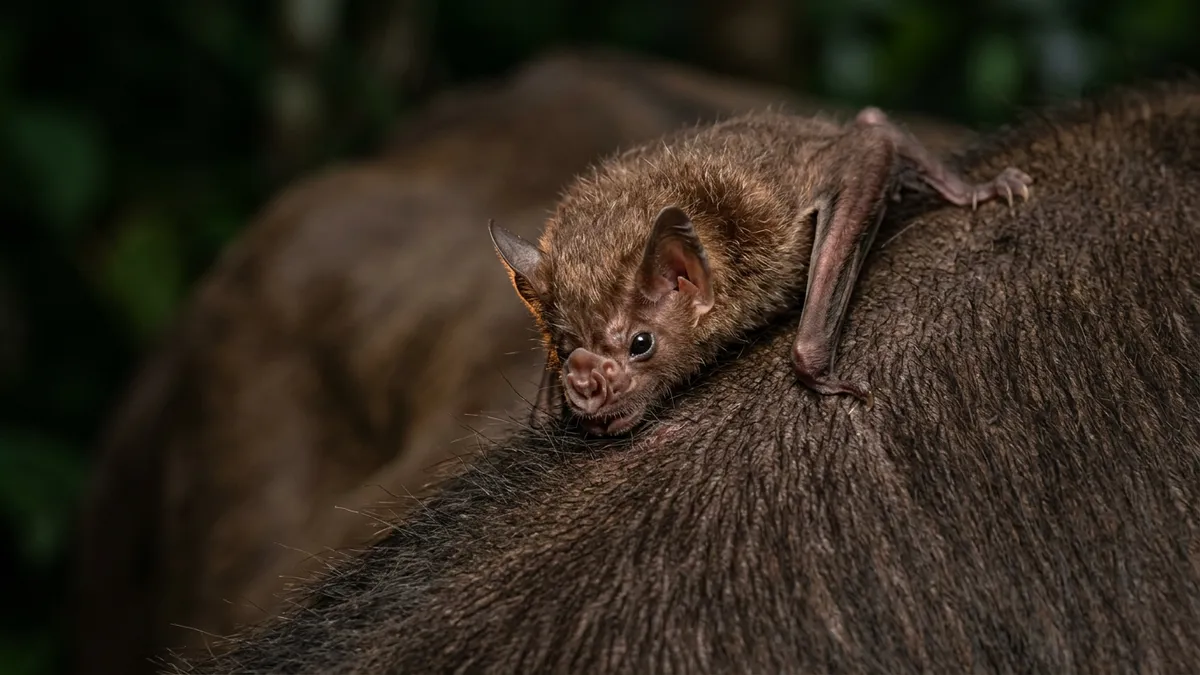
The common vampire bat has a reputation built on a single act: drinking blood. Yet the animal that earns that reputation survives on three separate tools. A heat receptor on its snout finds the meal, anticoagulant saliva keeps the meal flowing, and a memory for the voices of its colony mates turns a leftover of that meal into a lasting bond.
Put together, these traits show that surviving as a vampire bat depends as much on body sensors as on social relationships. Each one solves a different problem in the same life cycle, and none of them replaces the others.
The snout finds the vessel under the skin
Before it bites, a vampire bat has to locate a spot where blood runs close to the surface. For that it uses a heat receptor concentrated on its snout. The sensor picks up the warmth of blood circulating through superficial vessels and helps the animal choose the right place to start feeding. This is not a view into the inside of the body. It is a reading of temperature differences on the skin. The mechanism turns the snout into a search tool, letting the bat move toward the point with the best chance of finding available blood.
Once the area is identified, the bat makes a small wound and begins to feed. Its saliva contains anticoagulant substances that stop the blood from clotting quickly at that spot, so the flow stays available throughout the meal. Combining heat detection with the action of the saliva solves two different stages of the behavior: first finding the vessel, then keeping the blood flowing. The result is a precise strategy built on sensors and molecules, not on strength or speed.
The same set of adaptations explains why the bat can exploit a food source that is not visible from the outside. A meal that hides under the skin becomes reachable through warmth, and a wound that would normally seal itself stays open long enough to feed.
One meal can reach another animal
The blood a vampire bat obtains is not only an individual meal. Inside a colony, a bat that failed to find food can receive part of what another companion has swallowed. The transfer happens when the fed animal regurgitates blood for the colony member that went hungry. This behavior creates a direct form of help within the group, because the recipient gets a resource it could not obtain during that period.
The sharing is not described as a random donation, however. It is tied to reciprocity, in which individuals that help may also receive food on another occasion. The arrangement depends on living together and on being able to recognize who belongs to the social network. That detail changes the picture of the vampire bat as an animal interested only in finding prey and taking blood. Feeding also includes a later stage, carried out inside the colony, in which one individual’s survival can depend on the cooperation of another. The social mechanism follows the biological mechanism of feeding without replacing either of them.
A voice tells the colony who lives nearby
For this network to work, the vampire bat has to tell individuals of its own colony apart. Recognition happens through vocalizations. Each animal produces sounds that can be linked to its identity, allowing companions to distinguish familiar neighbors from other members of the group. The voice therefore plays a social role similar to an individual signal. It helps organize interactions in an environment where many animals live close together and keep frequent contact.
Vocal recognition also gives context to food sharing. If an animal can identify who is around it, it can maintain relationships that include help and reciprocity. The behavior does not require every bat to be treated the same way, because the sound information makes it possible to separate one companion from another. This does not mean that each call is a message with a human translation, nor that the animal has a language equivalent to ours. What is known is the ability to recognize individuals by their calls and to use that information in the relationships of the colony. The voice works as a marker of identity inside the group.
Three mechanisms in one survival cycle
The cycle begins outside the colony, when the bat looks for a source of blood and uses the heat receptor on its snout to locate a superficial vessel. Next, the anticoagulant saliva keeps the blood available during feeding. Later, back at the roost, the animal may regurgitate part of the meal for a companion that could not eat. Reciprocity makes this help an ongoing social relationship, and recognition by vocalization provides a way to identify the participants.
These mechanisms should not be confused with a sequence proven for every single feeding episode. The central point stays concrete: the animal finds blood through temperature, keeps the flow going with its saliva and turns part of the meal into a social bond.
That combination shows that, for some species, survival depends as much on bodily sensors as on the memory of companions. A snout that reads heat and saliva that holds back clotting would be enough to explain how a vampire bat eats. They do not explain how it endures the nights when a meal is not found. For that, the colony and the voices of its members complete the picture.
Reporting: Natália Santos / Amazonia Mag

Editor · Amazonia Mag
Anne Silva is the editor of Amazonia Mag, the English-language edition of Revista Amazônia. She curates, translates and adapts the outlet's science and environment coverage for an international audience, reporting on Amazon wildlife, flora, rivers, climate and research. Every story she edits is grounded in peer-reviewed studies, official data and on-the-ground reporting from the Revista Amazônia newsroom in Belém, Pará, Brazil. More by Anne Silva →