
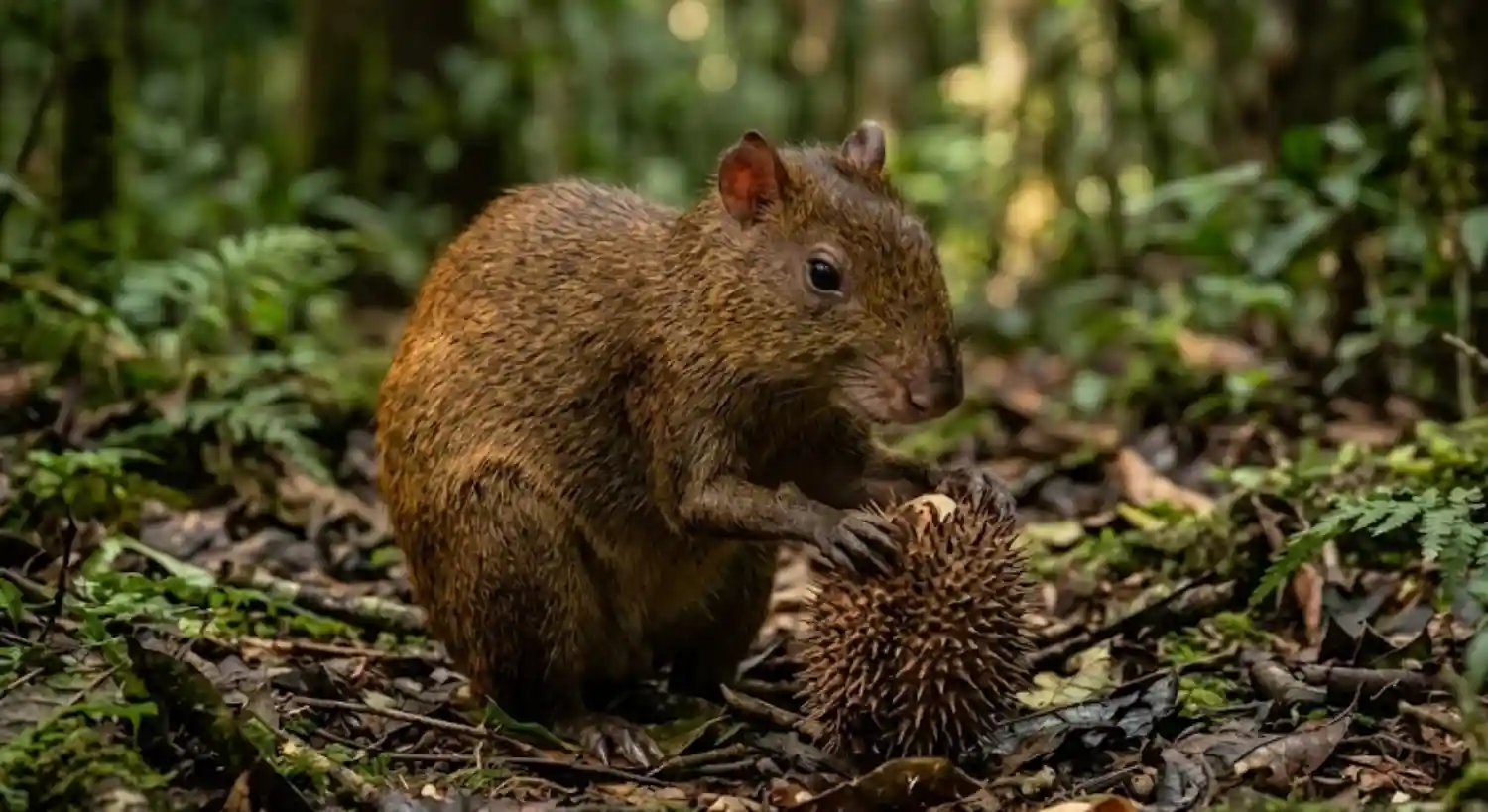
The survival of the Brazil nut tree, one of the tallest and longest lived trees in the Amazon rainforest, depends on a daily and seemingly trivial habit of a small rodent. The agouti (Dasyprocta) is the only animal in the ecosystem with the jaw strength and dentition needed to crack open the extremely hard woody pod that encloses the seeds of the Brazil nut tree (Bertholletia excelsa). After breaking into that nearly impenetrable fruit, the rodent eats some of the seeds to meet its immediate energy needs and buries the remaining ones individually across the forest floor, storing them for leaner times.
The decisive ecological impact arises from a limitation of the animal itself: its spatial memory is only partial. The agouti cannot recover every nut it has buried over the course of its daily life. The forgotten seeds, left beneath the leaf litter and a thin layer of soil, find there the ideal conditions of moisture and shade to germinate. Without the mechanical intervention of the rodent, which opens the pod and scatters the seeds across the ground, the nuts would rot together inside the original woody shell and never sprout. The agouti’s forgetfulness therefore works as the main engine of natural regeneration for the most emblematic plant species of the Amazon biome.
Biologists classify the relationship between the agouti and the Brazil nut tree as a classic example of mutualism and of seed dispersal through soil storage, a process known as scatter hoarding. The tree offers a dense and highly nutritious food source, rich in fats and proteins, wrapped in a casing that shields it from almost every other herbivore in the forest. In return, the rodent acts as a true ecosystem engineer, carrying the seeds far from the parent tree. That movement reduces competition for light and nutrients between the young seedling and the adult plant, and it also makes it harder for insects and fungi to destroy seeds piled up beneath the canopy.
The anatomy of the agouti evolved in close step with this way of life in tropical vegetation. Its long, powerful hind legs allow rapid leaps to escape predators while it carries heavy nuts in its mouth. Its incisors grow continuously and are coated with an extremely resistant outer layer of enamel, kept sharp by the constant friction of gnawing hard materials. The animal’s keen sense of smell lets it locate part of the buried seeds even after weeks of rain, yet the number of nuts it hides routinely exceeds its capacity to eat them or to recall where they lie.
The food chain and forest balance
The role of the agouti reaches across the entire food web of the Amazon ecosystem. By keeping the population of Brazil nut trees healthy and steadily expanding, the rodent indirectly secures the very structure of the primary forest. Adult Brazil nut trees provide shelter for dozens of species of birds, insects and tree dwelling mammals, and they filter large amounts of carbon from the atmosphere. Every giant tree that rises on the horizon is, in a sense, the failed memory of a rodent that fulfilled its part.
The agouti itself serves as essential prey for medium and large carnivores, such as the ocelot (Leopardus pardalis), the harpy eagle (Harpia harpyja) and the jaguar (Panthera onca). The abundance of this rodent on the forest floor sustains the presence of these top predators and preserves the dynamic balance of vertebrate populations in the region. A single quiet, discreet link props up much of the wildlife that crowns the chain.
The loss or decline of agouti populations because of deforestation, habitat fragmentation or uncontrolled hunting has an immediate effect on the reproduction of Brazil nut trees. In forest areas where the animal has been wiped out, the existing nut trees grow old without new young trees rising around them. The absence of the rodent breaks the natural cycle of plant renewal and shows how deeply the Amazon’s fauna and flora are bound together by biological connections that cannot be replaced.
The scale of this dependence is easy to underestimate because it unfolds silently and slowly. A Brazil nut tree can live for centuries and reach great heights, yet its entire future rests on whether a rodent forgets a single buried seed in the right patch of soil. When conservation debates focus only on the largest and most charismatic animals, the humble agouti is often overlooked, even though its daily foraging quietly rebuilds the forest that shelters those very species. Protecting the rodent means protecting the architecture of the rainforest itself.
The conservation of vast stretches of native forest is the only guarantee that the cycle between the agouti and the Brazil nut tree will keep unfolding without destructive interference. The agouti forgets where it buried some of the nuts, and that is exactly why Brazil nut trees still exist in the Amazon: this natural forgetting is the mechanical force that spreads the seeds and lets the tallest tree of the forest germinate. The mutual dependence between the two reveals how the simplest details of animal behavior sustain the grandeur of Brazil’s tropical ecosystems, and safeguarding every element of that chain is the only way to secure the future of the standing forest.
Reporting: Anne Silva / Amazonia Mag. Source: Revista Amazônia.

Editor, English Edition — Amazonia Mag
Anne Silva is the editor of Amazonia Mag, the English-language edition of Revista Amazônia. She curates, translates and adapts the outlet's science and environment coverage for an international audience, reporting on Amazon wildlife, flora, rivers, climate and research. Every story she edits is grounded in peer-reviewed studies, official data and on-the-ground reporting from the Revista Amazônia newsroom in Belém, Pará, Brazil. More by Anne Silva →