
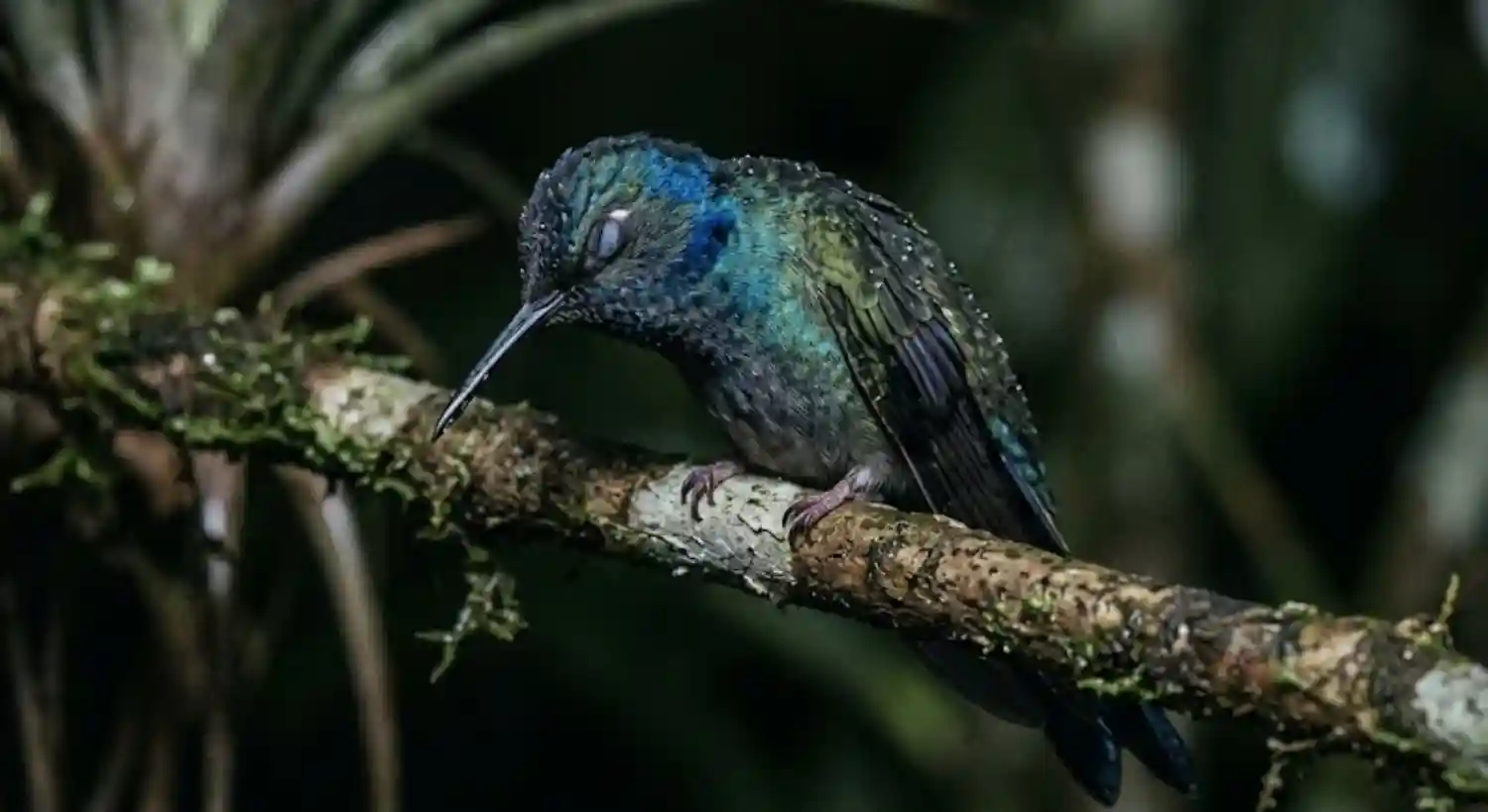
The hummingbird carries within its tiny frame the highest metabolic rate of any vertebrate animal on the planet. During the day, the heart of this small bird can beat more than a thousand times per minute, while its wings flap between fifty and eighty times per second to sustain its hovering flight in midair. That continuous energy expenditure demands an intense and uninterrupted diet, built mostly on the intake of sugar-rich nectar and the capture of small insects that round out its nutrition. When night falls and darkness makes it impossible to locate new flowers, the animal faces a genuine biological threat: the fat reserves it stored during the day would last only a few hours if the body kept its daytime pace, driving the bird toward death by starvation before dawn.
To overcome that physical limit, the hummingbird relies on a survival mechanism known as nightly torpor. When it enters this state, the animal temporarily shuts down the active thermal control of its body and lets its vital processes slow down dramatically. Its body temperature, which stays around forty degrees Celsius during daytime activity, plunges to levels close to ten degrees Celsius, settling almost to the temperature of the surrounding air. This is an extreme energy-saving strategy that cuts the consumption of oxygen and glucose by as much as ninety-five percent over the course of the night, allowing the bird’s scarce fat reserves to stretch all the way to the first rays of sunlight.
A Body Almost Lifeless on the Branch
Torpor radically alters the bird’s physiology while it hangs motionless from thin branches, sheltered within the vegetation. Its heart rate drops from the usual thousand beats to roughly thirty or fifty beats per minute. Its breathing slows so deeply that it presents prolonged pauses of several minutes between one cycle and the next. In this stage of deep dormancy, the hummingbird temporarily loses its ability to react quickly to external stimuli or to the approach of predators. If an observer happens to touch it, the animal appears to be without life, its feet rigidly locked onto the perch and its body cold to the touch.
The transition out of torpor is an active process that demands a concentrated physical effort before the day begins. About thirty minutes before dawn, the hummingbird’s body starts producing internal heat through involuntary muscular tremors in the pectoral muscles. That intense vibration burns a fraction of the bird’s last energy reserves in order to raise its body temperature back up to forty degrees Celsius. The heart accelerates gradually until it restores normal blood flow and returns to the animal the full motor capacity it needs for the morning hunting flight.
Precise Memory for Every Flower
The efficiency of this daily cycle is complemented by a finely tuned spatial memory. The hummingbird is able to map with precision the exact location of every patch of flowers within its foraging territory. It memorizes the nectar production rate of specific plants and the time each corolla needs to fill again with sugar after its last visit. This cognitive capacity prevents unnecessary flights toward food sources that have already been drained, optimizing the caloric gain in the first feeding cycle of the morning and ensuring the replenishment of the reserves lost during the rewarming process.
In the ecosystem of Brazil’s tropical and subtropical forests, this physiological adaptation turns the hummingbird into one of the most consistent pollinators of the native flora. By visiting hundreds of flowers every day in search of biological fuel, the bird carries pollen grains stuck to its feathers and its bill, ensuring the cross-reproduction of many plant species. A number of plants with tubular-shaped flowers evolved in step with the morphology of these birds, which belong to the family Trochilidae, and depend almost exclusively on their touch to fertilize their seeds and preserve the genetic variability of the forest.
The study of the hummingbird’s energy strategies reinforces just how complex the mechanisms of adaptation are within the fauna of Brazil. A small and seemingly vulnerable physical structure conceals one of the most efficient metabolic engineering feats in nature, capable of switching every single day between maximum biological acceleration and near-total energy saving. Preserving continuous forest areas and native flora is essential to guarantee that these birds find the daily supply of nectar they require to keep their life cycle in balance.
The hummingbird’s ability to alternate between the frenetic rhythm of flight and the stillness of torpor shows that survival in nature depends as much on the active search for resources as it does on the biological skill of conserving strength. Understanding these solutions from the natural world widens our respect for biodiversity and for the precision of the ecosystems that sustain it, where even the smallest of birds holds an engineering lesson written into its own body.
Reporting: Anne Silva / Amazonia Mag. Source: Revista Amazônia.

Editor, English Edition — Amazonia Mag
Anne Silva is the editor of Amazonia Mag, the English-language edition of Revista Amazônia. She curates, translates and adapts the outlet's science and environment coverage for an international audience, reporting on Amazon wildlife, flora, rivers, climate and research. Every story she edits is grounded in peer-reviewed studies, official data and on-the-ground reporting from the Revista Amazônia newsroom in Belém, Pará, Brazil. More by Anne Silva →