
“How much rain fell?” is the basic question in any conversation about climate. But there may be a more important one. Like any household budget, the global water economy rests on income, the water entering the system as precipitation, and outgo, the water leaving through various forms of evaporation.
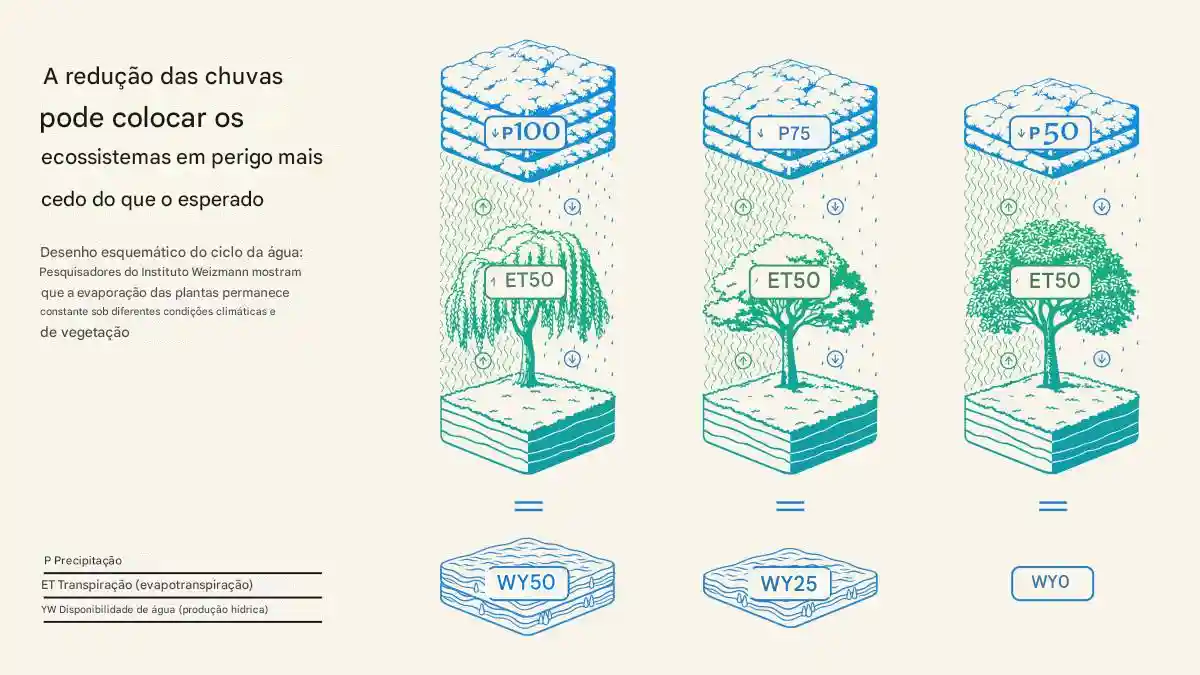
On land, water evaporates mainly through vegetation, in a process known as evapotranspiration. More than 60% of the rain that falls on the continents is consumed this way. What remains, available as runoff, groundwater recharge and human use, is what scientists call water yield.
An unexpected ceiling
In a study published in Nature Communications, scientists at the Weizmann Institute of Science found that, contrary to previous assumptions, evapotranspiration has a stable upper limit. Ecosystems saturate it at around 480 millimeters (about 19 inches) per year, give or take 210 mm, and that ceiling holds nearly constant across very different climates and biomes. It sits well below the theoretical maximum predicted by the physics of available energy.
The team, led by Dr. Eyal Rotenberg in the group of Professor Dan Yakir, built the work on climate model projections and long-term data from FLUXNET, a global network of measurement stations spread across hundreds of sites worldwide.
Why that ceiling matters
If vegetation cannot evaporate beyond a certain point, then every extra millimeter of rain flows straight into water yield. That rigidity has two opposite consequences, and both are uncomfortable.
In wet regions, excess precipitation is no longer buffered by more evaporation: it becomes runoff, which means greater vulnerability to flooding. In dry regions, the same inflexibility pushes the system faster toward the limits of ecological and social sustainability. By this metric, arid zones may be closer to the ecological red line than previously thought.
Both effects also appear in model-based projections, which reinforces the finding.
A more honest indicator
The authors conclude that water yield is a more sensitive and integrative indicator than rainfall alone. It measures what is actually left for rivers, aquifers, ecosystems and people, and therefore better reflects real climate risk.
For a region like the Amazon, where the forest moves colossal volumes of water into the atmosphere and feeds rainfall across half a continent, knowing where that ceiling sits is no technical footnote. It defines how much water returns to the sky, how much runs through the rivers, and how much margin the forest has left when the climate squeezes.
Reporting: Anne Silva / Amazonia Mag. Source: Weizmann Institute of Science study published in Nature Communications; FLUXNET network.
This article is the English edition of reporting originally published by Revista Amazônia. Images: Revista Amazônia archive.

Editor · Amazonia Mag
Anne Silva is the editor of Amazonia Mag, the English-language edition of Revista Amazônia. She curates, translates and adapts the outlet's science and environment coverage for an international audience, reporting on Amazon wildlife, flora, rivers, climate and research. Every story she edits is grounded in peer-reviewed studies, official data and on-the-ground reporting from the Revista Amazônia newsroom in Belém, Pará, Brazil. More by Anne Silva →