
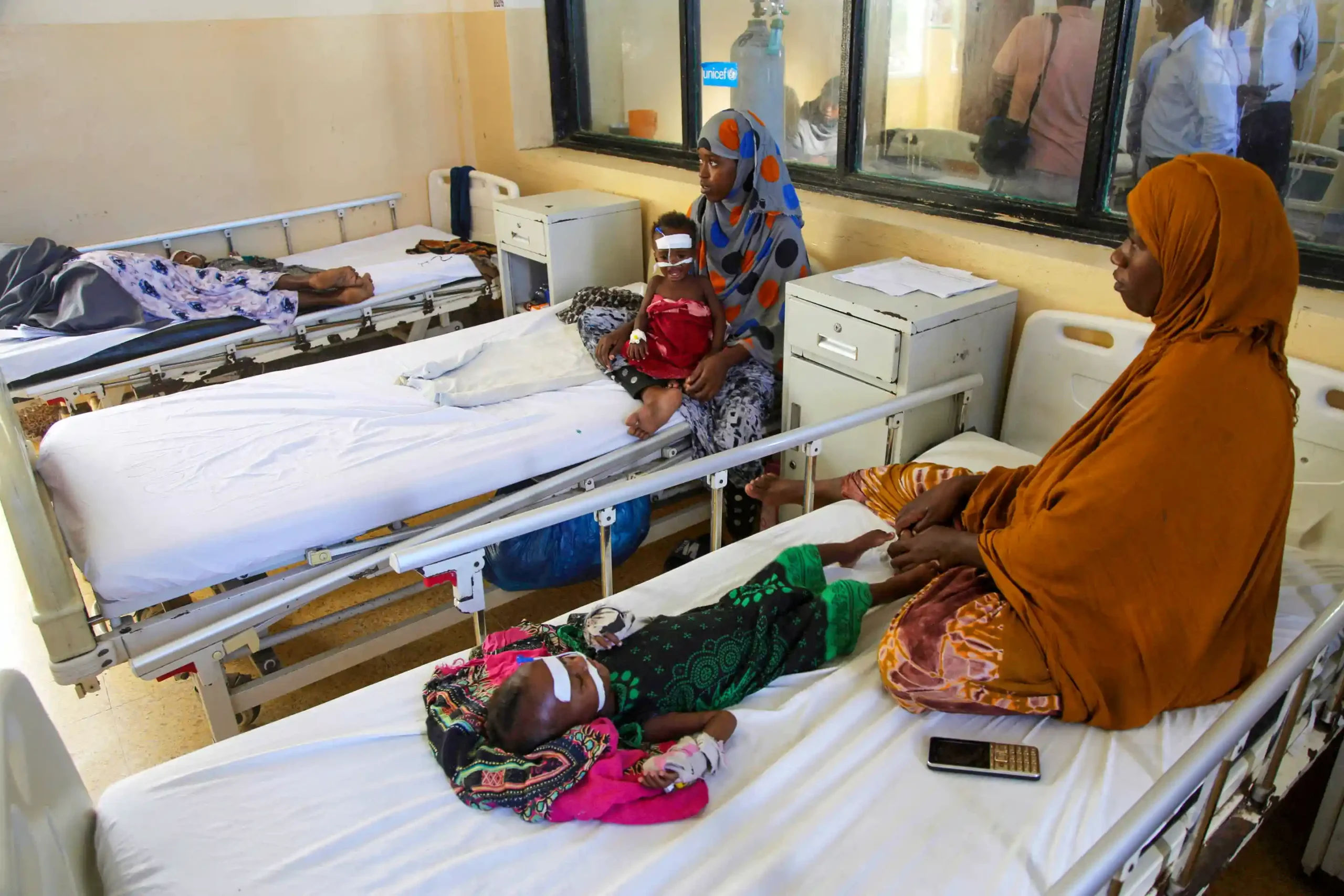
Nearly 6.5 million people in Somalia are facing severe hunger. Worsening drought, conflict and cuts to international aid are intensifying the country’s humanitarian crisis, the federal government and UN agencies warned recently.
The new figures come from the Integrated Food Security Phase Classification report, the technical tool that governments and international bodies use to rank how severe hunger has become in a given territory. According to that assessment, 6.5 million people are expected to face crisis levels of food insecurity or worse through the end of March.
The report also estimates that 1.84 million children under the age of 5 will suffer acute malnutrition in 2026, including nearly 500,000 who will be severely malnourished. Those roughly 500,000 cases represent the most severe tier within the estimate itself.
Authorities said the food security situation is deteriorating because of water shortages, insecurity, conflict and historically low levels of humanitarian assistance, a consequence of cuts to global funding.
The intensified drought, tied to below-average rainfall, has driven widespread food insecurity, crop failures, livestock losses, higher food prices and the displacement of people. The chain the report describes is a familiar one: when the rains fail, the harvest goes first, then the herds, and finally the ability to buy food at the market.
“The drought emergency in Somalia has worsened alarmingly, with soaring water prices, limited food supplies, the death of animals and a shortage of humanitarian funding,” said George Conway, the UN humanitarian coordinator for Somalia.
Conway said urgent, life-saving assistance is essential in the coming months, since no rain is expected until the main rainy season, which runs from April to June. In other words, the country’s climate calendar offers no immediate relief.
Even if the forecast rains arrive at average levels, 5.5 million people are expected to remain in crisis or worse during 2026. Recovery from the extreme drought will take time, authorities said.
Water scarcity is intensifying across southern and central Somalia, and no substantial improvement is expected even if the coming rains fall within the average range. Put another way, the return of the rain does not equal the return of usable water.
Drought and conflict displaced about 278,000 people between July and December, disrupting agricultural production, market access and the distribution of aid, according to UN estimates. Every displacement hits both ends of the problem at once: it breaks food production while breaking the logistics of the relief that is supposed to replace it.
“The severity of this drought is undeniable and deeply alarming,” said Mohamud Moallim Abdulle, commissioner of Somalia’s Disaster Management Agency. Abdulle appealed to international partners, the Somali diaspora, businesses and civil society to step up immediate support.
The United Nations and the Somali government warned that substantial funding cuts have forced humanitarian partners to reduce or suspend essential life-saving programs, including food security, health, nutrition, water and sanitation projects. The crisis, then, is not only climatic. It is also budgetary.
The State of Food Security and Nutrition in the World
Every year, this FAO report, the most rigorously reviewed of its kind, presents the total number of undernourished people worldwide while advocating strategies to combat hunger and malnutrition. After the global report is published, a broad range of statistics is broken down into regional reports. SOFI is produced jointly with other UN agencies, such as IFAD, UNICEF, the WFP and the WHO.
The 2025 edition of “The State of Food Security and Nutrition in the World” presents a complex picture. Although the world appears to be making cautious progress in reducing hunger, many countries in Africa, particularly in the Southern Africa region, are moving in the opposite direction. The report highlights a troubling truth: Africa is the only continent where hunger continues to rise, in both absolute and proportional terms.
The global trends sketch a slight recovery with sharp regional contrasts. The prevalence of undernourishment fell slightly, from 8.7% in 2022 to 8.2% in 2024. That positive trend is driven mainly by improvements in South and Southeast Asia and in South America.
The number of people unable to afford a healthy diet also fell globally, from 2.68 billion in 2022 to 2.60 billion in 2024. The decline is real, but modest, and it masks regional paths that move in opposite directions within the same global average.
The number of undernourished people in Africa rose to roughly 307 million in 2024, representing more than 20% of the continent’s population. The number of people unable to afford a healthy diet increased sharply there, from 864 million in 2019 to more than 1 billion in 2024.
Africa is now home to almost 40% of the world’s population that cannot afford a healthy diet, despite accounting for only about 17% of the global population. That gap between the continent’s demographic weight and its share of global hunger statistics is what gives a continental scale to what is unfolding in Somalia.
Seen together, the two documents tell the same story at different scales. The Integrated Food Security Phase Classification describes the immediate emergency: 6.5 million people through the end of March, and 1.84 million children at risk of acute malnutrition across 2026. SOFI describes the underlying trend: a continent drifting away from the global target while other regions move closer to it.
Between the two scales sits the variable both texts point to, and which does not depend on the weather: humanitarian funding. Conway and Abdulle agree on that point. Without resources, food security, health, nutrition, water and sanitation programs are cut back or suspended just as the next rainy season, from April to June, remains far off.
Reporting: Anne Silva / Amazonia Mag
This article is the English edition of reporting originally published by Revista Amazônia. Images: Revista Amazônia archive.

Editor · Amazonia Mag
Anne Silva is the editor of Amazonia Mag, the English-language edition of Revista Amazônia. She curates, translates and adapts the outlet's science and environment coverage for an international audience, reporting on Amazon wildlife, flora, rivers, climate and research. Every story she edits is grounded in peer-reviewed studies, official data and on-the-ground reporting from the Revista Amazônia newsroom in Belém, Pará, Brazil. More by Anne Silva →