
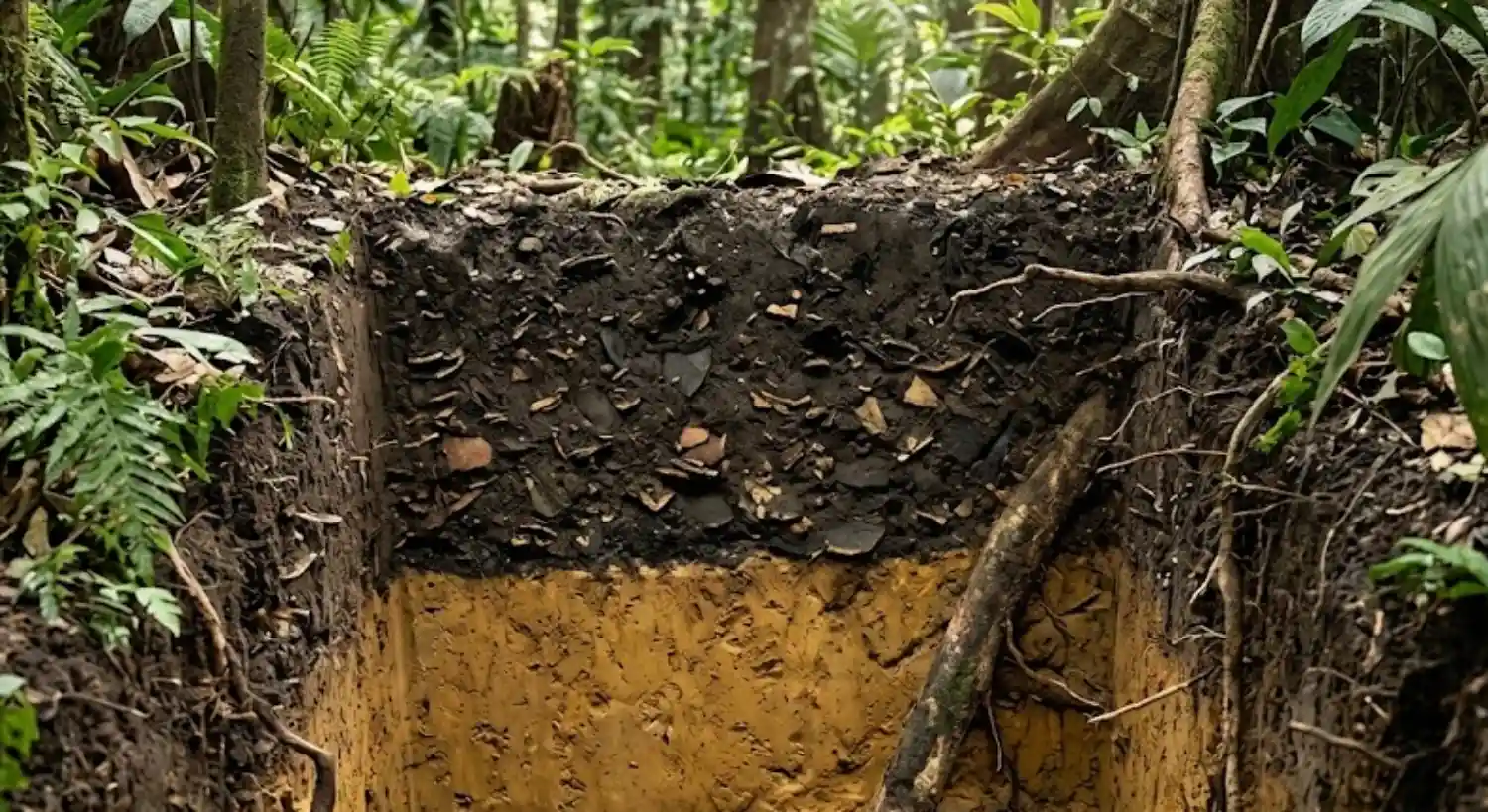
Able to hold essential nutrients and sustain high farming productivity for centuries, without any modern chemical fertilizer, Amazonian dark earth is the most fertile soil in the entire Neotropical region. While the vast majority of Amazon rainforest soils are naturally acidic, leached by intense tropical rains and extremely poor in minerals, these dark and rich patches scattered across the river basin defy the rules of conventional soil science. Known to researchers as anthropogenic soil, and called in Brazil terra preta de indio, this resource is the direct result of thousands of years of land management and accumulated knowledge held by the pre-Columbian Indigenous peoples who lived along the great rivers long before Europeans arrived.
The ancient engineering of charcoal and organic matter
The formation of terra preta did not happen through natural geological processes, but through a human creation sustained across many generations. Ancestral peoples systematically deposited around their villages the leftovers of food, animal bones, fish carcasses and spines, human and animal waste, pottery fragments and, above all, large amounts of charcoal produced by the gentle burning of biomass in domestic and management fires. Repeated over centuries, that steady contribution slowly turned the poor surrounding soils into one of the most productive substrates on the planet.
The great secret of this soil’s lasting fertility lies in the biological charcoal held within its structure, known in modern science as biochar. Produced under low-oxygen conditions, this charcoal has a highly porous physical structure that works like a microscopic sponge in the subsoil. That porosity prevents the heavy Amazonian rains from causing leaching, the washing and dragging of nutrients down toward the water table.
Elements that are vital for plant growth, such as calcium, magnesium, zinc, manganese and, above all, phosphorus, become chemically fixed on the surface of the charcoal and of the decomposing organic matter, staying available to plant roots for hundreds of years. That retention capacity explains why terra preta can support successive harvests in places where neighboring soils would be exhausted after only a few seasons.
A microscopic shelter and the power of self-renewal
Besides retaining minerals in proportions up to hundreds of times higher than the neighboring yellow soils, Amazonian dark earth hosts an extraordinarily diverse and active community of microorganisms. The microporous structure of the charcoal works as a safe refuge for mycorrhizal fungi, nitrogen-fixing bacteria and other beneficial soil organisms, which find both protection and food inside it.
These microorganisms process organic matter continuously and keep nutrient recycling at high levels. Studies indicate that this unique microbiota gives terra preta a surprising capacity for self-renewal. Even after years of intensive farming, when the soil is left to rest for a short fallow period, the dark layer manages to rebuild its biological and nutritional load far faster than any conventional tropical soil.
Another striking feature is the abundant presence of Indigenous pottery fragments mixed into the earth. These shards not only help aerate the soil and hold moisture, but also serve as key archaeological markers for mapping population density and the extent of human settlements in ancient Amazonia. In doing so, they dismantle the old idea that the forest was an untouched demographic void before the sixteenth century.
Inspiration for sustainable farming and the climate
The study of the physical and chemical makeup of terra preta de indio has opened new horizons for agronomic science and for the search for low-impact farming models. The application of biochar and of organic compounds inspired by the Amazonian model is already being tested in different regions of the world to restore degraded soils and boost crop productivity without the excessive use of synthetic fertilizers.
Recreating this process on an agricultural scale also represents a crucial opportunity in the fight against global climate change. Adding stable charcoal to the soil works as an efficient long-term carbon capture technique, pulling carbon dioxide out of the atmosphere and locking it safely into the ground for hundreds or even thousands of years. In this way, a soil created by Indigenous hands centuries ago could become an ally of today’s climate goals.
Terra preta shows that it is possible to produce food in abundance within the tropical ecosystem without destroying the native vegetation cover, using biological knowledge to enrich the soil instead of depleting it. This ancestral technology offers valuable lessons for building modern and sustainable agroforestry systems, in which productive fields and standing forest can coexist rather than compete.
Protecting an archaeological and environmental heritage
Despite its priceless value for science, history and the economy, the deposits of Amazonian dark earth face growing threats. The advance of illegal mining, disorderly urban expansion and the unauthorized removal of this fertile soil for sale in gardens and vegetable plots are destroying an irreplaceable archaeological and biological heritage.
Mining and mechanical disturbance without proper scientific supervision erase the historical context of the ceramic artifacts and alter the microbial structure that took centuries to consolidate. Protecting the archaeological sites where terra preta is present is essential to preserve the memory of the original peoples and to keep these natural fertility laboratories alive. Strengthening scientific research and supporting the traditional communities that use the soil consciously are indispensable steps to honor this legacy. The Amazon teaches us that the future of sustainability and food production may be kept safe within the lessons of the past.
Reporting: Anne Silva / Amazonia Mag. Source: Revista Amazônia.

Editor, English Edition — Amazonia Mag
Anne Silva is the editor of Amazonia Mag, the English-language edition of Revista Amazônia. She curates, translates and adapts the outlet's science and environment coverage for an international audience, reporting on Amazon wildlife, flora, rivers, climate and research. Every story she edits is grounded in peer-reviewed studies, official data and on-the-ground reporting from the Revista Amazônia newsroom in Belém, Pará, Brazil. More by Anne Silva →