
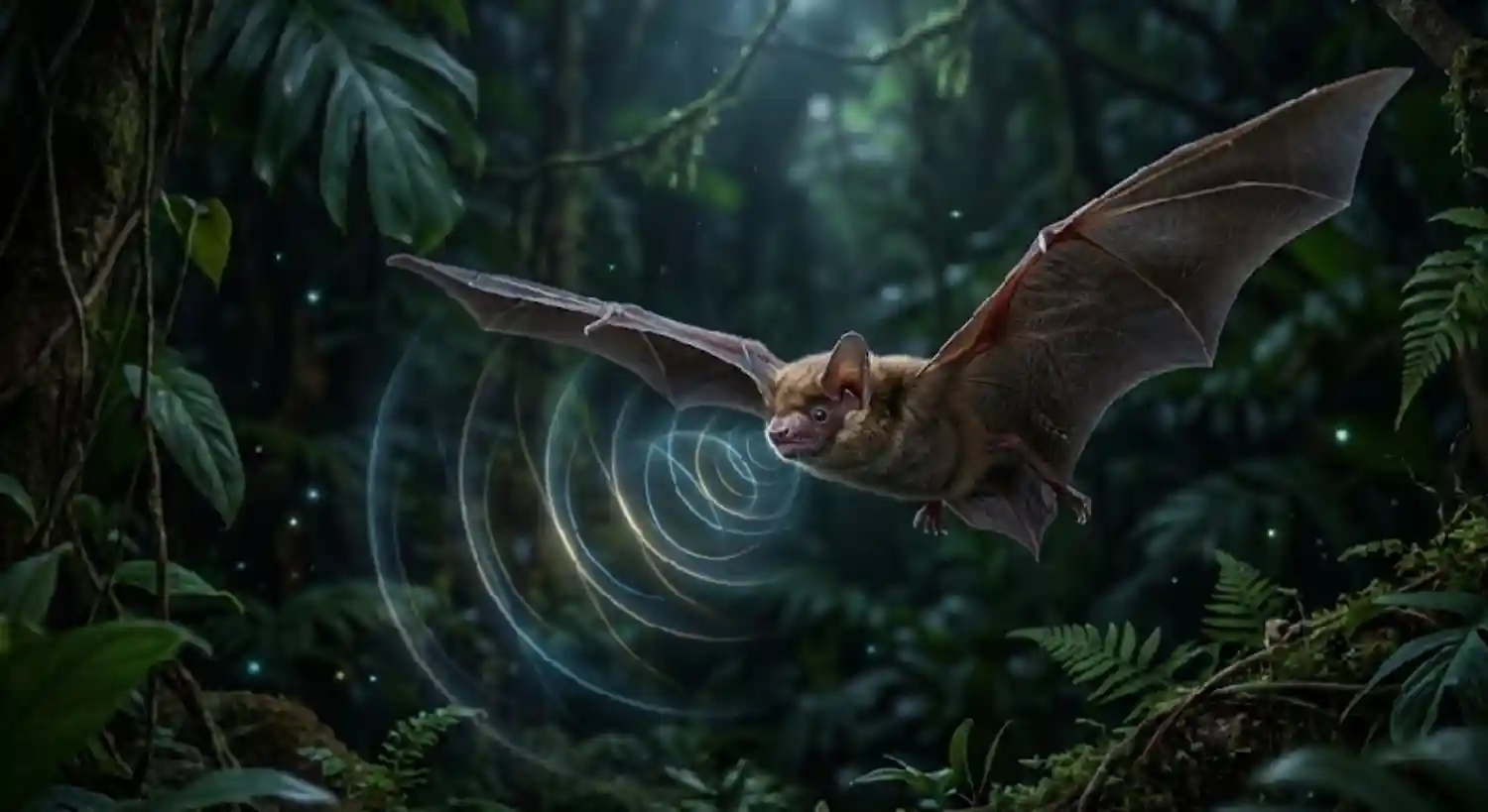
Able to fire up to two hundred ultrasonic pulses per second and to map obstacles thinner than a strand of hair in the absolute darkness of the rainforest, the echolocation system of Amazonian bats surpasses in precision and in energy efficiency any device created by human engineering. That extraordinary capacity for spatial orientation, refined across millions of years of evolution in the tropical forests, has become one of the greatest sources of inspiration for modern biomimicry. Today, the workings of the biological sonar of these flying mammals serve as a direct foundation for the development of advanced naval radar and of electronic canes designed to give autonomy and mobility back to people with visual impairment.
The biological sonar that works in total darkness
Echolocation is a fascinating physiological adaptation that allows the insectivorous and frugivorous bats of the Amazon to navigate and hunt amid dense vegetation without relying on sight. The animal emits high-frequency sound waves through its mouth or its nasal structure, waves that are imperceptible to the human ear. When those ultrasonic signals reach an object, such as a leaf, a moving insect or the trunk of a tree, they bounce back and return to the bat in the form of an echo. It is a constant dialogue between the emitter and its surroundings, repeated hundreds of times every second.
By capturing that return with its highly specialized ears, folded with intricate anatomical ridges, the bat brain processes the delay of the sound, the frequency and the intensity of the wave. This real-time processing builds a detailed three-dimensional image of the environment around it. The fleeing insect is located with millimeter accuracy, allowing the mammal to dodge tangled branches and seize fast prey in fractions of a second, all of it without a single flash of light.
The great advantage of biological sonar over conventional electronic systems is its energy efficiency and its capacity for noise filtering. Even in an environment saturated with sound, such as the Amazonian night rich with the calls of insects and amphibians, the bat manages to isolate its own echo and ignore outside interference. This is a feat that science still struggles to replicate in signal-processing software, where separating useful information from background noise remains one of the hardest challenges in engineering.
From forest biomimicry to urban autonomy
Turning that biological knowledge into innovation useful to society is the great triumph of biomimicry, the science that studies nature’s solutions to solve complex human problems. Understanding the mechanism of ultrasonic emission and reception in bats allowed engineers to develop electronic sensors able to emit high-frequency pulses similar to those of these members of the order Chiroptera.
The most striking application of this technology lies in the field of accessibility and social inclusion. Electronic canes and wearable navigation devices for blind people use small ultrasonic emitters and receivers attached to the structure of the cane or to special glasses. The equipment sends continuous sound waves into the environment and, upon detecting the proximity of aerial or ground obstacles, converts the returning echo into tactile signals, such as vibrations in the grip, or into audible alerts for the user.
Thanks to this inspiration drawn from Amazonian wildlife, a blind person can detect the presence of low branches, public telephones, dumpsters or open gates from meters away, avoiding accidents that a traditional touch cane cannot predict in time. The principle of echolocation extended human spatial perception beyond direct physical contact, providing greater confidence and safety when moving through cities and returning independence to people who once depended entirely on a companion.
Naval sonar and the advance of autonomous robotics
Beyond assistive health technologies, bat echolocation has profoundly influenced the refinement of maritime sonar and of autonomous robotics systems. Modern sonar used in ships and submersibles adopts algorithms based on the variable frequency control that bats use as they approach a target, alternating between long search pulses and short high-precision pulses at the moment of impact.
In robotics, drones and ground robots developed for rescue operations in rubble or dark caves use ultrasound arrays inspired by the facial anatomy of these animals. Such sensors allow machines to map unknown environments without the need for artificial lighting or high-resolution cameras, saving battery and ensuring continuous operation in extreme conditions of dust or smoke, precisely where conventional cameras are blinded.
The diversity of bat species in the Amazon offers an incalculable archive of anatomical variations. Species that hunt just above the water have systems optimized to avoid the reflection of the water’s mirror surface, while species of the forest interior carry frequencies adapted to penetrate closed foliage. Each biological variation represents an engineering solution ready to be studied and adapted by human laboratories.
Protecting bats and the forest ecosystem
Despite their invaluable contribution to science and to human technology, bats still face an unfounded stigma that leads to direct persecution and to the destruction of their colonies in several regions. In the Amazon, the advance of deforestation, wildfires and habitat fragmentation reduces the availability of caves, hollow trunks and native vegetation that serve as shelter and as hunting grounds for these animals.
The loss of bat species produces catastrophic impacts on the ecological balance of the forest. Frugivorous bats are the main dispersers of the seeds of pioneer trees in the Amazon, ensuring the natural reforestation of degraded areas, while insectivorous species consume tons of insects every night, controlling populations of agricultural pests and of tropical disease vectors. Protecting these mammals is therefore a way of protecting human health itself.
Ensuring the preservation of the Amazon’s biodiversity means protecting the greatest laboratory of innovation and technology on the planet. Every species that inhabits the forest holds evolutionary secrets capable of transforming medicine, engineering and the quality of life of future generations. Respecting wildlife and investing in the conservation of tropical forests is the only path for nature to keep teaching us brilliant solutions to the challenges of the modern world.
The story of echolocation shows that, by looking carefully at the secret life of animals, we find the keys to building a more accessible, sustainable and innovative future for all of humanity. What began as a survival strategy inside the dark canopy of the rainforest now travels through cities, oceans and disaster zones, proving that the protection of a single misunderstood mammal can echo far beyond the trees where it was born.
Reporting: Anne Silva / Amazonia Mag. Source: Revista Amazonia.

Editor, English Edition — Amazonia Mag
Anne Silva is the editor of Amazonia Mag, the English-language edition of Revista Amazônia. She curates, translates and adapts the outlet's science and environment coverage for an international audience, reporting on Amazon wildlife, flora, rivers, climate and research. Every story she edits is grounded in peer-reviewed studies, official data and on-the-ground reporting from the Revista Amazônia newsroom in Belém, Pará, Brazil. More by Anne Silva →