
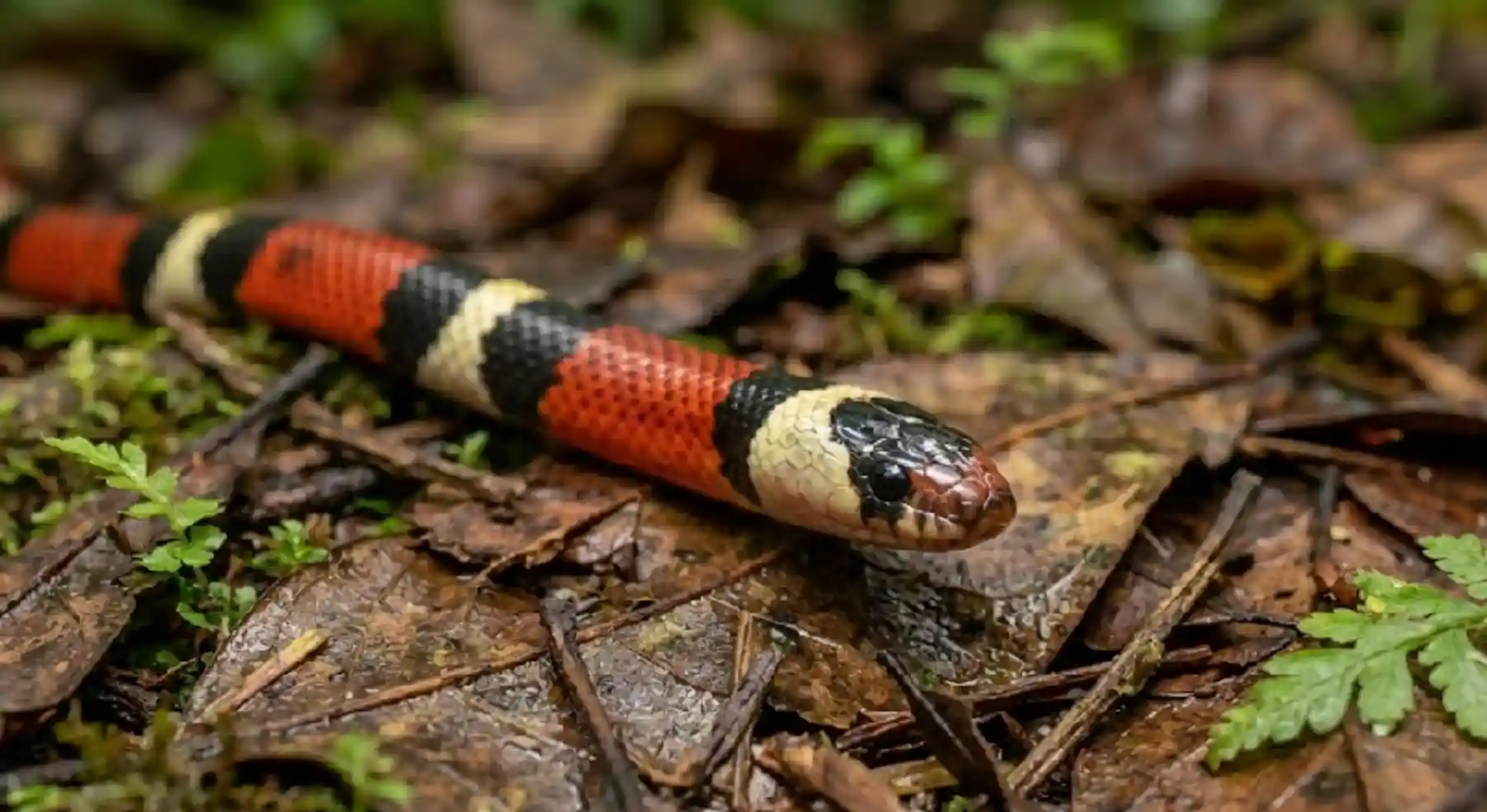
We have already told the story of the false coral snake, the harmless species that survives by copying the colored rings of a dangerous neighbor. This report is about the other one, the real thing: the snakes of the genus Micrurus, which carry the most potent neurotoxic venom of any snake in Brazil. The true coral snake has proteroglyphous dentition, meaning small fixed fangs set at the front of the mouth. That biological detail suggests more difficulty in injecting venom when compared with the long retractable fangs of the lanceheads, but it takes nothing away from how dangerous the animal is. On the contrary, its venom can paralyze the nervous system of a prey animal or of a human being in an alarmingly short span of time.
Unlike other snakes, which deliver fast strikes from a distance, the coral snake tends to bite and chew lightly to make sure the venom goes in. Once inside the body, the neurotoxins block neuromuscular receptors and stop brain impulses from reaching the muscles. That silent process is what turns the elapid accident, the technical name for coral snake envenomation, into one of the most critical medical emergencies in animal toxicology. It demands a fast and technical response to prevent death from respiratory failure.
Rings that warn but do not identify
The vivid colors of the true coral snake are a classic case of aposematism, the defense mechanism in which an animal displays warning signals to tell predators about its toxicity. In Brazil, the pattern of colored rings wrapped around the body is the trademark of these snakes. Nature, however, is more complicated than that. There are the so called false coral snakes, species that are not venomous or whose venom is of little consequence, and that imitate those colors to protect themselves.
Studies indicate that trying to tell a true coral snake from a false one by the ring pattern alone is an extremely risky task for anyone who is not a specialist, and even more so in the Amazon region, where the diversity of species is immense. The golden rule of biological safety is clear: any snake with a pattern of red, black and white or yellow rings should be treated as a true coral snake. Precise identification is only possible through technical analysis of the dentition and the scales, something that must be left to specialists. When in doubt, keeping your distance is the only effective preventive measure.
The devastating mechanism of a neurotoxic venom
The venom of the true coral snake is made of a complex mixture of low molecular weight polypeptides that spread quickly through the bloodstream. Unlike the venom of the lanceheads, which causes intense pain, swelling and local necrosis, a coral snake bite can be almost painless and show few visible signs at the wound. That absence of dramatic immediate symptoms is precisely what makes it dangerous, because it can lead the victim to underestimate how serious the situation is.
The systemic symptoms arrive as a cascade of paralysis. The first clinical sign is usually palpebral ptosis, the drooping of the eyelids, followed by double vision and difficulty swallowing. If there is no medical intervention with the administration of antielapid antivenom, the paralysis advances to the intercostal muscles and the diaphragm. Without respiratory support and without the correct antidote, the victim succumbs to asphyxia within a few hours. The neurotoxic potency of the Amazonian species is so high that a minute amount of venom is enough to compromise the vital functions of a healthy adult.
What to do and what never to do after a bite
Immediate care is the only guarantee of survival in an elapid accident. The first step is to keep the victim calm and at rest, because a rising heart rate speeds up the absorption of the neurotoxins. The bitten area should be washed with soap and water only. It is imperative to take the patient as quickly as possible to a health facility that is a reference in the treatment of accidents with venomous animals, ideally carrying a photo of the snake to make the choice of antivenom easier.
Never use tourniquets, never cut the site of the bite and never try to suck out the venom. Beyond being ineffective against fast absorbing neurotoxins, those practices raise the risk of infection and of serious complications. According to medical research, the specific antielapid antivenom is the only treatment capable of neutralizing the circulating venom. In many cases the victim may need mechanical ventilation in an intensive care unit until the antivenom takes effect and muscle function is restored.
One detail is worth repeating, because it is the one that costs lives. A bite that barely hurts is not a bite that can wait. The coral snake leaves few visible signs at the wound, and the first systemic sign, the drooping eyelids, only appears once the neurotoxins are already circulating. Anyone bitten by a ringed snake, or by a snake that could not be identified with certainty, should be taken to a reference health facility right away, because the specific antivenom is the only thing that neutralizes the venom already in the blood.
Where the colorful danger lives
The Amazonian true coral snake has mostly fossorial or subfoveal habits, which means it spends most of its time hidden under leaf litter, inside decomposing trunks or in holes in the ground. These are discreet animals and they are rarely seen unless they are disturbed during the cleaning of a backyard or a walk along a forest trail. Some species, such as Micrurus surinamensis, have semiaquatic habits and turn up near igarapés, the small Amazonian streams, and in flooded areas.
Despite how lethal they are, coral snakes are not aggressive. They tend to flee when they feel the vibration of human steps. Most accidents happen when the snake is pressed against the ground or handled without the person noticing it. Closed shoes and protective gloves in rural areas or in dense forest are the simplest and most efficient physical barrier against direct contact with this species which, small as it is, holds the title of the most toxic in the country.
A specialized predator that interests medicine
In the Amazonian food web, the true coral snake plays a fundamental role. Many species of the genus Micrurus are ophiophagous, meaning they feed on other snakes, including species that can behave as pests or competitors. By controlling the population of other reptiles and of small amphibians, the coral snake helps to maintain biodiversity and the population balance of the forest ecosystem.
Science also looks at that venom with biotechnological interest. The same toxins that can be lethal are being studied in research aimed at developing new painkilling drugs and treatments for neurological diseases. Conserving these species is therefore essential not only for the balance of nature, but for the potential advance of human medicine. Respecting the habitat of the coral snake is a way of ensuring that those valuable chemical compounds remain available to science.
A pact of respect with Amazonian wildlife
The true coral snake is a symbol of the complexity and the power of Amazonian biodiversity. Its hypnotic beauty should not be a reason for carelessness, but for a deep respect grounded in knowledge. Living alongside venomous animals in a tropical country such as Brazil demands continuous environmental education and the understanding that every living being has a purpose in the ecosystem.
It is worth reflecting on how our actions and the urban expansion over forested areas increase the probability of these encounters. Protecting the forest and keeping the areas around rural homes clean are the best ways to leave the coral snake where it belongs: inside the forest, far from human conflict. Correct information is the best antidote against fear and the main tool for saving lives.
Keep your distance, use protective equipment in the forest and, in case of an accident, seek immediate medical help. Time is the most precious factor when it comes to the queen of the neurotoxins.
Reporting: Anne Silva / Amazonia Mag. Source: Revista Amazônia.

Editor, English Edition — Amazonia Mag
Anne Silva is the editor of Amazonia Mag, the English-language edition of Revista Amazônia. She curates, translates and adapts the outlet's science and environment coverage for an international audience, reporting on Amazon wildlife, flora, rivers, climate and research. Every story she edits is grounded in peer-reviewed studies, official data and on-the-ground reporting from the Revista Amazônia newsroom in Belém, Pará, Brazil. More by Anne Silva →