
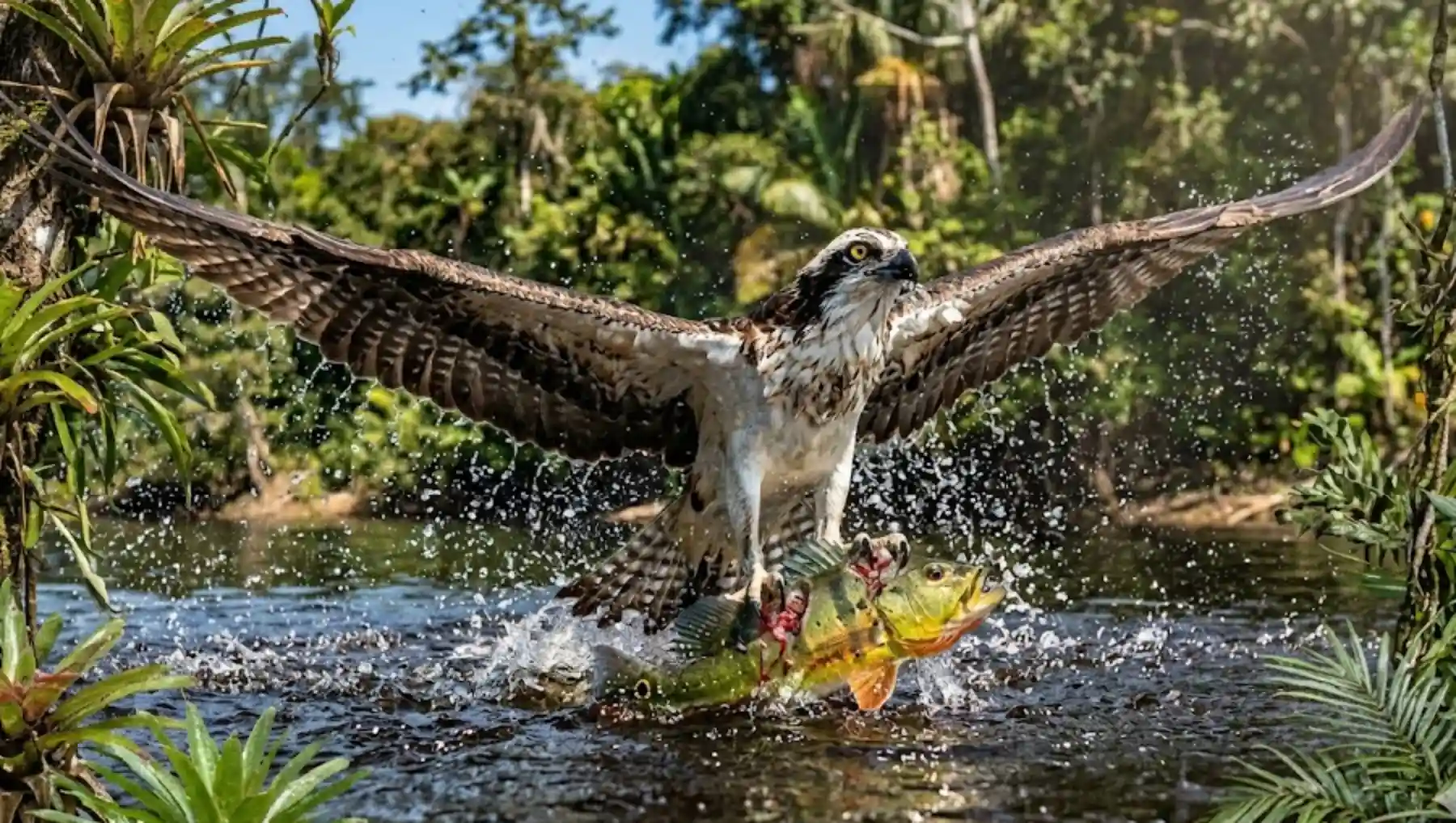
Every year, as the northern winter locks the lakes of Canada and the United States under ice, a long winged raptor sets off on one of the most extraordinary journeys in the animal world. The osprey (Pandion haliaetus), one of the most widely distributed birds of prey on the planet, leaves its breeding territories in North America and covers more than 8,000 kilometres to reach the Amazon basin. Satellite tracking has confirmed what river dwellers had long suspected whenever they looked up: the Amazon is not a habitat closed in on itself. It is a resting hall and a dining room for migratory wildlife from the far end of the hemisphere.
The arrival of these birds on Brazilian rivers and lakes, usually concentrated between October and April, changes the look of the shoreline. Unlike the resident hawks of the region, the osprey has an unmistakable silhouette: in flight the wings fold into a shallow letter M that any observer learns to pick out at a distance. The fact that Brazil is the main wintering destination for a large share of the American population turns the conservation of Amazonian water bodies into an international matter. Without healthy river systems in the south, the life cycle of the species in the north would be seriously compromised.
The biomechanics of a perfect catch
The osprey is the only raptor that feeds almost exclusively on live fish, and its anatomy is a masterpiece of natural engineering built for that single purpose. Unlike other eagles, it has feet covered in spiny scales, known as spicules, and a reversible outer toe that lets it hold slippery prey with two toes forward and two toes back. When it hits the water, often submerging completely, it seals its nostrils shut to keep the liquid out. That adaptation still fascinates the biologists who study how vertebrates evolved to exploit aquatic environments.
The attack itself is applied physics. The bird glides at heights of up to 40 metres, locks onto a target and drops in an almost vertical dive, correcting its trajectory to compensate for the refraction of light at the surface of the water. The moment it seizes a fish, it turns the prey head first in its talons to cut aerodynamic drag on the flight back to the perch. In the Amazon, species such as the peacock bass, known locally as tucunaré, and the piau are frequent targets, which shows how readily the osprey adapts its hunting tactics to tropical fish with hard scales.
The Amazon as a climate refuge
The southward migration is a textbook case of ecological connectivity. While the northern hemisphere endures winters that freeze lakes and shrink the food supply, the Amazon offers abundant aquatic biomass and stable temperatures for months on end. The refuge, however, is no longer as safe as it looks. River contamination by mercury from illegal gold mining is an invisible hazard: as top predators, ospreys accumulate heavy metals in their tissues through bioaccumulation, which can undermine their ability to make the return journey or to produce viable eggs once they are back on their breeding grounds.
Institutions such as the Instituto Nacional de Pesquisas da Amazônia (INPA) and the conservation group Save Brasil monitor these migrant populations to understand how shifts in the flood and drought cycles of the rivers change the availability of prey. Deforestation along riverbanks adds a less obvious problem: it removes the tall perches the birds need in order to process their food and watch over their stretch of water. Protecting the osprey in the Amazon therefore means protecting the water quality that sustains both the biodiversity of the region and the people who live along its rivers.
Faithful to the same lake, year after year
One of the most intriguing features of the species is its fidelity to wintering sites. Many individuals return to exactly the same lake or the same stretch of Amazonian river season after season. Young ospreys make their first migration without any guidance from their parents, navigating with an inherited genetic map and an internal magnetic compass. They tend to stay in the Amazon for a long stretch, sometimes as much as two years, before heading north for their first breeding season, using that time to gain maturity and physical strength.
That deep link between continents makes the osprey an ambassador for conservation. It ties the environmental policies of Canada, the United States and Brazil into a single biological web. Environmental education in riverside communities matters here, because seasonal visitors are sometimes mistaken for predators of farmed animals when they are in fact an integral part of the river ecosystem. The presence of the bird in Amazonian skies is a signal that the migratory corridors of the Americas are still functioning, despite the pressures created by human activity.
Telemetry, cooperation and an open horizon
Advances in telemetry have allowed the public to follow these routes almost in real time, and that visibility has had a direct effect on public engagement with conservation. When a satellite tagged osprey crosses the Caribbean Sea and enters the Amazon rainforest, it tells a survival story capable of moving governments and civil society alike. International cooperation projects seek to harmonise the laws that protect migratory birds, so that the Brazilian rest period of these raptors is safe and productive.
For readers in the north, the implication is easy to miss and hard to unsee once noticed. The osprey that nests beside a Canadian lake or an American river may well be the same bird that spends the following months diving into an Amazonian lagoon. Conservation decisions taken in one hemisphere land squarely on the other. A river degraded by illegal mining thousands of kilometres away can quietly reduce the number of viable eggs laid the following spring in the north, which is precisely why researchers insist on treating the two ends of the route as a single system rather than as two unrelated conservation problems.
The osprey is a reminder that the Amazon does not belong only to those who live there all year round. It is global heritage, indispensable to the maintenance of life on the planet. Its journey is a testament to the resilience of wildlife and to the urgency of keeping rivers clean and forests standing. It is the link that joins boreal forests to tropical ones, proof that geographical borders do not exist for nature. Protect the lake where the osprey dives and you protect the essence of the most important water network in the world.
Reporting: Anne Silva / Amazonia Mag. Source: Revista Amazônia, Instituto Nacional de Pesquisas da Amazônia (INPA), Save Brasil.

Editor, English Edition — Amazonia Mag
Anne Silva is the editor of Amazonia Mag, the English-language edition of Revista Amazônia. She curates, translates and adapts the outlet's science and environment coverage for an international audience, reporting on Amazon wildlife, flora, rivers, climate and research. Every story she edits is grounded in peer-reviewed studies, official data and on-the-ground reporting from the Revista Amazônia newsroom in Belém, Pará, Brazil. More by Anne Silva →