
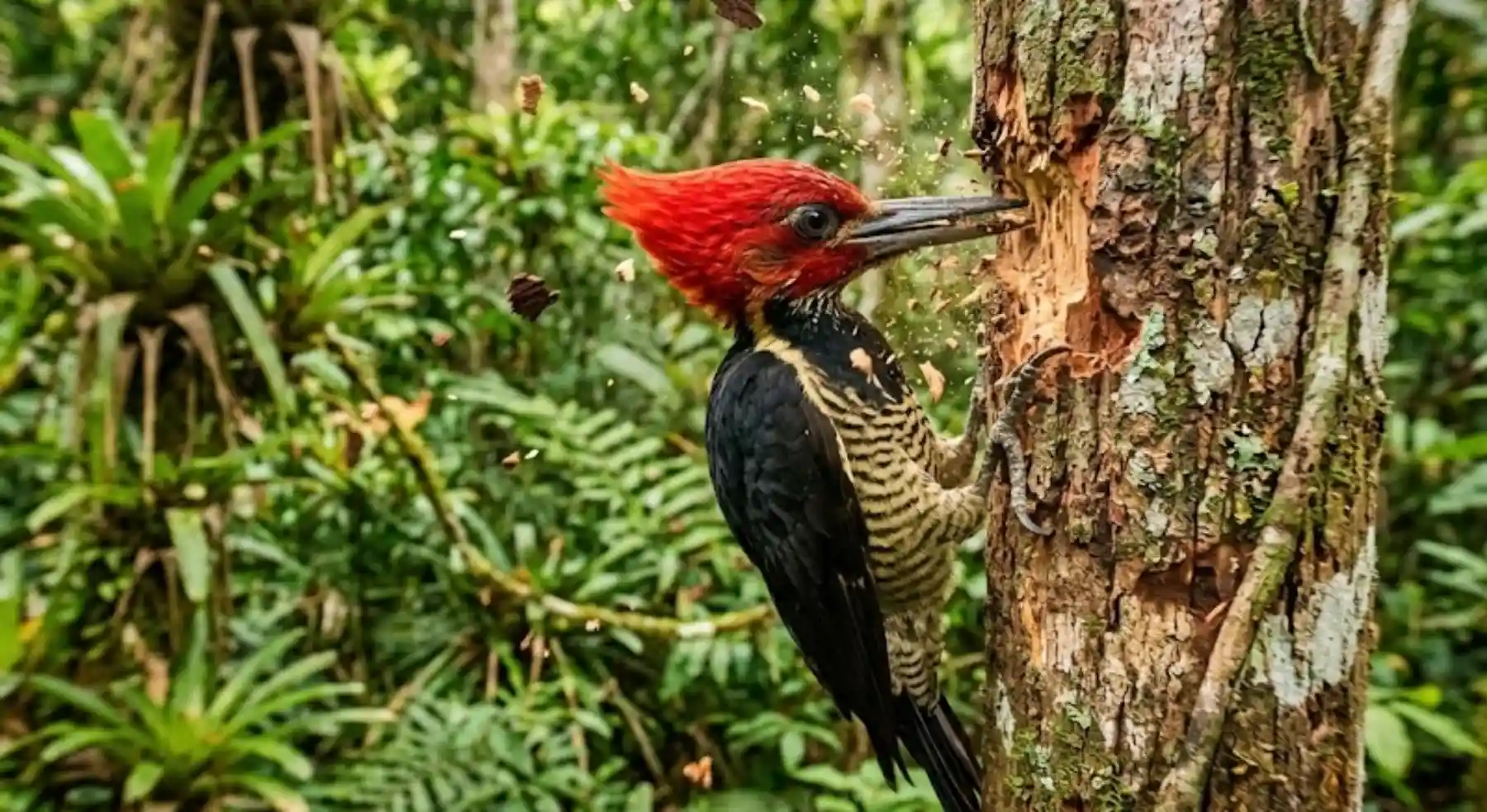
There is a bird in the Amazon that breaks the rules of human sports medicine every single day. The woodpecker slams its beak into hard tree trunks up to twenty times per second and ends the day with no concussion, no headache, no lasting damage. The deceleration it absorbs with each strike reaches roughly 1,200 g, that is, one thousand two hundred times the force of gravity. A human being exposed to just 100 g would suffer a severe concussion or fatal brain injury. No miracle is involved. What protects the bird is a cranial shock absorption system refined over millions of years of evolution in the forest.
That resilience is not decorative. The tasks that keep the species alive depend on it: digging out insect larvae buried deep in hard wood and carving the cavities where chicks will hatch. Without the natural protection, the bird’s brain would be reduced to pulp in the first seconds of work. That is why the woodpecker family, Picidae, stopped being a subject only for biologists. Engineers now study it too, looking for clues to the design of helmets and aircraft black boxes.
Three parts working as one
The first part is the hyoid bone, the structure that supports the tongue in birds. In the woodpecker it is disproportionately long: it leaves the base of the beak, runs behind the skull and wraps around the entire braincase like a biological seat belt. When the beak hits the trunk, that bone acts as a spring and spreads the impact energy evenly around the skull instead of letting it concentrate exactly where the brain sits.
The second part is the material of the cranial bone itself. Unlike the human skull, which is stiffer, the woodpecker’s has a spongy, porous structure, especially in the frontal region. That trabecular bone works as a shock absorber and dissipates vibration waves before they reach soft tissue. The third part lies in the junction between beak and skull, connected in a way that allows a micro displacement. In mechanical terms it is a suspension: the blow comes in, the interface deforms, and what reaches the animal’s nerve center is already blunted.
A brain that cannot rattle
On top of the bone cushioning comes a simple and decisive physical advantage: the size and orientation of the brain. Because of its small volume, the bird’s brain mass has a far higher surface area to weight ratio than that of a large mammal. Pressure is therefore spread over a proportionally wide area and internal stress drops. Then comes the fit. The brain sits very tightly inside the braincase, with almost no room for cerebrospinal fluid.
That detail explains much of the puzzle. In human concussions, the main damage occurs when the brain sloshes inside the skull and collides with the bony walls after an impact. In the woodpecker that oscillation is physically impossible because there is no room to move: brain and skull travel as a single solid unit. Studies also indicate that the bird shuts its eyelids milliseconds before each strike, a strategy to keep ocular pressure from pushing the eyes out of their sockets.
The tongue that cushions too
The Amazonian woodpecker’s tongue is one of the most complex structures in the bird world. Beyond its role in cushioning through the hyoid bone, it is extraordinarily long: in some species it can measure up to three times the length of the beak. The tip is usually fitted with barbs and a sticky saliva, which lets the bird fish insects out of deep galleries carved inside the wood.
During hammering, that tongue stays retracted and coiled around the skull. The arrangement does more than protect the brain: it also stabilizes the head through high frequency strikes. The resulting precision is remarkable. The bird can hit the same point over and over with a variation of millimeters, so the energy of the blow goes entirely into breaking wood fiber rather than being wasted on lateral movement that could cause neck injuries.
From the forest to the test bench
What engineering sees here is not a single clever part but a layered strategy. An effective helmet does not rely on a hard shell alone: it has to spread energy across the whole surface, dissipate vibration inside a porous material, and allow a small controlled displacement between layers before the blow reaches the head. All three principles are already written into the woodpecker’s skull, with the difference that there they operate thousands of times a day for the animal’s entire life.
The second lesson is about fit. The bird’s brain is safe precisely because it has no room to rattle: content and container form one block. That logic interests anyone designing housings for delicate instruments, from flight recorders to the sensors and accelerometers that must survive violent impacts without losing the data they captured. Instead of isolating the object with free space around it, you immobilize it and spread the load across the whole assembly.
A caution belongs here. Biomimicry is never a literal copy. The woodpecker works at a tiny scale, and many of its advantages depend on exactly that: the small size of its brain and the brevity of contact in each strike. Carrying the principle over to a human head or a metal box means redoing the math from scratch. What nature offers is the conceptual draft, not a plan ready for the factory floor.
It is worth noting what the bird is not doing, either. It does not simply endure the blow the way a suit of armor does. It manages the blow, routing energy away from the fragile part and turning the whole head into a distribution system. That shift, from resisting force to steering it, is the part engineers find hardest to reproduce and the part most likely to change how protective gear is designed.
Engineer of the ecosystem
The ability to drill hard trunks makes the woodpecker what biologists call an ecosystem engineer. The cavities it carves out to live in are often abandoned after a single breeding season and become vital shelters for dozens of other species that lack the anatomy to bore into wood: small parrots, swallows, bats and even native bees. Without that relentless work, the biodiversity that depends on tree hollows in the Amazon would shrink drastically.
There is a second, less visible service. By opening the galleries of xylophagous insects, the ones that eat wood, the bird helps with the biological control of populations that, left unchecked, could compromise the health of the trees. The hammering echoing through the forest is, in the end, the sound of a maintenance and habitat creation cycle that supports an entire community.
The strength that does not stop a chainsaw
Despite its impressive physical resilience, the woodpecker is vulnerable to habitat degradation. Larger species need old trees, with wide trunks and decaying sections, to find food and nesting sites. Selective logging, which removes exactly the oldest specimens, strips away these birds’ workshops. Forest fragmentation makes it worse by isolating populations and reducing genetic variability.
And there lies the paradox that organizes the whole story. The woodpecker’s cranial cushioning system is a marvel of natural engineering, able to neutralize 1,200 g of deceleration twenty times per second, and it offers no protection at all against the loss of territory. The extreme specialization that opened a niche nobody else exploits is also what binds the bird to the integrity of the forest. Preserving the Amazon is therefore the only guarantee that the frantic rhythm keeps sounding among the trunks, and that human engineering still has somewhere to look for answers life has already found.
Reporting: Anne Silva / Amazonia Mag. Source: Revista Amazônia.

Editor, English Edition — Amazonia Mag
Anne Silva is the editor of Amazonia Mag, the English-language edition of Revista Amazônia. She curates, translates and adapts the outlet's science and environment coverage for an international audience, reporting on Amazon wildlife, flora, rivers, climate and research. Every story she edits is grounded in peer-reviewed studies, official data and on-the-ground reporting from the Revista Amazônia newsroom in Belém, Pará, Brazil. More by Anne Silva →