
In the humid vastness of the Amazon forest, survival demands architectural solutions that border on the fantastic. Among the roots and the leaf litter, the architect cicada, scientifically known as Guyalna chlorogena, has developed an engineering strategy that has intrigued observers for decades. During its nymph stage, this insect lives underground, but it builds vertical clay structures that rise above the surface and look like miniature chimneys.
A group of Brazilian scientists set out to answer a simple question: are these constructions mere by-products of digging, or do they serve a vital function in the biology of the animal? Their approach combined academic rigor with a good dose of practical creativity, and it showed that the towers are instruments of physiological regulation and tactical safety.
Clay engineering and the breath of life in the soil
The study was supported by the Serrapilheira Institute and carried out by the researchers Marina Méga, Sara Feitosa and Maria Luiza Busato, among other authors. It was published in the journal Biotropica and started from a clear premise: life underground imposes severe challenges, especially regarding the availability of oxygen and the accumulation of toxic gases.
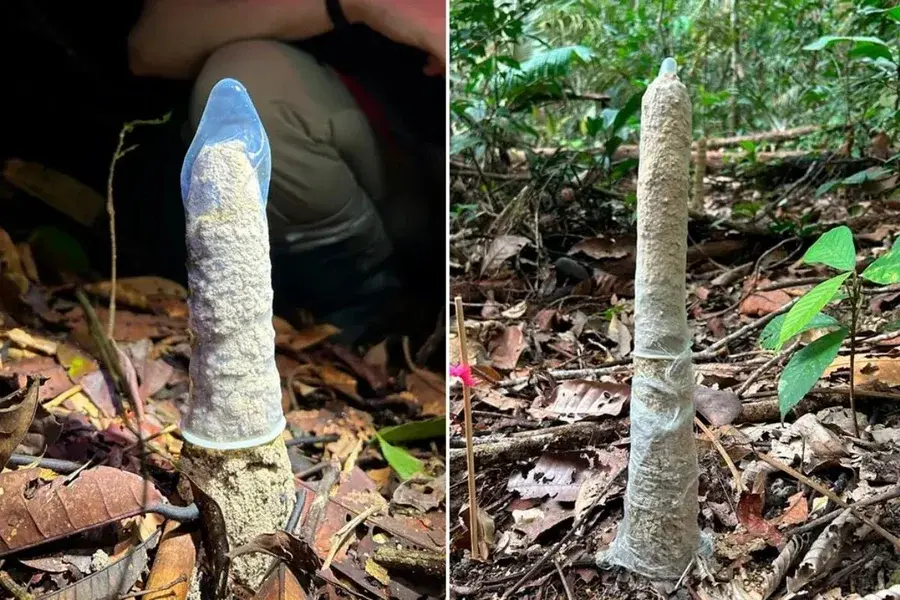
To test this idea, the scientists turned to a material that is unusual in conventional laboratories but extremely efficient for airtight sealing in the field: latex condoms.
The latex experiment and the flow of gas
The choice of condoms as a measuring tool was not random. In a demanding environment like the forest, sealing the clay towers without destroying them required a material that is elastic, resistant and able to show pressure visually. By covering the structures with the condoms and reinforcing the seal with plastic film, the researchers created a closed system that interrupted the natural exchange of air between the inside of the underground gallery and the outside atmosphere. The goal was to observe whether the metabolism of the nymph would generate enough pressure to change the shape of the latex.
The result was an elegant demonstration of biological physics. The condoms began to inflate, driven by gas accumulating from the insect below. This visual evidence confirmed that the towers work as essential vents. Without that ventilation, the concentration of gases at the bottom of the tunnels, which can reach a depth of about one meter (3.3 feet), would make survival impossible.
More than simple mounds of earth, the chimneys are external lungs. They allow the architect cicada to keep up its metabolic rhythm while it prepares for the great final transformation of its life.
Architecture as a strategy of defense and survival
Besides the question of breathing, the research looked at the tactical advantage of the height of these constructions. In the Amazon, the towers of Guyalna chlorogena can reach as much as 47 centimeters (about 18.5 inches). The statistical analysis revealed a direct correlation between the height of the tower and the safety of its inhabitant.
The team placed baits on the ground and on top of the chimneys. The probability of an encounter with ants, which are the most voracious predators of these nymphs, turned out to be eight times lower on the heights.
This finding changes the way the tower is understood, from a simple vent into a true fortress. During metamorphosis, the cicada goes through a phase of extreme vulnerability, staying motionless while it leaves its old exoskeleton behind. Being almost half a meter above the ground gives the insect a vital window of safety, keeping it away from the patrol routes of the ant colonies that dominate the forest surface. The structure acts as an environmental filter that selects which biological interactions are allowed, helping the journey from the soil to the air end in success.
The extended phenotype in Amazonian biology
The deepest conclusion of the study is the reading of these towers as part of the organism itself. In evolutionary biology, the term extended phenotype describes constructions or behaviors of an animal that, although external to its physical body, are direct expressions of its genes and essential to its biological fitness.
Just as the web is to the spider or the dam is to the beaver, the clay tower is a functional extension of the architect cicada. The nymph does not simply live in the tower. It designs it and keeps it up as an accessory organ for breathing and protection.
A life cycle that depends on the tower
The life cycle of this insect reinforces that dependence. For years, the nymph feeds on the sap of roots in the dark depths of the soil. It then devotes months to building and constantly maintaining its chimney, using a precise mixture of clay and liquid excreta.
This huge energy investment is justified by the benefits shown in the Brazilian experiment. At the end of the process, the tower fulfills its final mission and serves as the stage for the emergence of a winged adult.
The work of the Brazilian researchers, by joining the simplicity of a condom with the complexity of tropical ecology, opened a new chapter in the understanding of how life shapes itself and extends beyond the skin, turning the mud itself into a tool of evolutionary success.
Reporting: Revista Amazônia newsroom / Amazonia Mag

Editor · Amazonia Mag
Anne Silva is the editor of Amazonia Mag, the English-language edition of Revista Amazônia. She curates, translates and adapts the outlet's science and environment coverage for an international audience, reporting on Amazon wildlife, flora, rivers, climate and research. Every story she edits is grounded in peer-reviewed studies, official data and on-the-ground reporting from the Revista Amazônia newsroom in Belém, Pará, Brazil. More by Anne Silva →