
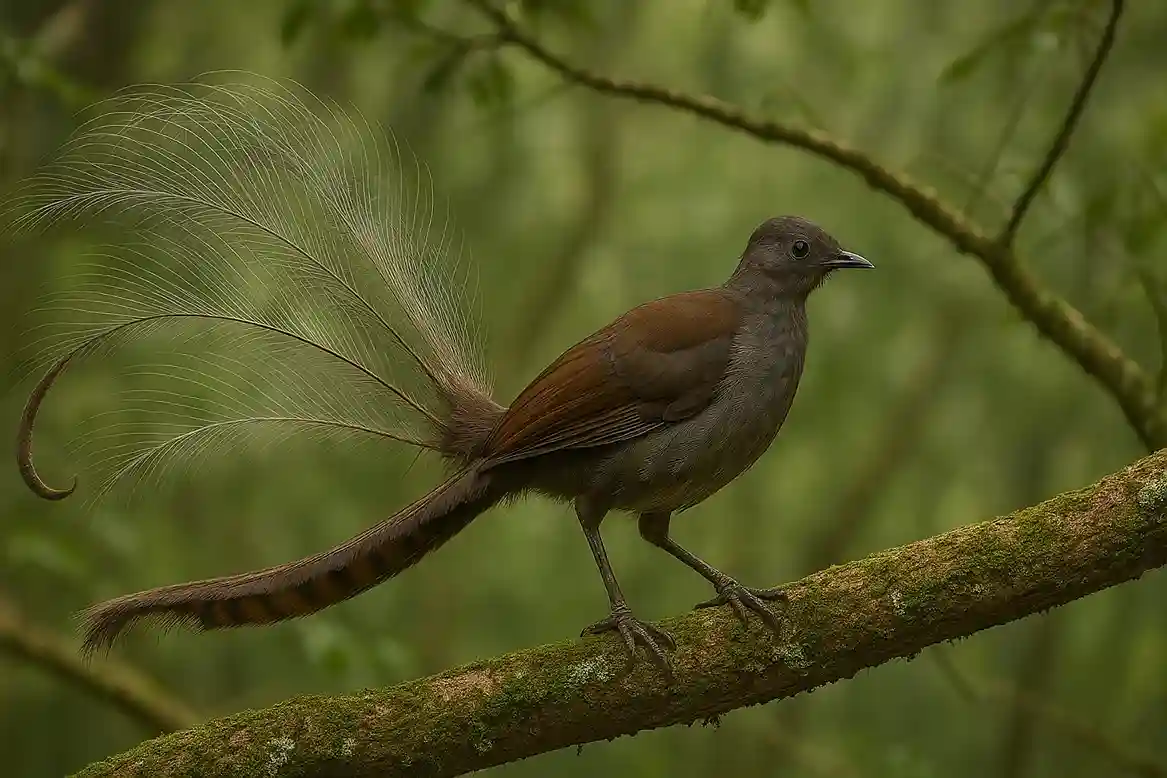
The superb lyrebird (Menura novaehollandiae), native to the forests of Australia, is considered one of the great mimics of the animal kingdom. It can copy with precision the songs of dozens of other birds, and also the sounds of camera shutters, car alarms and chainsaws. In documented cases, it has even reproduced the cry of a human baby.
Males display lyre-shaped tail feathers during complex courtship rituals that biologists use as a reference for sexual selection. Few birds combine such a striking appearance with such a flexible voice, and the combination has made the lyrebird a favorite subject of documentaries and of studies on animal behavior and cognition.
Where the lyrebird lives
The lyrebird is native to Australia and lives mainly in the humid forests of the southeast of the country. Two species are known. The superb lyrebird (Menura novaehollandiae) is the more common one, found in the humid temperate forests of Victoria and New South Wales, and it favors protected areas such as national parks. Albert’s lyrebird (Menura alberti) is rarer and lives only in a restricted area of subtropical rainforest along the border between Queensland and New South Wales.
Both prefer environments with dense vegetation and a forest floor covered with leaves, where they find shelter and food: insects, earthworms and other small arthropods. They live on the ground and have a reserved temperament, which contrasts sharply with their impressive vocal presence. A visitor walking through the forest is far more likely to hear a lyrebird than to see one.
The lyre-shaped tail that gave the bird its name
The name comes from the spectacular shape of the male’s tail, which recalls the lyre, an ancient stringed instrument. During the breeding season, males spread their feathers in an elegant fan while vocalizing intensely to attract females.
The tail can reach 70 centimeters (about 28 inches) in length. It is not just a visual ornament. It also vibrates during the vocal displays, so that movement and sound reinforce each other in a synchronized audiovisual show.
A natural imitation machine
What makes the lyrebird truly unique is its ability to imitate sounds with great fidelity. It can reproduce the songs of other birds, such as kookaburras, crows and parrots. It can also reproduce the electronic alarm of a car, the click of a camera and the roar of a chainsaw.
These imitations are not an instinct that the bird is born with. They are acquired through observation and listening over the course of its life. The lyrebird hears the sounds around it and incorporates them into its repertoire, which it uses to impress females and mark its territory.
The secret lies in the syrinx, the vocal organ of birds, which is extremely well developed and complex in the lyrebird. It allows precise control over the flow of air and over the vibrations of the internal membranes, so the bird can produce sounds with very different timbres and rhythms. The bird also has an acute auditory memory and a high cognitive capacity to recognize and reproduce sounds in realistic detail. The result is imitations that can confuse even human listeners.
An odd consequence follows. A lyrebird that lives near a logging site, a trail with many visitors or a busy parking lot may carry those sounds in its song, so its repertoire reflects the places it has lived in as much as the forest around it.
One of the longest and most varied songs of the animal kingdom
A lyrebird’s song is long, with hundreds of variations and repetitions. It often combines the bird’s own sounds with imitations, creating compositions that work like artistic performances in the animal world.
During the breeding season, males climb onto logs or into open clearings and perform as if they were on a stage. Besides the voice, they use body movements and tail vibrations to give the performance more intensity. Singing is therefore only one part of the display. The whole presentation is built to be seen as well as heard.
Because of that effort, the males’ repertoire is a key part of how they attract females and defend their territory. That is why researchers who study sexual selection pay so much attention to this bird.
From documentaries to the laboratory
The lyrebird has appeared in many audiovisual productions and is a frequent subject of scientific study. One of the most famous performances was recorded by David Attenborough for a BBC documentary, in which the bird imitated mechanical sounds, including a camera with a film-advance motor.
Scientists continue to investigate how the lyrebird processes sounds and how sexual selection has shaped the development of this very specific talent. It is a clear example of how evolution can create unusual skills in the animal kingdom.
Having a lyrebird in the Australian forest is like having a performing artist in an open-air theater. Its abilities challenge what we know about animal behavior and communication between species. More than a curiosity, it is a symbol of the natural and acoustic richness of the Australian continent.
Protecting its habitat and understanding its complexity are essential steps to make sure that this unique voice of nature keeps echoing through the forest for many generations.
Reporting: Revista Amazônia newsroom / Amazonia Mag

Editor · Amazonia Mag
Anne Silva is the editor of Amazonia Mag, the English-language edition of Revista Amazônia. She curates, translates and adapts the outlet's science and environment coverage for an international audience, reporting on Amazon wildlife, flora, rivers, climate and research. Every story she edits is grounded in peer-reviewed studies, official data and on-the-ground reporting from the Revista Amazônia newsroom in Belém, Pará, Brazil. More by Anne Silva →