
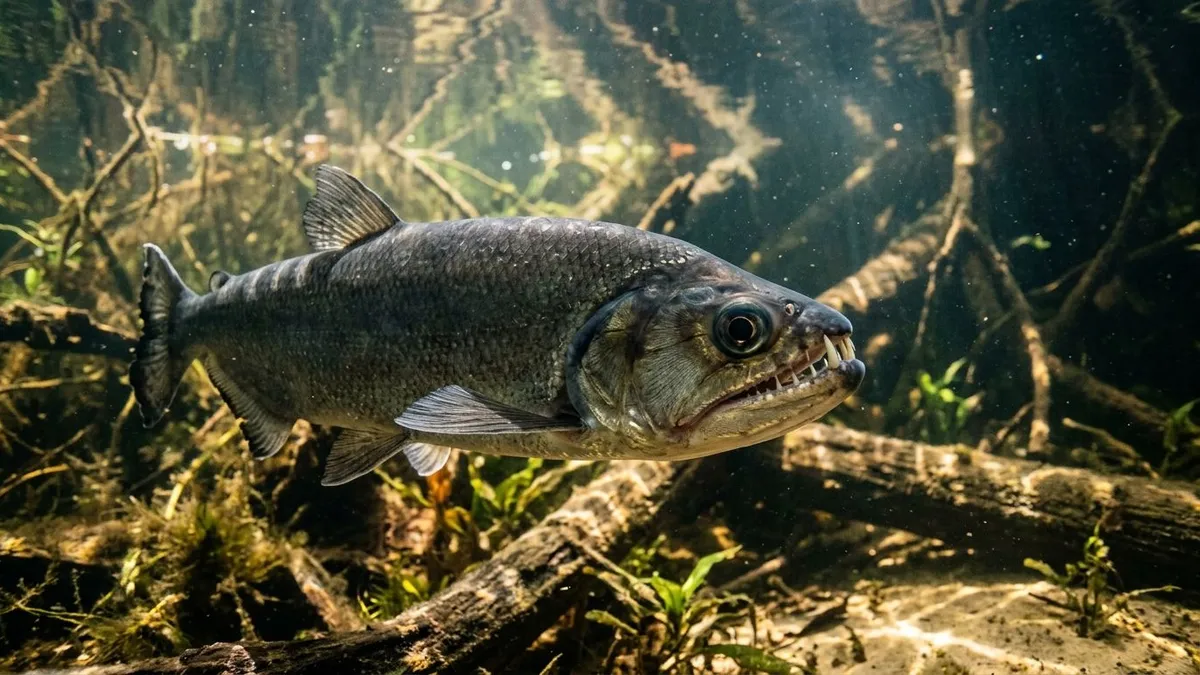
“Peixe-cachorro”, or dog fish, is a popular name given in Brazil to several fanged predatory fishes of South American rivers. One of the best-studied cases is the cachorra-facão, Rhaphiodon vulpinus, a member of the family Cynodontidae, the dogtooth characins. It has an elongated, laterally compressed body, a large oblique mouth and a pair of well-developed canines on the lower jaw. That description comes from the 2000 revision of the subfamily Cynodontinae by the ichthyologist Mônica Toledo-Piza, published in the journal American Museum Novitates of the American Museum of Natural History.
According to that revision, the species occurs in the Amazon basin, from the Ucayali River system in Peru to the Xingu River in Brazil, and also in the Tocantins and Capim river basins. It also occurs in the Paraná basin, where, according to researchers who analyzed the population of the Ilha Solteira reservoir, it originally occupied the lower and middle river and began to appear in upper stretches after the Itaipu reservoir was formed.
Canines that lock into the upper jaw
The most characteristic trait of the group is the way the teeth fit together. According to Toledo-Piza, the canines of the lower jaw slot into matching openings in the upper jaw, which allows the mouth to close completely. One of the front canines of the lower jaw is larger than the others and projects into the upper jaw when the mouth is shut.
In a close relative, the payara (Hydrolycus scomberoides), the description is similar. Professor Don Orth of Virginia Tech writes, in a text for the university’s ichthyology course, that the long, sharp fangs of the lower jaw fit into pockets in the skull, without which the fish could not close its mouth. The same text says these fishes are specialized piscivores, meaning fish-eaters, that use the lower-jaw canines to puncture their prey.
A diet of fish
The dogtooth characins of the family Cynodontidae prey on other fishes. A study published in the journal Biota Neotropica examined the stomach contents of 214 specimens of Rhaphiodon vulpinus in the upper Tocantins River, in Goiás, before, during and after the river was dammed by the Serra da Mesa hydroelectric plant. The authors confirmed that the species is piscivorous, with occasional consumption of insects and plant material. The most frequent prey were Geophagus cf. surinamensis, Hemiodus ternetzi and Pimelodus blochii, depending on the phase of the river, and prey richness was greater in the reservoir.
The study found no correlation between predator size and prey size, but the larger predators ate prey across a wide range of sizes. In other words, a bigger fish did not necessarily eat bigger fish, although it was able to take a broader range.
In the upper Paraná basin, research published in 2019 in the journal Acta Limnologica Brasiliensia, by Orlandi Neto and colleagues, analyzed 51 specimens from the Ilha Solteira reservoir, collected between 2014 and 2016, measuring 9.1 to 18.7 inches (23 to 47.6 centimeters) in standard length. The diet consisted of small fishes, such as Geophagus sveni, and shrimps of the genus Macrobrachium. The authors interpret the abundance of shrimps as a sign of feeding opportunism, and they classify the species as a pursuit predator with a pelagic habit, meaning it hunts in open water rather than on the bottom.
How the group hunts
The shape of the body helps explain the strategy. Orth observes that the large eye, the laterally compressed body and the wide, oblique mouth suggest visual hunters, able to move fast to catch live fish. In the payara, according to the same text, the number of individuals and the biomass increased with water transparency, which reinforces the importance of sight in hunting.
The natural history museum of the Universidad Nacional de Colombia, in material about the payara, describes the two lower-jaw canines as an instrument for hooking and holding the fish on which the species feeds. That description refers to the payara and serves as a reference for the group, not as a measurement made on each species.
Reproduction follows the river’s flood
The reproductive biology of the cachorra-facão was studied in the Tocantins basin by Neuberger and colleagues, in a 2007 article in the journal Neotropical Ichthyology. The reproductive period ran essentially from November to January, with a peak in November. Males were active for longer than females, from September to April, compared with October to March for females. Reproduction is seasonal and synchronized with the rising waters.
According to the same study, sexual maturity is reached at 10.6 inches (27.0 centimeters) in females and 8.5 inches (21.7 centimeters) in males, at the point where half of the individuals are already mature. Average fecundity was about 98,000 oocytes, or immature eggs, per female, ranging from 38,000 to 216,000, and males outnumbered females in a ratio of 1.6 to 1.
The link between breeding and the flood pulse is a recurring theme in the biology of river fishes. In this case, the synchronization with rising water means that the timing of the reproductive season depends on the annual cycle of the river itself.
What the common name hides
The name peixe-cachorro, or cachorra, serves more than one species, and what holds for one does not always apply to another. For the cachorra-facão, the reviewed studies describe a fish predator with a pelagic habit, with canines that lock into the upper jaw and with reproduction during the river flood.
That set of facts, measured in the field and in museums, is what supports the image of the dogtooth characin in the rivers of the Amazon and of other South American basins.
Reporting: Natália Santos / Amazonia Mag

Editor · Amazonia Mag
Anne Silva is the editor of Amazonia Mag, the English-language edition of Revista Amazônia. She curates, translates and adapts the outlet's science and environment coverage for an international audience, reporting on Amazon wildlife, flora, rivers, climate and research. Every story she edits is grounded in peer-reviewed studies, official data and on-the-ground reporting from the Revista Amazônia newsroom in Belém, Pará, Brazil. More by Anne Silva →