In the green immensity of the Amazon forest, there is no shortage of stories that border on the fantastic. One of the most intriguing is about a tree said to be able to move. The plant in question is Socratea exorrhiza, a slender palm known in Brazil as the “tree that walks” and in English as the walking palm.
The nickname is more than a folk label. It reflects a belief that has long drawn the attention of scientists and forest dwellers alike. A plant that changes place on its own sounds like magic, yet there is a lot of biology behind the idea. Here is what is fact, what is myth, and how science explains this puzzle of Amazonian botany.
How to recognize the walking palm
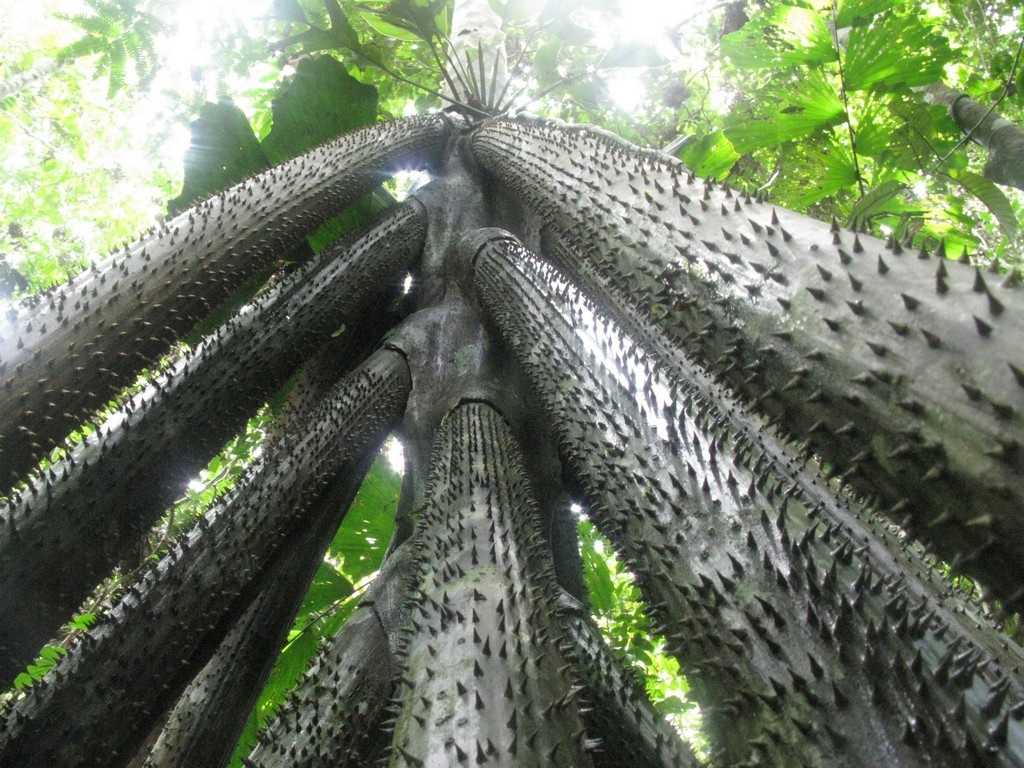
Socratea exorrhiza is a palm typical of the tropical forests of Central and South America, and it is especially abundant in the Amazon. It stands out for its slim, elegant shape, but above all for one unusual anatomical detail: its prop roots, also called adventitious roots.
An adventitious root is one that does not start from the main root system of the plant. In this palm, the roots emerge from the trunk itself, above the soil, and reach down until they touch the ground. Each one works like a brace that holds the tall, thin stem upright.
Together these roots rise above the ground and form a structure that looks like a tripod or the legs of a spider. Instead of growing straight out of an underground stem, they spread sideways from the trunk. The palm seems to stand on tiptoe over the forest floor, and that is what gives the impression that it is slowly walking through the forest.
Where the myth comes from
The belief that the walking palm really walks comes from an observation: over time, its roots appear to shift toward more stable ground or toward places with better light.
According to local residents and forest guides, the palm can “walk” as much as 2 or 3 centimeters (about 1 inch) per day. Over the months, it would change position to escape the shade of neighboring trees or unstable soil. The story is easy to picture. If new roots appear on the side facing the light while the old ones on the opposite side die away, the trunk seems to have traveled a short distance.
The idea also reached the scientific literature. In 1980, the anthropologists John H. Bodley and Foley C. Benson described stilt-root walking in this palm, and the story has circulated ever since. But does it really happen?
What science says about the walking palm
From a botanical point of view, there is no consensus that this palm performs true locomotion. What happens is a process of root replacement. When the soil under the palm becomes unstable or the light dims, it can develop new roots in another direction and abandon the old ones.
This replacement gives the impression that the palm moves. In fact, it is only relocating its base to stay upright and alive in an environment that is always changing. The behavior is a sophisticated adaptation, but it is not the same as walking, which requires muscles and a nervous system.
The unusual structure of these roots has been described by researchers since the 1980s. More recently, the biologist Gerardo Avalos, from Costa Rica, studied the myth in greater depth. He carried out detailed fieldwork and published his results in 2005. His conclusion was that the idea of a palm that walks is a myth. Even with careful observation over years, he found no evidence that the plant is displaced in the way popular accounts suggest.
Even so, scientists recognize that the directional growth of the roots is an unusual survival strategy among palms. This capacity to adapt can be mistaken for movement, especially when it is observed over long periods. A person who visits the same spot years apart may see roots in new places and conclude that the trunk has traveled, when what changed was the arrangement of its supports.
Why did this palm evolve this way?
The Amazon forest is a dynamic environment. Trees fall, clearings open, and the soil floods, dries out or shifts with ease. In that setting, having raised roots that can “change sides” gives Socratea exorrhiza an evolutionary advantage.
Think of the problem from the palm’s point of view. A tall, narrow trunk with a small base is vulnerable. A patch of ground that softens, or a clearing that suddenly changes how much light reaches the crown, can threaten it. Prop roots spread the support over a wider area, and the ability to grow new ones on the favorable side while letting others go is a way of correcting course without moving the whole plant.
This form reduces competition for light, increases stability on unstable soils and allows a certain structural mobility. In other words, the tree does not walk the way animals do, but it has its own strategy of adaptive permanence.
The palm is also useful to the community around it. It is considered a fast-growing palm. Its wood is used in rustic construction and in crafts. The prop roots serve as shelter for small animals of the forest, and its fruit is eaten by birds and mammals of the Amazon.
The legend walks beside science
Although there is no scientific proof that this tree walks in the literal sense, the way it grows and adapts to its surroundings is remarkable enough to explain the myth. Like many forest stories, the truth about the walking palm lies somewhere between the real and the imaginary.
Perhaps that is exactly what makes it special. The Amazonian palm Socratea shows that even a tree can seem like an explorer, as long as we look at it with curiosity and attention.
Reporting: Revista Amazônia newsroom / Amazonia Mag

Editor · Amazonia Mag
Anne Silva is the editor of Amazonia Mag, the English-language edition of Revista Amazônia. She curates, translates and adapts the outlet's science and environment coverage for an international audience, reporting on Amazon wildlife, flora, rivers, climate and research. Every story she edits is grounded in peer-reviewed studies, official data and on-the-ground reporting from the Revista Amazônia newsroom in Belém, Pará, Brazil. More by Anne Silva →