
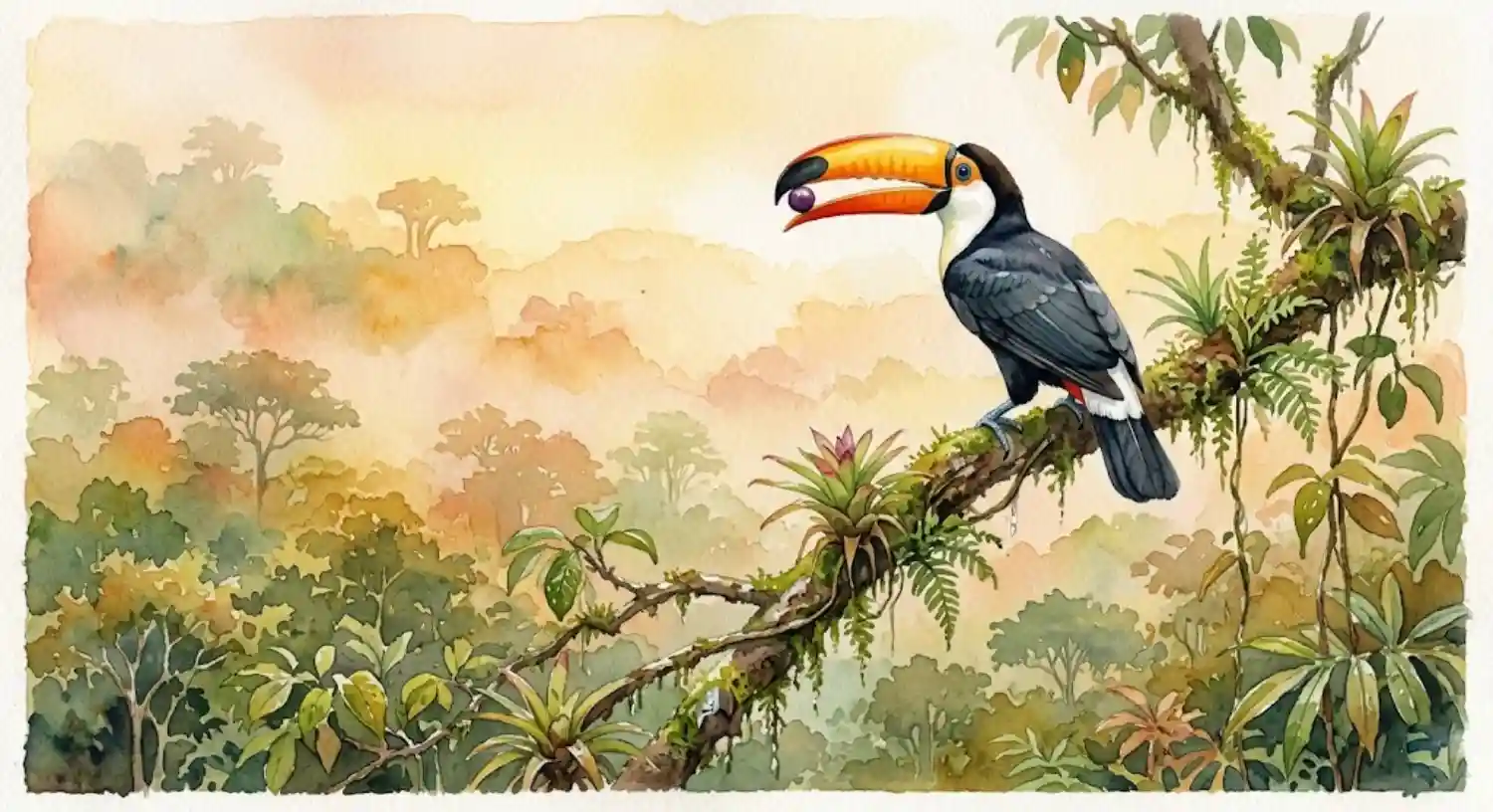
High above the Amazon forest, the toco toucan performs a task that can remain unnoticed even when it takes place directly overhead. By eating fruit and moving between different parts of the forest, the bird carries seeds and helps new palms and other plants find places where they can grow.
The process begins with a surprising feature of the toucan’s digestive system. While many birds and mammals break up or digest the seeds they consume, the toco toucan can expel the pit intact, ready to sprout after the fruit pulp has been processed. This biological fact drives one of the canopy’s most important mutualistic relationships: the bird gains food, while the plant moves its genetic material to distant areas.
That is why the toco toucan can be understood as an invisible gardener. It does not plant with conscious intent, but every fruit it eats and every flight that follows may increase the chance that a seed will become a new tree.
A bill built for the canopy
The toucan’s anatomy is adapted to the challenges of the upper forest. Its large, colorful bill may look heavy, but it is surprisingly light because it is made of spongy keratin. This combination allows the bird to reach and collect large fruits from thin branches where heavier animals cannot go.
The bill is not only associated with thermoregulation or sexual selection. It is also a precision tool for gathering large fruits and seeds in the Amazon canopy. In that setting, the toucan can reach botanical resources that are difficult to access and occupies a prominent position among the forest’s seed dispersers.
The vivid colors of its plumage and bill are connected to social signaling. They can also provide a surprising form of camouflage against the filtered light beneath the canopy, where shifting brightness and shadow continually change the forest’s appearance.
The toco toucan’s diet is predominantly frugivorous. Its careful selection of the ripest fruits means that seeds with the strongest germination potential are among those transported to other parts of the forest.
Two routes for the same seed
Seed dispersal mainly takes place in two ways. Larger seeds that cannot pass through the intestinal tract may be regurgitated by the bird. Smaller seeds may leave through defecation after passing through the digestive system without losing their ability to germinate.
In both cases, the seed is deposited away from the parent plant. The destination may often be a clearing or a regenerating area, where greater access to light offers favorable conditions for the growth of a new plant.
Distance matters for young seedlings. When they germinate beneath the parent plant, their survival is significantly lower because competition for resources is stronger and the pressure from pathogens and seed predators is greater.
The absence of dispersers able to carry large fruits can seriously affect the regeneration of certain Amazonian palms. The toco toucan is one of the few species capable of swallowing and dispersing some seeds whole, including seeds of considerable size.
Palms that rely on animal transport
Palms that produce fruits with large pits, such as açaí, bacaba and inajá, need large animals to carry their seeds. According to the studies cited in relation to this process, the toco toucan performs a role that is difficult to replace.
Its work is not measured only by the number of seeds moved. The quality of the transport also matters. Toucans fly long distances between feeding grounds and resting sites, linking forest fragments and promoting gene flow between plant populations that have become isolated.
This movement supports the genetic health of plant species and strengthens the forest’s resilience to environmental changes. Each seed carried to another location can extend a plant’s distribution and help build the forest’s future structure.
The family Ramphastidae has a complex presence in the Amazon. Several species of toucans and aracaris contribute to seed dispersal, although the toco toucan stands out for its broad distribution and its ability to handle seeds of considerable dimensions.
A sign of forest health
The presence of the toco toucan can be a positive indicator of ecosystem health. Maintaining healthy populations of top predators and dispersers reflects the integrity of the food web and the availability of resources throughout the forest.
Protecting these birds therefore also means protecting Amazonian biodiversity. Without the service they provide, the landscape could change dramatically, because some plants would lose one of their main ways to move seeds away from the parent plant.
The ecological role of Ramphastos toco extends beyond planting. The species helps create a living network that connects different parts of the ecosystem. Its flights between feeding areas and resting sites link forest fragments and make genetic exchange possible among separated plant populations.
The image of the toucan as an invisible gardener helps reveal interactions that usually remain out of sight. Whenever the bird eats a fruit and flies to another area, it may be helping a new tree emerge and gradually shaping the future composition of the forest.
The future of palms depends on the network
This constant activity, carried out without a conscious intention to plant, shows how ecological processes work when biodiversity is maintained. The forest is not a static collection of trees, but a living and dynamic system driven by interactions that have developed over thousands of years.
Ensuring that the toco toucan can continue flying freely through the canopy means protecting a natural mechanism of renewal. Through that movement, palms can find new spaces and continue rising toward the sunlight in the world’s largest tropical rainforest.
Recognizing the importance of this invisible gardener also means understanding that conserving the Amazon is not only about protecting individual trees. It means keeping alive the complex web of relationships that allows each seed to find a place in the forest’s future.
Reporting: Anne Silva / Amazonia Mag

Editor, English Edition — Amazonia Mag
Anne Silva is the editor of Amazonia Mag, the English-language edition of Revista Amazônia. She curates, translates and adapts the outlet's science and environment coverage for an international audience, reporting on Amazon wildlife, flora, rivers, climate and research. Every story she edits is grounded in peer-reviewed studies, official data and on-the-ground reporting from the Revista Amazônia newsroom in Belém, Pará, Brazil. More by Anne Silva →