
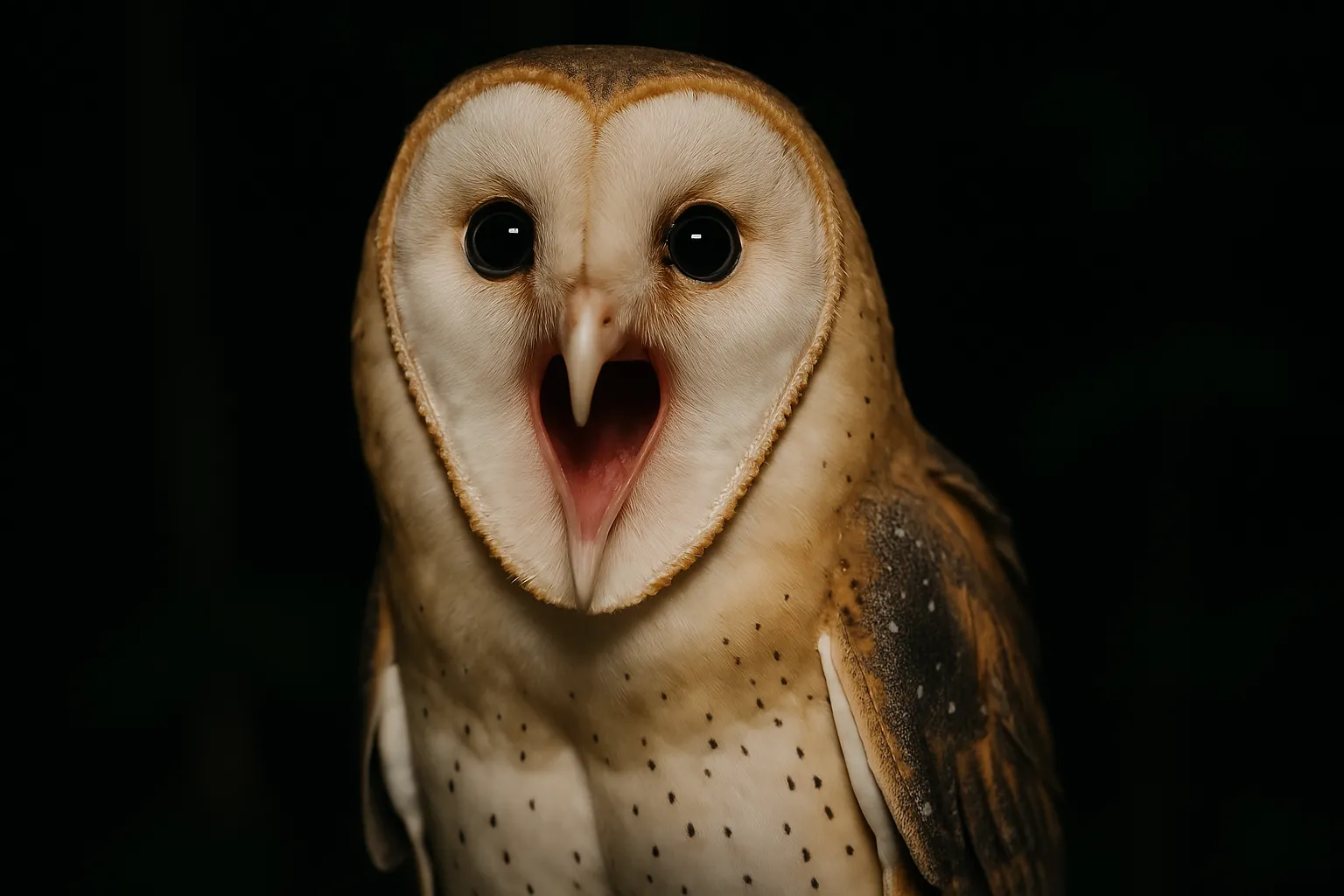
Some sounds of nature are so strange that they give people goosebumps, and one of the most unsettling comes from the barn owl, known in Brazil as the suindara. Its cry is high, harsh and drawn out, and it resembles, in a frightening way, a baby crying in the middle of the night. For anyone who has never heard it before, the impression can be deeply disturbing. It is no accident that this bird stars in legends, myths and even horror stories in many regions of Brazil.
A bird with an unforgettable look
The bird is also called the coruja-das-torres, the “tower owl”, and in Brazil it is classified as Tyto furcata. Its appearance is unlike that of other owls: dark, deep eyes, pale plumage that forms a heart shape around the face, and nocturnal habits that add to its air of mystery.
Barn owls as a group are among the most widely distributed birds in the world, present on nearly every continent except Antarctica. The form that lives in the Americas is Tyto furcata, the one found across Brazil.
During the day the owl tends to hide in dark places such as attics, church towers and tree hollows. At night it comes into action, both to hunt and to call out. That is the moment when its cry can cause fright and confusion among people who happen to be nearby.
Why the sound is so frightening
What the barn owl produces is not exactly a song. Unlike owls that give a soft hoot, or other birds with melodic voices, it lets out a rasping, continuous and very high-pitched scream. It is a territorial call, used mainly to mark its presence or to alert other owls of its own species.
Heard in total silence, the sound seems to come from a crying child. That is what makes it so effective at startling people, especially in rural areas or places with poor lighting, where there is little else to explain a voice in the dark. Human ears are tuned to react to the cry of a baby, so a sound that imitates it, coming out of the night with no visible source, is hard to ignore.
Sound also behaves differently from sight. Many animals are harmless when seen from a distance, but in the dark a listener cannot tell how far away the bird is, how large it is or what it is doing. That uncertainty, more than the sound itself, is what feeds the stories people tell about it.
In small inland towns and in forested zones, the cry has long been tied to omens and supernatural events. Many people believe that hearing the barn owl means death is near or that bad news is on the way, which reinforces the bird’s reputation as a messenger from the beyond. A natural call, produced by an animal going about its business, becomes a story about fate.
The ecological value of the barn owl
Despite its gloomy air and frightening cry, the barn owl is a great ally of environmental balance. It feeds mainly on small rodents such as rats and mice, which helps control infestations in both urban and rural areas. A single owl can capture dozens of rodents per week.
For this reason the barn owl is considered an essential species for the biological control of pests. Many farmers value its presence precisely because it helps avoid the excessive use of poison. Every rodent taken by an owl is one less that needs to be dealt with by chemical means, and that benefits soil, water and the other animals that share the farm.
Controlling rodents with owls works quietly: it costs the farmer nothing and leaves no chemical trace behind. A barn roof or an old tower that shelters an owl is, in practice, a free service station for pest control.
The contrast is striking. The same bird that people fear because of its voice is quietly doing a service that would otherwise cost money and carry risks for health and the environment.
Protection and coexistence
Unfortunately, because of superstition, the barn owl is still a target of mistreatment and persecution. Some people try to scare these birds away or even kill them out of fear or ignorance. Yet owls are protected by environmental laws and are part of the biodiversity that must be respected and preserved.
Killing a barn owl because of its cry is also a poor trade. The person who removes the bird loses a natural pest controller, and the rodents it kept in check are free to multiply.
The best approach is to learn to live with these birds and to understand that the frightening sound they make is, in fact, part of their natural communication. It is a bird announcing where it lives and speaking to others of its kind.
Environmental education can change the story. When people learn that the cry is communication and that the bird feeds on rodents, fear gives way to curiosity, and a bird once chased away becomes one that the neighbors are glad to have around.
Hearing a barn owl can be a rare privilege, and an opportunity to connect with the mysteries of nocturnal life. The next time a thin, rasping scream cuts through the dark, it is worth remembering that no baby is crying. An owl is simply at work, protecting its territory and, without anyone asking, protecting the harvest as well.
Reporting: Revista Amazônia newsroom / Amazonia Mag

Editor · Amazonia Mag
Anne Silva is the editor of Amazonia Mag, the English-language edition of Revista Amazônia. She curates, translates and adapts the outlet's science and environment coverage for an international audience, reporting on Amazon wildlife, flora, rivers, climate and research. Every story she edits is grounded in peer-reviewed studies, official data and on-the-ground reporting from the Revista Amazônia newsroom in Belém, Pará, Brazil. More by Anne Silva →