
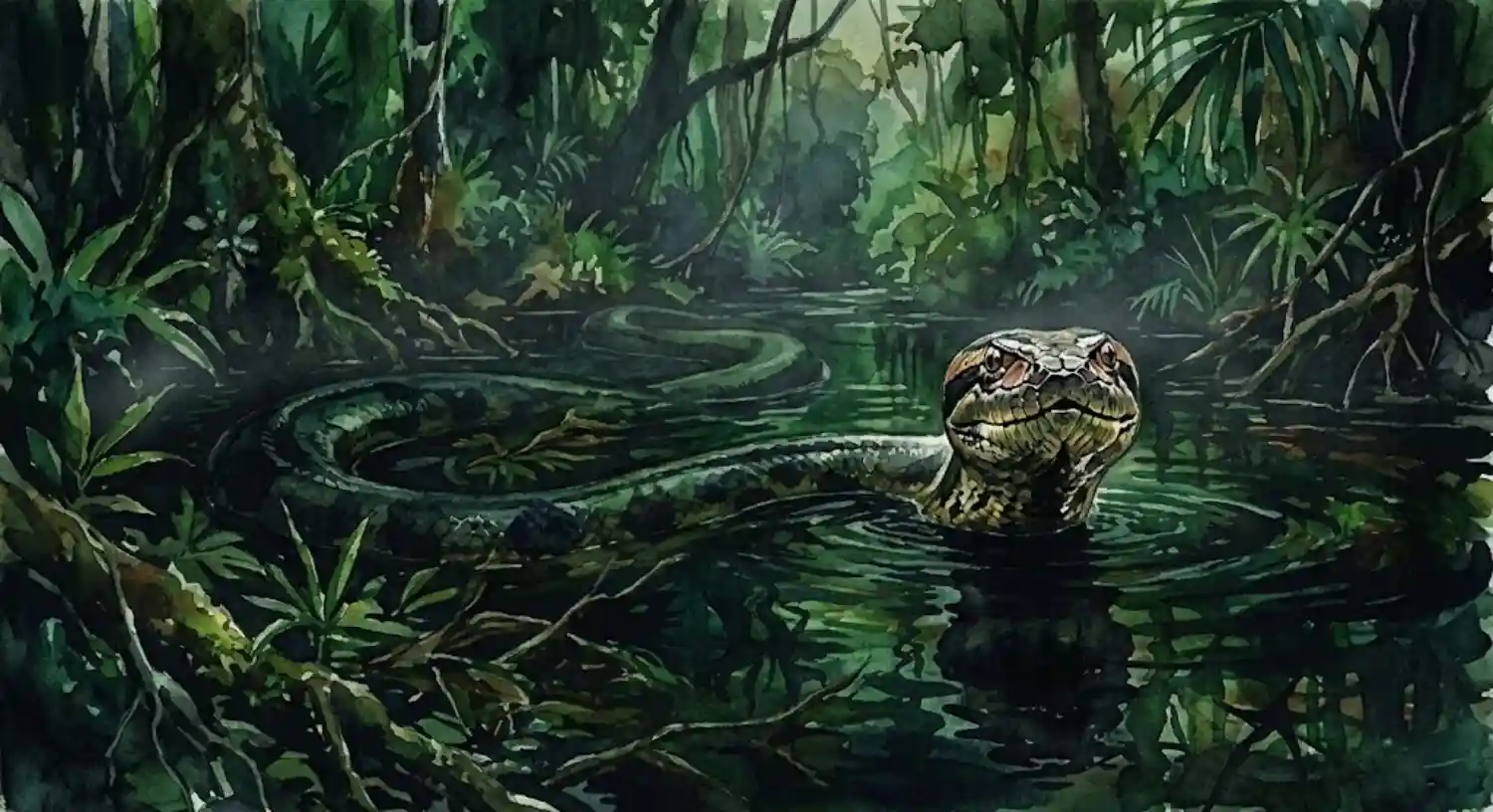
The green anaconda has a unique physiology that allows it to survive for long periods without food. Science recognizes that this South American giant can often go for months without taking in a single calorie, a capacity that is not a sign of suffering or desperate scarcity.
Instead, it is an evolutionary adaptation that allows the snake to thrive in an environment where large prey are sporadic but highly valuable. The biology of Eunectes murinus is a demonstration of energy efficiency taken to an extreme, with every movement calculated and patience serving as one of its most refined survival tools.
A metabolism built for conservation
The green anaconda’s ability to fast for long periods is closely tied to its exceptionally slow metabolism. Unlike mammals, which constantly burn energy to maintain body temperature, snakes are ectothermic and depend on external heat sources.
That trait allows the green anaconda’s metabolism to operate at a very low baseline. When the snake is not digesting prey, its energy requirements fall sharply, helping explain how the animal can preserve the energy gained from a previous meal for weeks or months.
According to the studies referred to in accounts of its physiology, the snake’s metabolism can rise dramatically after a large meal as the body processes the food. Once digestion is complete, it returns to a state of extreme energy conservation. This metabolic shift is a vital strategy for managing resources in a complex ecosystem.
The anaconda does not need to maintain a constant energy expenditure or search continuously for food. Its body moves between a period of intense internal activity, when a large prey item is being digested, and another period of minimal consumption. Energy from a single large meal can be carefully distributed to support essential functions while the snake remains almost motionless.
How an ambush turns water into a trap
The green anaconda’s hunting strategy in water is essential to this low-consumption way of life. Motionless and camouflaged among riverside vegetation or on the bottom of small streams, the snake turns its own body into a living trap.
It does not actively chase prey. Instead of spending energy on a prolonged search, it waits with extraordinary patience for an unsuspecting animal to approach the bank to drink. The prey mentioned in descriptions of this strategy include capybaras and caimans, animals that may come close to the water without detecting the snake.
This ambush tactic minimizes energy expenditure and prevents the energy stored from earlier meals from being wasted on unsuccessful hunts. Waiting, stillness and camouflage are parts of the same strategy, a form of hunting in which opportunity matters more than speed.
Across the Amazon’s extensive waterways, the anaconda can remain in place until the right moment arrives. Its apparent stillness is not laziness or weakness. It is behavior suited to a body that conserves energy and to an environment where large prey are valuable, although not necessarily common.
A digestive system that changes the body
The anaconda’s digestive physiology is also adapted to a cycle of abundance and scarcity, often described as “feast and famine.” When the snake swallows a large prey item, its digestive system undergoes remarkable changes to deal with the metabolic demand of processing the meal.
Organs such as the heart, liver and kidneys can temporarily increase in size during this process. The change allows the body to respond to the demands of a substantial meal and process nutrients that will be used during the long period of inactivity that follows.
After the food has been processed and the nutrients absorbed, those organs return to their normal size. This later reduction saves valuable energy and accompanies the snake’s return to a state of very low activity.
This organic flexibility is one of the features that makes the green anaconda so distinctive. Its body does not maintain the same internal demand at all times. Instead, it adjusts its functions according to food availability, making intense digestion and prolonged rest parts of one survival system.
Patience also supports the Amazon ecosystem
The life of a green anaconda is a constant exercise in energy balance. The animal spends much of its time in complete rest, digesting a meal or waiting for another opportunity. This behavior is not laziness, but careful management of available resources.
Every successful attack provides a massive input of energy that can secure survival for a long period. The ability to go for months without eating reflects the efficiency of this strategy and allows the snake to persist even when large prey become scarce for extended periods.
In an environment as dynamic and competitive as the Amazon, the green anaconda shows that brute strength is not the only way to dominate an ecological space. Patience, efficiency and physiological adaptation are equally powerful tools for long-term survival.
Understanding these mechanisms offers a new perspective on the complexity of wildlife and the beauty of evolutionary solutions. The green anaconda can remain nearly motionless in the water, conserve energy and still maintain the vital functions needed to wait for its next opportunity.
Conserving the green anaconda and its habitat is crucial not only for protecting this fascinating species, but also for the health of the entire Amazon ecosystem. As a top predator, it plays a fundamental role in regulating the populations of other species and helping maintain the natural balance.
The existence of the anaconda, with its remarkable biology and unique life strategy, is a reminder of the complexity and interdependence of life in the forest. Even the creatures people fear most have a vital role within the environment that supports them.
Watching the anaconda’s silent persistence across the forest’s green vastness invites us to reconsider how we understand efficiency and survival in the natural world. In the dark waters of the Amazon, its slow metabolism and patience show how a seemingly simple strategy can sustain one of the continent’s great vertebrates.
The green anaconda demonstrates energy efficiency that is nearly unmatched among large vertebrates. Its extremely low basal metabolism allows the energy gained from a single large meal to be carefully distributed over weeks or months, supporting essential vital functions while the snake remains practically motionless in the water, waiting for its next opportunity.
Reporting: Anne Silva / Amazonia Mag

Editor, English Edition — Amazonia Mag
Anne Silva is the editor of Amazonia Mag, the English-language edition of Revista Amazônia. She curates, translates and adapts the outlet's science and environment coverage for an international audience, reporting on Amazon wildlife, flora, rivers, climate and research. Every story she edits is grounded in peer-reviewed studies, official data and on-the-ground reporting from the Revista Amazônia newsroom in Belém, Pará, Brazil. More by Anne Silva →