
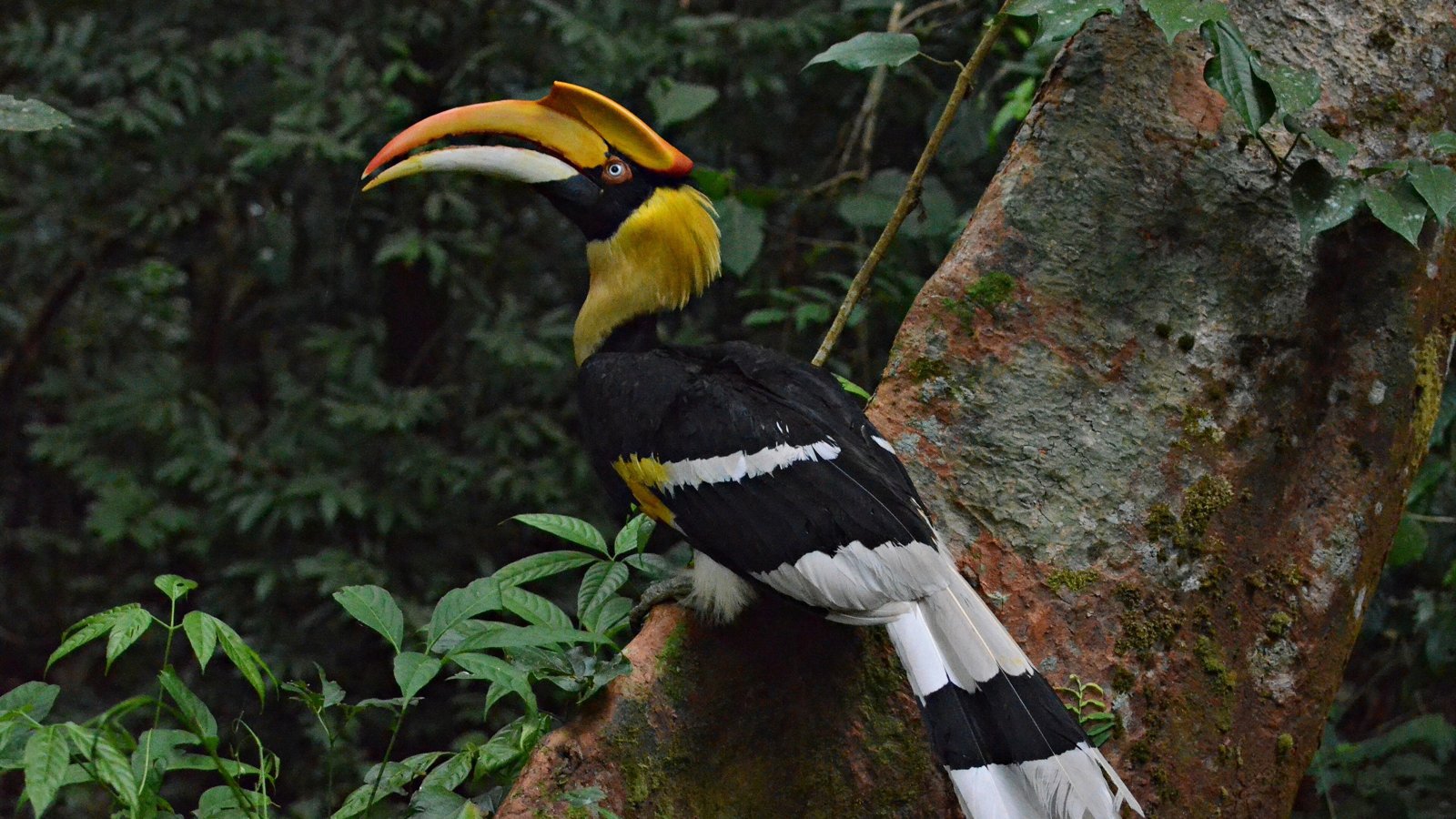
Every start of the year, in the forests of northeast India, a female great hornbill enters the hollow of a tall tree and begins closing the entrance from inside. The plaster is made of her own droppings. She leaves only a narrow slit and, for the next three or four months, depends on the male, who brings food and hands it to her through the opening.
A study spanning nearly two decades shows that this ritual has held firm. While many birds in Europe and North America have started laying eggs a few days earlier each decade because of warming, female great hornbills have not moved forward the average date on which they shut themselves into the nest.
Almost 20 years watching nests
The data come from researcher Aparajita Datta and colleagues at the Nature Conservation Foundation, who have monitored nest trees in Pakke Tiger Reserve, in the state of Arunachal Pradesh, since 1998. The work is still a preprint, which means it has not yet been reviewed by other scientists for publication in a journal.
The team marked hollows that looked like nests and checked them every year, occupied or not. It followed 65 nests of three hornbill species. Between February and August, observers checked each nest every two or three days: a sealed entrance, a male carrying food or sounds coming from inside the trunk meant the nest was in use. The standardized routine began in 2007, and the analysis uses 18 seasons, from 2007 to 2024.
This kind of follow-up is rare. To know whether a species is changing its calendar, the same observation has to be repeated year after year, with the same method, for a long time. Only then can a passing variation be told apart from a real trend.
The date did not change
On average, the female great hornbill shut herself into the nest around March 17. The earliest entered on February 17 and the latest on April 18. Across the 18 seasons, that average did not move, and neither did the share of hollows occupied or of nests that raised at least one chick.
What does vary is the year-to-year picture. After warmer late Januaries and Februaries, the birds tended to nest earlier, by about ten days for each degree Celsius (1.8°F) of extra warmth. The evidence for the great hornbill, however, is weak, since it rests on eight years of records. El Niño and La Niña years made no difference. For now, the yearly adjustment appears to be enough, because nest success did not fall.
In other words, the birds respond to the climate of each season, but that response has not turned into a lasting shift of the calendar. That reproductive success has stayed steady is the most reassuring sign, although the authors do not present it as a guarantee for the future.
Droppings plaster and fig seeds
Old natural history books disagreed about the plaster material. Several spoke of mud, and some said the male helped by bringing clay. Biologists Ragupathy Kannan and Douglas James watched a great hornbill nest for 183 hours over two years in southern India and never saw a bird carry mud. The female used only her own droppings, and after she left, the chick resealed the entrance with its own.
Pieces of the plaster were analyzed at a University of Arkansas laboratory: the chemical makeup matched that of animal excrement, not tropical soil. The result was published in 2007 in the Wilson Journal of Ornithology. Datta had already seen the same in eight nests during her doctoral work. The droppings were made mostly of fig seeds, which, according to Kannan and James, hold the plaster together the way gravel does in concrete.
The image of a chamber sealed with such an unexpected material looks strange at first. But the design has a logic: a closed hollow with a single slit keeps eggs and chicks out of the reach of predators while the female stays inside.
It looks like a toucan, but it is not a relative
The great hornbill (Buceros bicornis) is the largest of the three hornbill species in Pakke. It measures 47 to 59 inches (120 to 150 centimeters) and weighs up to 8.6 pounds (3.9 kilograms). It eats mainly fruit and is studied as a seed disperser. The IUCN classifies it as Vulnerable, with habitat loss and hunting among the threats.
For readers in the Americas, the huge bill recalls that of the toucan. The resemblance is a classic case of convergence: hornbills, from Asia and Africa, and toucans, from the Americas, are not close relatives, but they developed large bills and similar habits, such as eating fruit and nesting in tree hollows.
That likeness helps explain why the study of an Asian species matters on the other side of the world too. Large fruit-eating birds that nest in cavities depend on old trees and on forests with fruit available at the right time of year, a condition that repeats in the Amazon rainforest and in the forests of Asia.
Frequently asked questions
Why does the female hornbill seal herself in the nest? To protect eggs and chicks from predators. With the entrance almost closed, only the slit through which the male delivers food stays open.
Are hornbills and toucans in the same family? No. They are different groups that came to look alike through convergent evolution.
Reporting: Revista Amazônia newsroom / Amazonia Mag

Editor · Amazonia Mag
Anne Silva is the editor of Amazonia Mag, the English-language edition of Revista Amazônia. She curates, translates and adapts the outlet's science and environment coverage for an international audience, reporting on Amazon wildlife, flora, rivers, climate and research. Every story she edits is grounded in peer-reviewed studies, official data and on-the-ground reporting from the Revista Amazônia newsroom in Belém, Pará, Brazil. More by Anne Silva →