
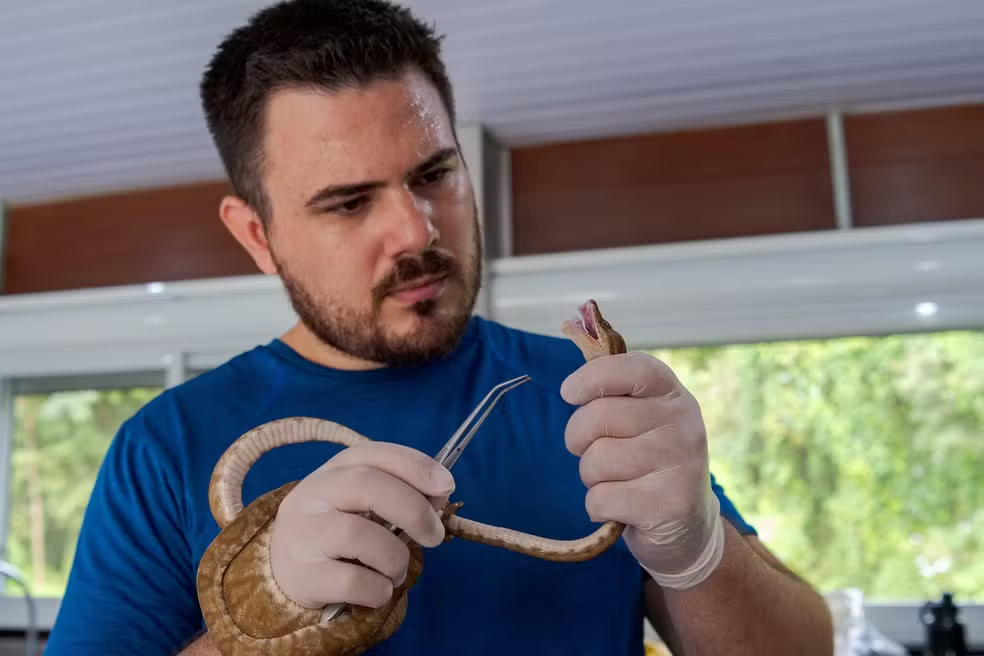
The story of the colonization of the Caribbean usually brings to mind caravels and bold navigators crossing the Atlantic in search of unknown lands. Long before any human vessel touched the ocean, however, nature already had its own transport system. An international study, led by Brazilian researchers, proposes that the suaçuboia, or garden tree boa (Corallus hortulana), a snake typical of the Amazonian treetops, may have made a journey worthy of fiction, helped by what science calls natural rafts.
Biological rafts and the suaçuboia’s journey
Natural rafts are pieces of vegetation and logs torn from riverbanks during severe storms. Events like this are not rare on large river systems: water erodes the banks, topples trees and sweeps masses of plants downstream. If an animal is caught in them, it travels without meaning to.
According to the authors of the work, published in the Zoological Journal of the Linnean Society, the snake would have used this mechanism to cross the barrier of salt water and reach Caribbean islands. This is a hypothesis the researchers put forward from their data, not a direct observation: nobody saw the snakes cross the sea. What the study does offer is a picture consistent with the geography of the islands and with the genetic kinship of the populations.
The process is known as passive dispersal. It happens when animals are held in plant debris that the strong currents of Amazonian rivers carry out to sea. The study changes how we think about the mobility of tree-dwelling species, which seem tied to the trees but may travel much farther than assumed.
It is worth being clear about what a finding like this can and cannot show. Genetic data reveal who is related to whom and, roughly, when lineages separated; they cannot show how a particular individual crossed the water. That is why the journey on rafts is presented as a route consistent with the evidence, not as a proven fact, and more research would be needed to test it.
Genetics as a compass to the evolutionary past
To reconstruct that path, scientists from the National Institute for Amazonian Research (INPA) and the Museu Paraense Emílio Goeldi combined complex genetic data with fossil records. The research sought to understand not just the route but the moment when these populations diversified. Fossils serve here as reference points in time: they let researchers calibrate the genetic clock and estimate when the different lineages split.
Unlike other islands that were once joined to the mainland by land bridges, the islands of the Lesser Antilles have volcanic origins and were never connected to the continent. That means any land life found there had to arrive by alternative routes, such as wind or ocean currents.
The phylogeographic analysis, which combines genetic kinship with geographic distribution, indicated that the suaçuboia has an ancestry closely tied to the heart of the rainforest. By mapping genetic variants between populations in South America and on the islands, the work reinforces the idea that the Amazon works as a great center from which biodiversity spreads to other regions. That dynamic helps explain how changes in the landscape and in regional hydrography influenced the evolution of the continent’s snakes.
Rivers as corridors
The traditional view holds that large rivers act only as geographic barriers that isolate species on their banks. This study adds a new layer to that interpretation. For the suaçuboia, the river channel could act as an expansion corridor. Rivers remain a partial barrier, but they may also be a route.
The joint work between institutions such as the Butantan Institute, the University of São Paulo and the University of Brasília, along with the University of Oklahoma and the University of Puerto Rico, reinforces the idea that the connection between forest and ocean matters for keeping genes flowing between populations. When a tree-dwelling species uses the aquatic environment to widen its range, it shows an ecological plasticity that challenges rigid classifications in biology.
The role of ocean currents in the distribution of life is a field that joins oceanography and zoology. Colonization events like this one, even if they look accidental, can recur across geological time: a single success is enough to found a new population on an island.
What it means for conservation
Knowing that a harmless tree snake may have crossed the Atlantic invites us to rethink the fragility and the strength of nature. The suaçuboia is not venomous, so learning its story also helps us look at it differently.
The species’ success in new environments offers clues about how animals may react to climate changes that alter rainfall patterns and river flow. If the great rivers of the Amazon are the arteries through which life projects beyond continental borders, any degradation of those systems interrupts a long-running evolutionary process. Preserving river ecosystems means preserving the mechanism that lets life colonize new territory.
The story of the suaçuboia is a reminder that the forest is not a static system. Its inhabitants constantly test the limits of space and time, and what looks today like a calm snake on Amazonian branches carries in its genetics the trace of a journey that changed the map of its species.
Reporting: Revista Amazônia newsroom / Amazonia Mag

Editor · Amazonia Mag
Anne Silva is the editor of Amazonia Mag, the English-language edition of Revista Amazônia. She curates, translates and adapts the outlet's science and environment coverage for an international audience, reporting on Amazon wildlife, flora, rivers, climate and research. Every story she edits is grounded in peer-reviewed studies, official data and on-the-ground reporting from the Revista Amazônia newsroom in Belém, Pará, Brazil. More by Anne Silva →