
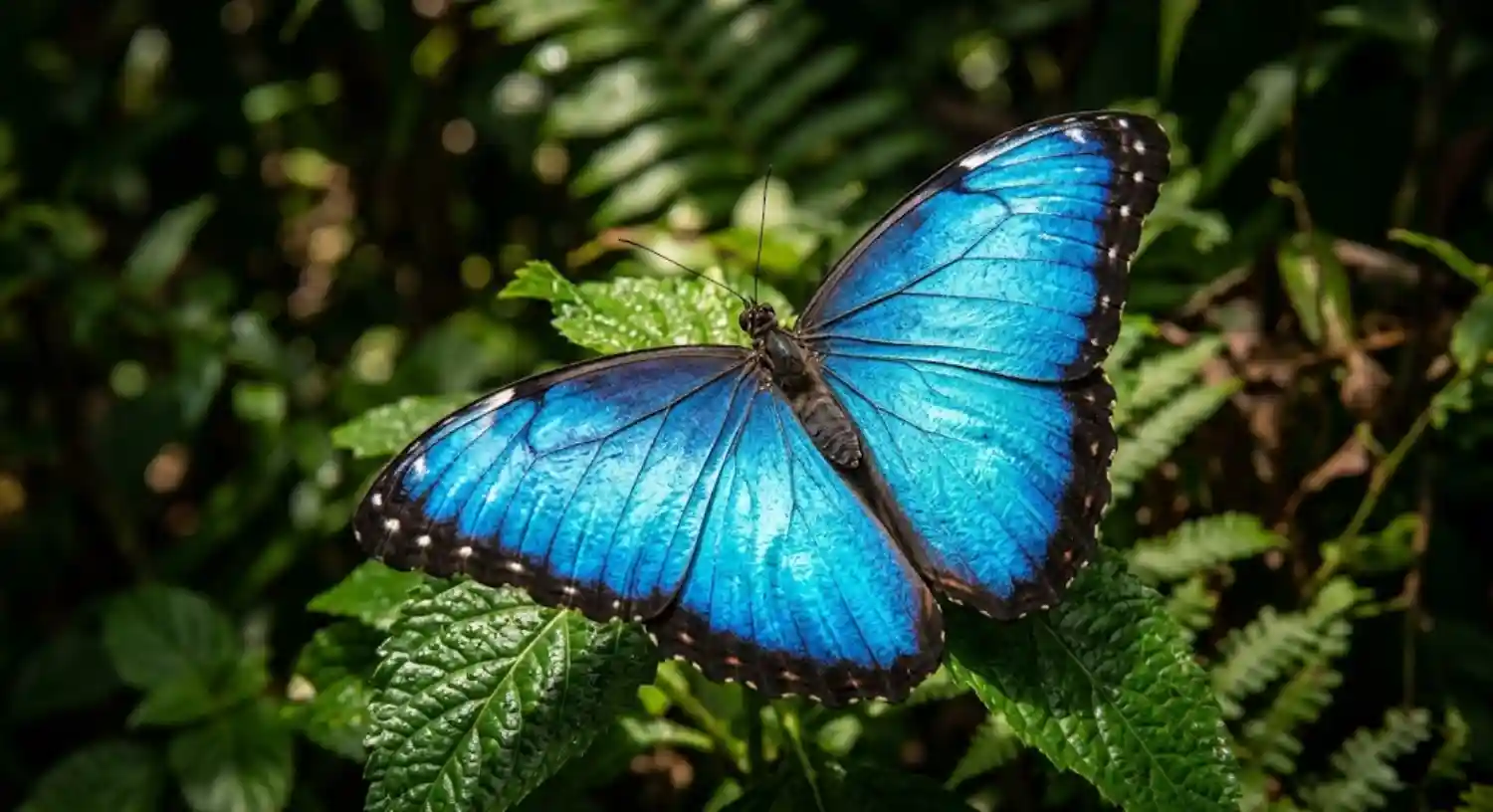
The blue Morpho butterfly has a biological feature that challenges the common idea of how colors occur in nature: its wings contain not a single drop of blue pigment. The phenomenon that has fascinated observers for centuries comes from the physical interaction between sunlight and carefully arranged microscopic structures.
Most living things obtain their colors from chemical molecules that absorb and reflect specific wavelengths. This butterfly instead uses what science recognizes as structural color. The blue is not stored as a blue substance inside the wing. It appears when light encounters a tiny architecture able to select and return particular wavelengths.
This mechanism keeps the blue vivid and unchanged throughout the insect’s life, unlike organic pigments, which tend to fade after prolonged exposure to ultraviolet rays. In the Amazon, that physical solution makes the blue Morpho a visible example of how evolution can create intense effects without relying on coloring molecules.
A microscopic architecture of scales
The visual effect begins with the tiny scales covering the wing surface. Under powerful electron microscopes, these scales are arranged in patterns that resemble microscopic Christmas trees. The image shows that the brightness depends on a precise arrangement rather than on a uniform layer of color.
The nanostructures consist of layers of chitin and air arranged in a precise lamellar architecture. The distance between those layers is critical because sunlight does not simply bounce off the surface. Every element of the structure contributes to a coordinated optical response.
When sunlight reaches the layers, constructive interference occurs. Only the wavelength corresponding to blue is reflected back toward the observer’s eyes, while the other colors in the visible spectrum are canceled or pass through the structure. The perceived color therefore comes from the geometry of the scales and from the way they interact with light.
The structure is so fine that even a minimal change in the distance between the lamellae would completely change the perceived color. This precision shows how accurately natural selection maintains a feature that depends on microscopic measurements. On the wing surface, a tiny variation can transform the way the insect appears to the world.
A flash connected to life in the forest
In the dense forests of the Amazon, the metallic shine plays a fundamental role in the species’ ecology. The reflected blue is so intense that it can be seen by pilots of small aircraft flying over the treetops. The light turns the butterfly into a striking presence in a landscape dominated by green.
For the butterfly, that extreme visibility works as a territorial signal and as a mating tool. Visual communication is vital for reproduction and defense against predators. In this setting, iridescence is not merely an aesthetic feature. It is part of the insect’s relationship with other animals and with the forest space.
The wings, however, do not always look the same. Their underside has brown colors and eyespots that imitate the eyes of larger animals. When the butterfly closes its wings, it can disappear instantly against tree trunks, replacing the blue flash with a more subdued surface.
The alternation between shimmering blue and dull brown creates a flickering effect during flight. That change can confuse the path of birds and other natural hunters. The same butterfly that becomes extremely visible at one moment can reduce its visual presence at the next, depending on the position of its wings.
From iridescence to biomimicry
Modern science is deeply interested in these nanostructures for the development of new materials and sustainable technologies. The ability to generate intense colors without toxic chemical dyes opens possibilities for paints that never fade and fabrics that shift in tone according to the viewing angle.
Studies indicate that replicating these lamellar structures could help produce electronic device screens that are far more energy efficient. Instead of depending exclusively on internal light sources, such displays would use ambient light to show colors. The idea is inspired by a solution that already works on the butterfly’s wings.
The wing structure also inspires engineers developing ultrasensitive gas sensors and surfaces that repel water and dirt. Because the nanostructures are extremely regular, any foreign molecule deposited between the lamellae changes the reflection of light. That change can serve as an immediate visual warning.
The scales offer an example of biomimicry, the field that looks to nature for answers to technical challenges in the twenty-first century. The butterfly uses geometry rather than chemistry to produce color, and this principle of economy and efficiency has become a reference for imagining high-performance materials with less dependence on coloring substances.
The forest as a living laboratory
The blue Morpho butterfly is therefore a living laboratory of nanotechnology that nature perfected over millions of years of biological evolution. Its color shows that exuberance can emerge while using the minimum possible amount of chemical resources. In the wing, optical physics and biology are integrated into one solution.
Amazonian iridescence also reveals that life has found ways to manage energy efficiently. The butterfly produces a powerful visual effect from layers of chitin and air, without relying on blue pigment. The result may look magical at first sight, but it follows from the interference of light within an ordered structure.
Watching a blue Morpho fly is witnessing an event of quantum physics with the naked eye in the middle of a tropical forest. Light traveling from the Sun is filtered and returned in a shade of blue that does not exist as a substance inside the insect. It exists in the way the wings present the insect to the world.
Protecting the habitat of these butterflies is essential not only because of the beauty they add to Brazil’s biodiversity, but also because of the scientific knowledge they represent. The degradation of tropical forests threatens species that possess biological secrets humanity still does not fully understand.
Every individual flying beneath the Amazon canopy carries a lesson in pure physics and energy efficiency. The structure of its wings shows that Amazonian biology can provide high-performance models for a global and sustainable technology industry.
Understanding that the beauty of a living creature may lie in the exact way it interacts with light invites us to see the forest not as a stockpile of resources, but as a compendium of silent knowledge. Nature does not need chemical artifice to be magnificent when it masters the fundamental laws governing the universe and the propagation of luminous energy.
Reporting: Anne Silva / Amazonia Mag

Editor, English Edition — Amazonia Mag
Anne Silva is the editor of Amazonia Mag, the English-language edition of Revista Amazônia. She curates, translates and adapts the outlet's science and environment coverage for an international audience, reporting on Amazon wildlife, flora, rivers, climate and research. Every story she edits is grounded in peer-reviewed studies, official data and on-the-ground reporting from the Revista Amazônia newsroom in Belém, Pará, Brazil. More by Anne Silva →