
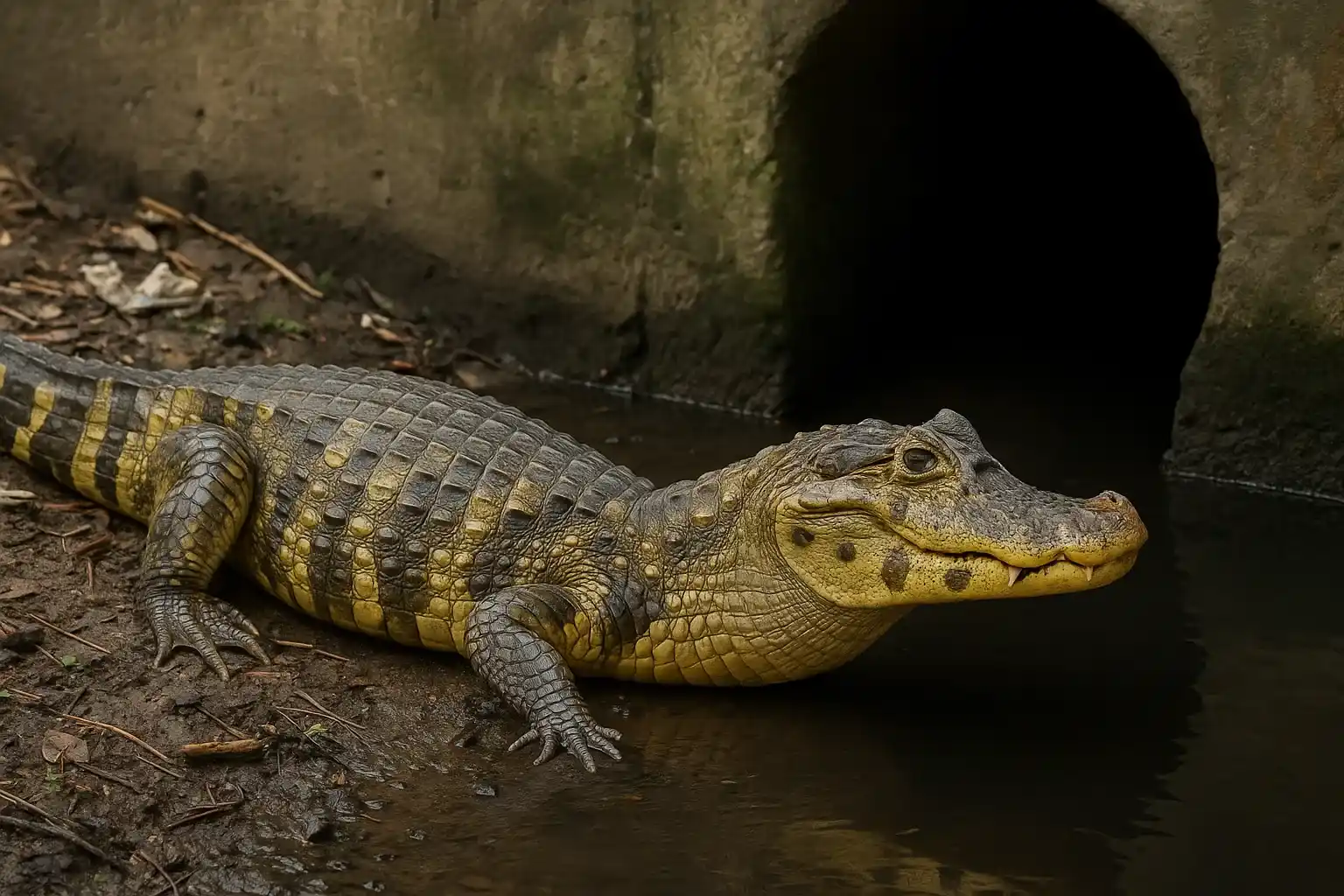
Quiet, patient and almost invisible among riverside vegetation, the broad-snouted caiman (Caiman latirostris) is a born survivor. In Brazil it is known as jacaré-de-papo-amarelo, the “yellow-throated caiman”. This reptile, typical of the flooded regions of South America, is known for its capacity to adapt, even to extreme settings such as drainage ditches, polluted canals and sewage-fouled urban waters. What sounds like a scene from a film is a daily reality in several Brazilian cities, and it reveals two things at once: the resilience of the species and the direct consequences of human action on ecosystems.
A survivor at the edge of the city
The broad-snouted caiman is native to South America and is found mainly in Brazil, Argentina, Paraguay and Uruguay. By preference it lives in flooded areas, swamps, mangroves and slow-moving rivers, places where water spreads across the land and vegetation offers cover. Even so, it can adapt to environments heavily modified by people, and that is where the story becomes remarkable.
Reports of these caimans living in sewage-affected canals, urban streams and even the drainage systems of large cities have become more frequent. Animals have been recorded in cities such as Rio de Janeiro and Recife, far from the quiet wetlands where the species is usually described.
This adaptation, however, is not a voluntary choice. As natural habitats are destroyed, the animal is forced to look for alternatives in order to survive. Often it finds shelter exactly where most species could not endure: in polluted, foul-smelling water full of garbage and human waste. Its presence there says less about the toughness of the caiman than about how little space the city has left for it.
Armored body, tough digestion
One reason the broad-snouted caiman can survive in such hostile places is its extremely resilient body. Its thick, bony-plated skin protects it from injuries and outside aggression, a kind of natural armor that matters in waters full of debris and sharp objects.
Its powerful digestive system, in turn, can deal with food scraps, dead fish and small animals. In practice this gives the caiman a wide menu in places where few other creatures could find anything to eat.
The caiman can also go for long periods without feeding, a mechanism that helps in times of scarcity. In sewage-affected waterways it keeps going by preying on rodents and waterbirds, and even by eating leftovers discarded by people. This adaptability is impressive, and also a little unsettling, because it shows how far an animal will go when its habitat has been taken from it.
A caiman in the city: curiosity and fear
In cities such as Rio de Janeiro and Recife, sightings of broad-snouted caimans in urban areas have become common. They have been recorded in rainwater canals, in contaminated lagoons and along the edges of busy avenues. In many cases the animal is noticed only when it comes out to bask in the sun, or when flooding forces it to move from one place to another.
The presence of a wild reptile in such surroundings does more than draw attention. It also raises fear and sparks debate about public safety and conservation. Residents say they are afraid of attacks, although these are extremely rare, and questions arise about how to deal with a wild animal right in the middle of the city.
Those questions are legitimate, but they are easier to answer when the facts are clear. The caiman did not move into the city on a whim. The city grew over the places where the caiman already lived, and the animal is simply trying to stay.
A sign of an unbalanced environment
Above all, the appearance of a broad-snouted caiman in an urban area is a warning. It shows how natural ecosystems have collapsed and how cities have advanced without order over wetlands and permanent preservation areas. Channeled rivers, filled-in mangroves, open-air garbage and uncontrolled pollution push wildlife toward whatever corner it can still survive in.
In this context the caiman becomes a bioindicator species, an animal whose presence or condition says something about the state of the place where it lives. Here the message is blunt: something is wrong with the environment. The caiman is there because its habitat was invaded, destroyed or degraded.
And if a caiman is forced to live in a sewer, what can be said about the many other species that simply disappeared? The ones we see in the canals are the ones that managed to hold on. The ones we do not see are the ones that did not.
Coexistence, risk and conservation
The image of a caiman peering out of a storm drain can cause panic, yet these animals, when left in peace, avoid contact with humans. They are shy by nature, they prefer to flee rather than attack, and they pose a real danger only in situations of stress or threat.
Even so, increasingly frequent contact with inhabited areas creates a dangerous scenario for caimans and for people alike. Many animals end up run over, illegally captured or killed out of fear or lack of knowledge. For this reason, environmental agencies have stepped up monitoring, rescue and release into more suitable environments.
More than an urban curiosity, a broad-snouted caiman in a sewage-affected canal is a portrait of nature trying to resist the pressure that cities impose on it. It forces us to rethink how we handle the environment, garbage, the occupation of natural spaces and sanitation policy.
It is also a symbol of strength and resilience, a reminder that life, in spite of everything, always finds a way. But for how long can we count on the endurance of wildlife? The question that remains is whether we want to see caimans in clean rivers, inside protected areas, or keep treating their presence in sewers as just another “big city phenomenon”.
Reporting: Revista Amazônia newsroom / Amazonia Mag

Editor · Amazonia Mag
Anne Silva is the editor of Amazonia Mag, the English-language edition of Revista Amazônia. She curates, translates and adapts the outlet's science and environment coverage for an international audience, reporting on Amazon wildlife, flora, rivers, climate and research. Every story she edits is grounded in peer-reviewed studies, official data and on-the-ground reporting from the Revista Amazônia newsroom in Belém, Pará, Brazil. More by Anne Silva →