
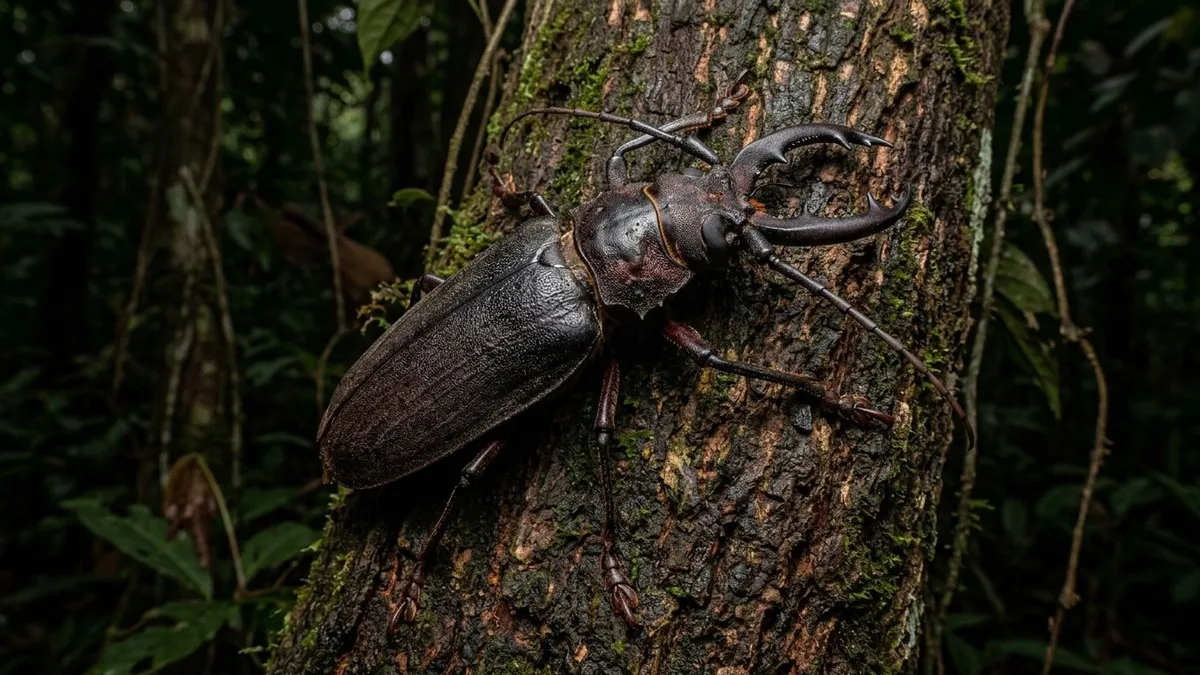
When an adult titan beetle turns up in the glare of a light, the first impression comes from its size and from the build of its head. The animal can reach 6.7 inches (17 centimeters) in body length, a measure that makes it the largest beetle known by that criterion. The dimension does not depend only on an outside ornament such as a horn or an isolated extension. The whole body takes part, with thorax, abdomen, legs and a head equipped with very well-developed jaws.
The contrast grows when you look at where that body is headed. The adult does not look for leaves, fruit or other food to restore its energy. It uses reserves accumulated during the larval phase and goes through adult life without eating. The beetle reaches the most visible stage of its existence already carrying the fuel it needs to stay active, find a mate and carry out the reproductive functions of that phase.
Titanus giganteus and the pull of light
The titan beetle is known scientifically as Titanus giganteus, a name associated with the large beetles of South American forests. Among the best-known records, adults appear drawn to lights, a behavior that makes it possible to observe an animal that is normally hard to find in its natural setting. Artificial lighting works as a gathering point for the insect, but it does not turn the beetle into a domestic species or mean that it depends on urban environments.
The attraction also explains why photographs and accounts of encounters with the animal tend to happen near lamps, street poles and other sources of light. The exact mechanism that guides the flight to the light should not be confused with feeding. The beetle does not approach to consume the bulb, the heat or anything around it. The light simply interferes with the adult’s orientation and can bring it face to face with people.
The story starts before the beetle appears
The adult’s story begins in the larval phase, when the animal builds up the reserves it will use later. That order changes how the beetle’s behavior should be read. The absence of feeding in the adult does not mean the insect went through its whole life without taking in energy. It means that most of that investment took place before metamorphosis, in a stage that is less known and less often seen by the public.
After the transformation into the adult form, the beetle depends on the stock built earlier. The body keeps the energy needed for the activities of this phase, while the jaws become the most obvious feature of its anatomy. The adult emerges, finds the conditions to continue its cycle and does not have to spend time looking for food. This strategy draws a sharp line between the roles of the larva and the adult.
Jaws that concentrate force
The head of the titan beetle holds jaws that are large and sturdy in proportion to the rest of the body. They are not just a visual mark. Their force is out of proportion to the size of many objects the animal can press, and the best-known example is the breaking of a pencil. The example helps put into words a capacity that is hard to judge from photographs alone, because the structure works as a rigid, powerful closing tool.
The pencil, however, is a comparison and not a universal measure of the species’ strength. Performance can vary with the material, the point of pressure, the condition of the jaws and the way the object is placed. So the correct description is that the titan beetle has jaws capable of breaking a pencil, not that every individual will produce exactly the same result in every situation. The anatomy remains the central fact.
Six point seven inches and a cycle without adult feeding
The 6.7 inches (17 centimeters) correspond to the maximum body length reported for the titan beetle, and they support its position as the largest beetle known in that kind of comparison. Rankings can change when different criteria are used, such as weight, width, the presence of horns or the length of specific structures. Here the criterion is body length. The distinction avoids mixing Titanus giganteus with beetles that may look bigger because of their appendages.
The second number that matters is the zero tied to adult feeding. The beetle does not eat once it reaches the adult form, because it depends on its larval reserves. That does not mean it stays still. It can fly, move around and react to its surroundings, including by following sources of light. All of this activity is sustained by what was accumulated before, which makes the transition between phases decisive for understanding the animal.
The adult’s role and the limits of the account
The most concrete consequence of this strategy is a change in the insect’s role over its life cycle. As an adult, the titan beetle invests the energy it has in moving around and reproducing, instead of looking for food. The jaws can be used in disputes or interactions, but they should not be taken as proof that the animal hunts people. Size and strength do not automatically make the beetle a threat. Contact should still be avoided, because a bite can be painful.
These data should not be filled in by estimate. The story comes from these established biological traits of the titan beetle, with no recent event involved. In the Amazon, where the animal’s name has circulated most widely, seeing an adult still depends on very particular conditions. The encounter is a reminder that size alone does not reveal how a species works. It is the sequence of larva, reserve and adult that explains how one of the largest beetles reaches the light without having to eat.
Reporting: Natália Santos / Amazonia Mag

Editor · Amazonia Mag
Anne Silva is the editor of Amazonia Mag, the English-language edition of Revista Amazônia. She curates, translates and adapts the outlet's science and environment coverage for an international audience, reporting on Amazon wildlife, flora, rivers, climate and research. Every story she edits is grounded in peer-reviewed studies, official data and on-the-ground reporting from the Revista Amazônia newsroom in Belém, Pará, Brazil. More by Anne Silva →