
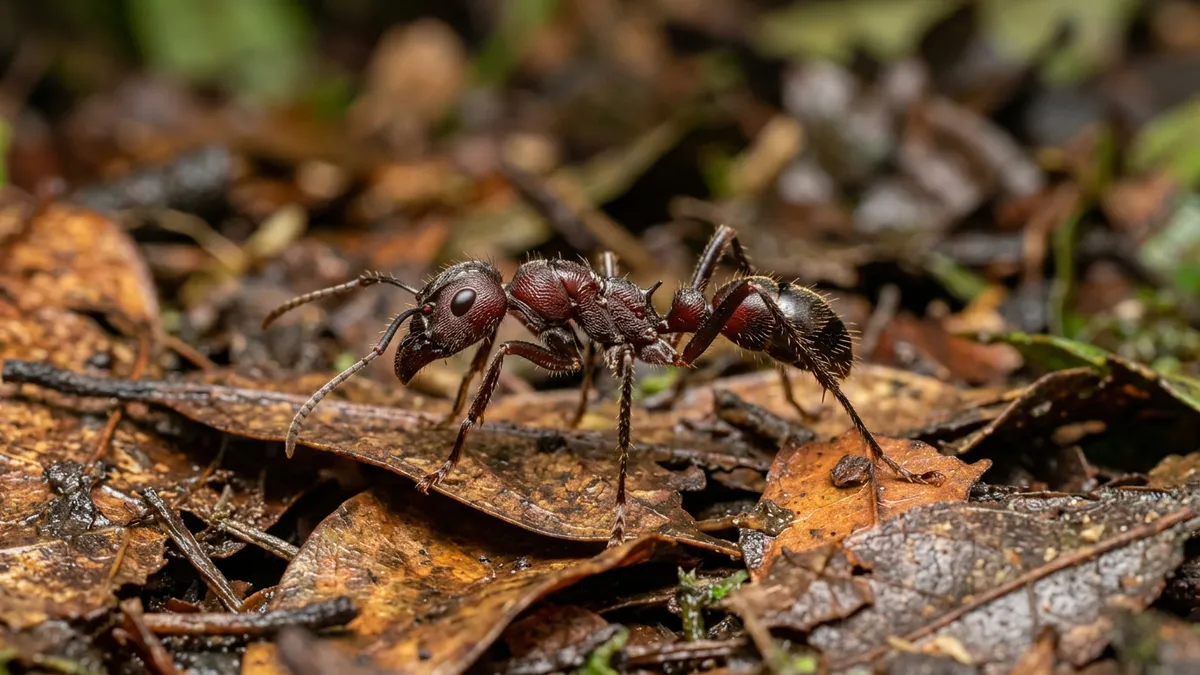
A bullet ant does not need to stay on the skin for long to produce an effect that stretches over hours. Its sting is linked to pain of very high intensity, described as the most painful among insect stings in references based on the Schmidt pain scale. The key is not only the puncture but the venom the worker injects when it attacks or defends itself. One of its components is poneratoxin, a substance able to interfere with the neurons that carry pain signals.
The ant is known in Brazil as the tocandira. It is a large ant, and it combines two things that are often confused: a painful reaction that lasts many hours, and the absence of a lasting injury caused directly by the venom.
A sting that goes on after the contact ends
The result is a sensation that does not stop when the ant moves away. The pain can last for more than 12 hours, although its duration and intensity vary with the person, the spot that was stung and the amount of venom injected. That long duration does not mean, by itself, that the sting destroyed muscle, nerve or skin.
The figure should be treated as a reference, not a guarantee for every case. The exact duration is not a biological clock that runs the same way in everyone. What the number does is give a sense of scale for a phenomenon that, with most other stings, would be over far sooner.
The worker behind the reaction
The bullet ant is a large ant, and a worker can reach 1.2 inches (3 centimeters) in length. Size helps make the difference between this ant and many of those found on the ground or in vegetation easy to see, but it does not explain the duration of the pain by itself. The mechanism lies in the composition of the venom and in the way it acts on nerve cells. The sting works as an entry route for poneratoxin, which reaches structures involved in the passage of electrical signals through neurons.
Contact can happen when the ant is pressed against the body or when it reacts to a threat. As with other animals that have a stinger, the sting serves a defensive purpose. In the case of the bullet ant, the consequence for the person stung can be pain that lasts for a significant part of the day.
The description does not correspond to one episode with a specific date and place. It is an established biological trait of the species. For that reason there is no recent discovery to credit to a researcher or an institution. The phenomenon is known from observation of the ant, from descriptions of its stings and from the study of its venom.
How poneratoxin keeps neurons active
Neurons transmit information through electrical changes across the cell membrane. Among the elements that take part in this process are sodium channels, structures that let ions pass and help start or spread a nerve impulse. Poneratoxin acts on this system. Instead of simply causing a brief pain at the moment of the puncture, it alters how the sodium channels of neurons work. That alteration favors the maintenance of signals associated with pain and helps explain why the sensation can continue after contact with the ant has ended.
The mechanism should not be described as the destruction of nerves. The available information points to a functional interference with the neuronal signal, with no permanent tissue damage. That difference is important for understanding the effect of the sting: the body can receive an intense, prolonged pain message without the poneratoxin having burned or cut the tissue.
The numbers help size up the phenomenon. The worker reaches up to 1.2 inches (3 centimeters), and the pain can last more than 12 hours. Because the exact duration varies, the range should be taken as a reference point.
From the ant’s defense to an initiation ritual
The sting also appears in a cultural context tied to Indigenous initiation rituals. In this practice, contact with the ants is not presented merely as an accident but as part of a ceremony that gives meaning to endurance of pain and to the passage into a new stage of life.
This calls for care. The ritual should not be reduced to a test of suffering, and it should not be generalized to all Indigenous peoples. It is also necessary to separate what is established from what depends on context. The intensity felt by an individual, the amount of venom and the cultural experience all depend on the concrete situation.
What is established, and what depends on the case
What is established is the biology: a large ant, a venom with poneratoxin, an action on the sodium channels of neurons, pain that can pass 12 hours and no permanent tissue damage. What varies is the person, the place on the body and the dose.
The story concerns a known trait of the bullet ant and an Indigenous ritual use of it, not a recent event with a confirmed date. In Brazil, this link between biodiversity and culture is a reminder that a species can be studied as an organism and, at the same time, be recognized by peoples who developed their own ways of dealing with it.
Reporting: Natália Santos / Amazonia Mag

Editor · Amazonia Mag
Anne Silva is the editor of Amazonia Mag, the English-language edition of Revista Amazônia. She curates, translates and adapts the outlet's science and environment coverage for an international audience, reporting on Amazon wildlife, flora, rivers, climate and research. Every story she edits is grounded in peer-reviewed studies, official data and on-the-ground reporting from the Revista Amazônia newsroom in Belém, Pará, Brazil. More by Anne Silva →