
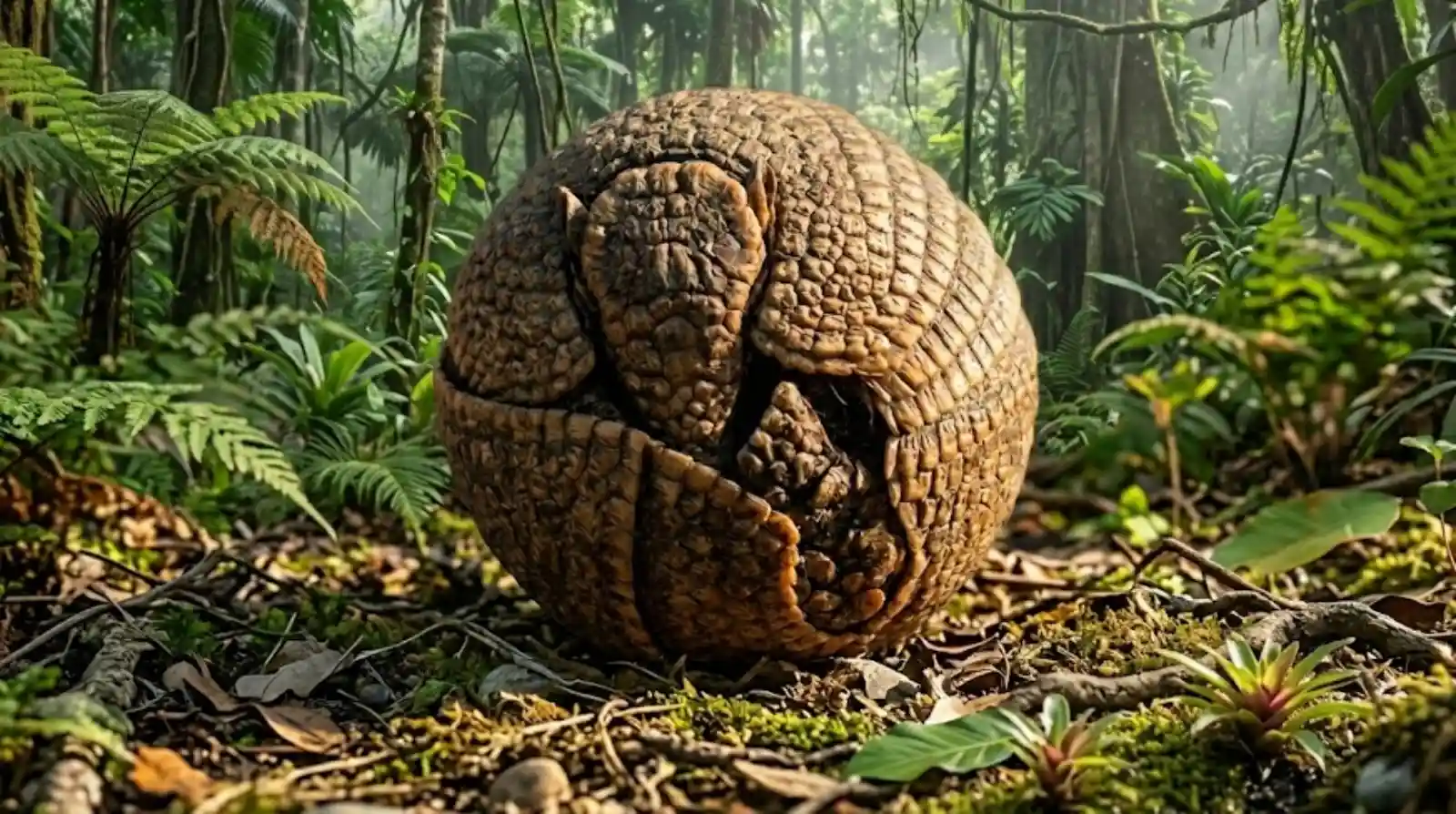
When it senses danger, the Brazilian three banded armadillo does not run for a burrow and does not try to dig itself out of trouble. It does something no other mammal on the planet manages to repeat with the same precision: it closes in on itself until it becomes a sphere. The head and the tail slot into place with millimetric accuracy, the belly and the legs are sealed inside a bony shell, and what the predator now faces is no longer an animal but a compact ball with no edges, no gaps and no obvious weak point. It is a purely geometric defence, and it is efficient enough to pose a serious problem even for the jaguar, the cat with the most powerful bite in the Americas.
Armour that is not a single piece
The Tolypeutes tricinctus, a species found only in Brazil, does not carry a rigid one piece shell on its back. Its armour is built from dermal bony plates, known as osteoderms, covered by keratinised epidermal scales. Those plates are joined to one another by bands of flexible skin, which is what allows the animal to walk, to scratch through leaf litter and to move around without becoming a prisoner of its own protection. The armour is therefore rigid and articulated at the same time, an unusual combination in nature, and it is the reason this armadillo can go from fully mobile to fully closed in a matter of seconds.
The secret of the complete closure lies in the three mobile central bands and, above all, in the shape of the plates on the head and on the tail. Both work like puzzle pieces that lock from the outside, covering precisely the opening that would otherwise remain when the animal curls up. There is also a second component that is often overlooked: muscle. As it closes, powerful abdominal muscles pull the carapace together with such force that prising it apart by brute strength becomes extremely difficult. That tension keeps the sphere sealed and resists considerable outside pressure. This is not merely a shell, it is a shell actively held shut from within.
A jaguar facing a sphere with no edges
Confronted with a perfectly closed armadillo, hunting stops being a question of raw power and turns into a test of technique and patience. The spherical shape removes the limbs and the edges a predator would need in order to hook its claws in and try to separate the plates. When the first bite lands, the bony carapace absorbs the impact and spreads it across the whole curved surface instead of concentrating it at a single point. Jaguars and pumas, which rank among the main natural enemies of the species in the Caatinga and the Cerrado, meet a prey animal that offers nothing to hold on to.
The most interesting detail is that the obstacle is not the hardness of the material. A jaguar bite can pierce turtle shells and caiman skulls, so bone strength alone would not explain why the attack fails. What frustrates the cat is geometry. Without a lever on which to apply its full force, and without a gap into which it can drive its canines, much of the predator energy is dissipated on a surface that keeps slipping between its jaws. That moment of initial resistance buys the small mammal something decisive: time.
A defence that is not infallible
Science, however, does not treat this armour as an absolute guarantee. The question of how a predator eventually opens the sphere has an uncomfortable answer, and it has little to do with immediate strength. It has to do with attrition. Holding the muscles contracted to sustain the closed shape demands an enormous energy expenditure from the armadillo. Studies indicate that experienced predators may bet on exhaustion: if the cat stays for hours watching and manipulating the ball, the animal can reach muscular fatigue and be forced to relax slightly, opening the fatal gap. And although the sphere makes the ideal bite difficult, adult jaguars can, with persistence and the right handling technique, find the correct angle to apply their full jaw pressure and break the armour open.
Far more than a defence
Rolling into a ball serves purposes that go well beyond an encounter with a predator. The same posture helps with thermoregulation and reduces water loss, which is no small advantage in the arid climate of the Caatinga and in the strongly seasonal Cerrado, where resources can be scarce for long stretches of the year. The behaviour that saves the animal from the jaguar also helps it survive heat and drought, and that dual function is part of why the trait was so strongly favoured by evolution in these particular landscapes.
It is worth remembering that this is one of the few armadillo species that does not dig deep tunnels in order to escape. While the six banded and the nine banded armadillos bolt for a burrow at the slightest sign of danger, this one relies almost entirely on its armoured ball to survive in the sparse vegetation of its habitats. Even so, it remains a digger. Turning over the soil in search of food aerates the ground, and its feeding habits contribute to seed dispersal. That quiet ecological role sustains processes that benefit the entire environment around it, which is why losing the species would mean losing far more than a single animal.
The paradox of the perfect ball
Here lies the cruellest irony of the story. The very trait that protected the species for millennia against its natural predators is exactly what made it vulnerable to a modern threat: human hunting. An animal that seals itself into a sphere and stops moving is trivially easy to pick up by hand. The perfect strategy against claws and fangs becomes an absolute liability in front of someone who only has to bend down.
If a biological armour this robust and this well engineered, forged over millions of years to defy the strength of the largest cats in the Americas, cannot protect the three banded armadillo from the simplicity of being picked up by hand, what does that say about our responsibility towards the most vulnerable species? Conserving Tolypeutes tricinctus is not only about preserving a biological curiosity. It is about guaranteeing the continuity of one of the most ingenious defensive solutions Brazilian nature has ever produced.
Reporting: Anne Silva / Amazonia Mag. Source: Revista Amazônia.

Editor · Amazonia Mag
Anne Silva is the editor of Amazonia Mag, the English-language edition of Revista Amazônia. She curates, translates and adapts the outlet's science and environment coverage for an international audience, reporting on Amazon wildlife, flora, rivers, climate and research. Every story she edits is grounded in peer-reviewed studies, official data and on-the-ground reporting from the Revista Amazônia newsroom in Belém, Pará, Brazil. More by Anne Silva →