
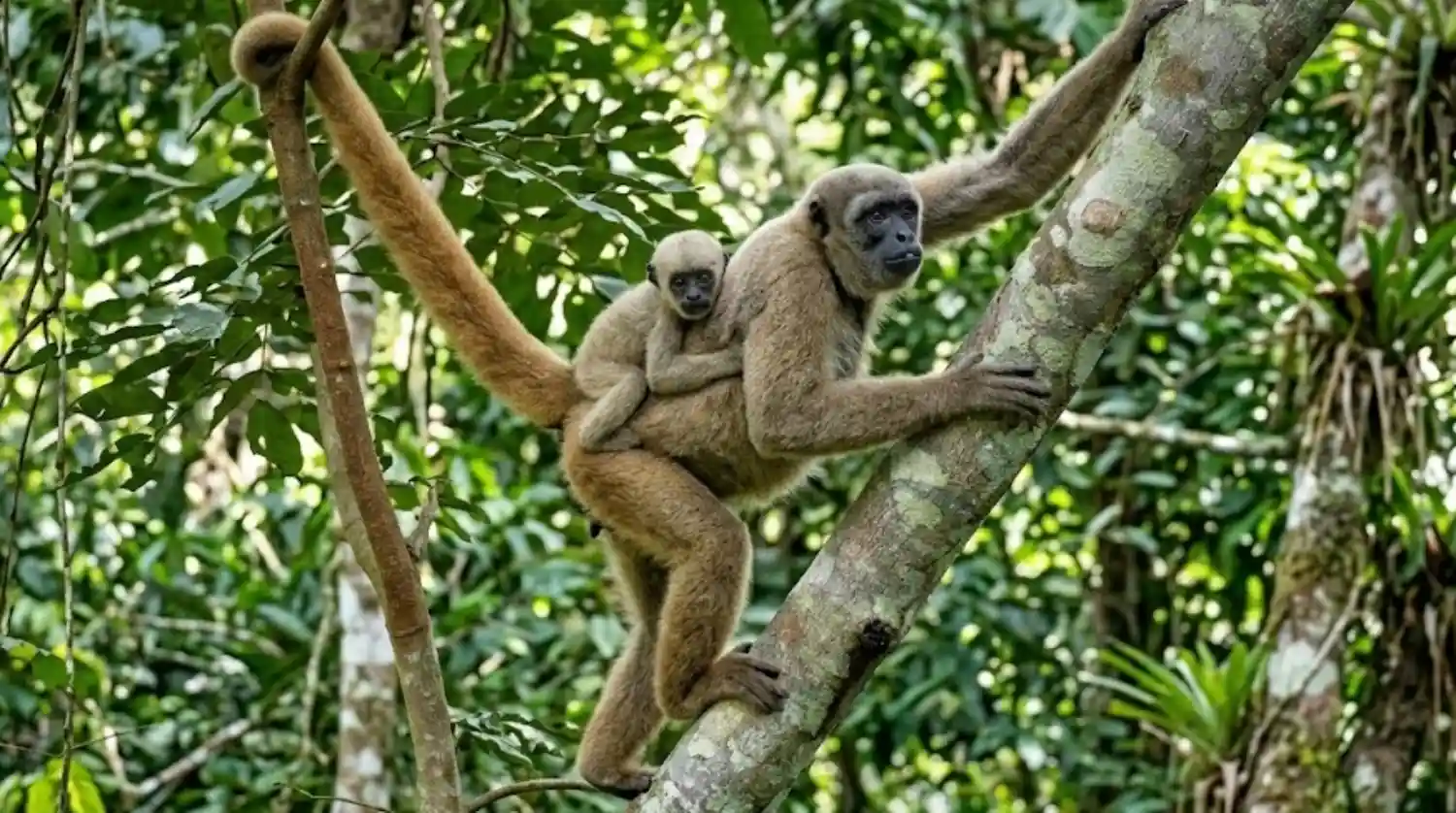
High in the surviving canopy of Brazil’s Atlantic Forest lives an animal that breaks nearly every expectation people carry about primates. The northern muriqui is the largest primate in the Americas, a gentle giant that does not need to shout to hold its place, does not bare fangs and does not answer to any boss. Its quiet and increasingly fragile existence is one of the most eloquent reminders of the biological complexity still holding on inside one of the most threatened biomes on the planet.
Known to science as Brachyteles hypoxanthus, this primate lives exclusively in the Brazilian Atlantic Forest and is found nowhere else on Earth. Its size alone is striking. Yet what turned the muriqui into a case study followed closely by researchers is not its build: it is the combination of unusual biological adaptations with a social behavior that challenges much of what has been observed in other primate species.
A set of teeth that tells a life story
Unlike most large primates, the northern muriqui evolved a highly specialized dental anatomy shaped by a strict diet. It is a vegetarian, feeding mainly on leaves and, to a lesser degree, on fruit and flowers. The teeth evolution handed it are built to process plant material, not to tear flesh or to threaten a rival inside the group.
The most revealing feature, however, is an absence. The muriqui lacks the large, sharp canines that other primates use in dominance displays or in defense. That anatomical detail is not an isolated evolutionary quirk. It is tightly bound to the animal’s way of life and to the way individuals relate to one another. Written into the muriqui’s own body is the fact that aggression was never its primary survival tool.
A society with no alpha male
Muriqui society is a striking example of peaceful and egalitarian coexistence. In many monkey species a clear dominance hierarchy exists, frequently maintained through physical aggression or intimidation. Among northern muriquis the opposite holds true. They live in groups where cooperation prevails, and studies indicate there is no alpha male and no leading female exercising control over the other members of the community.
Interactions are marked by tolerance and by the absence of serious conflict, a rare and genuinely inspiring trait in the animal kingdom. No single individual decides who eats first or who takes the best spot in the canopy. Daily life is organized without the imposition of force, which is all the more remarkable given that this is the largest primate on the entire American continent.
That egalitarian structure extends even into reproductive habits and the raising of young. The lack of large canines and the absence of aggressive behavior among males suggest that competition for mates is not settled by brute strength. On the contrary, science recognizes that muriqui social organization favors strong and lasting bonds among all members of the group, which in turn feeds the cohesion and the stability of the community.
For researchers, that combination makes the species something close to a natural experiment. Here is a large, powerful primate whose evolutionary path led away from confrontation rather than toward it, and whose anatomy and social rules line up with one another instead of pulling in opposite directions. The muriqui shows that a peaceful society is not a fragile exception in nature but a viable strategy, tested and sustained across generations in the forest canopy.
Acrobats of the treetops
Muriquis are arboreal animals and spend most of their time high above the forest floor. Their long limbs and their prehensile tail, which works as a fifth limb, are perfect adaptations for life in the trees. They move with an agility and a grace that contrast with their size, using the tail to hang and to reach food on thin branches that would never hold the full weight of the animal.
That efficient locomotion is not a luxury but a necessity. Muriquis cover large areas in search of resources, above all the leaves that form the base of their diet. A group depends on a wide and continuous territory to sustain itself through the year, and that is exactly where the biology of the animal collides with the present state of the Atlantic Forest.
A giant on the edge
Despite its unique traits and its vital role in the ecosystem, the northern muriqui faces significant challenges to its survival. Habitat fragmentation and habitat loss are the main threats, sharply reducing the areas available for these primates to live and to reproduce. The muriqui population is extremely small, which places the species in a critical situation and demands urgent conservation efforts to prevent its extinction.
Protecting the muriqui means far more than saving a single species. As large herbivores, these primates play an important part in seed dispersal and in maintaining the balance of the forest. Every group that disappears takes with it an ecological function that is hard to replace. Protecting the remaining habitat and building ecological corridors that reconnect isolated populations rank among the fundamental steps toward securing a future for this singular primate.
The story of the northern muriqui teaches that nature can invent surprising solutions for peaceful coexistence and for adaptation to the environment. Its egalitarian society and its gentle way of life are a reminder that strength and aggression are not the only routes to survival. In protecting the muriqui and its habitat, we are not only safeguarding a rare species: we are preserving a living example of harmony and cooperation that invites us to rethink our own relationship with the natural world.
Faced with the fragility of that existence, an uncomfortable and urgent question remains: what legacy do we want to leave to the generations that follow, and will we prove capable of acting in time to save this gentle giant of the Brazilian Atlantic Forest.
Reporting: Anne Silva / Amazonia Mag. Source: Revista Amazônia.

Editor · Amazonia Mag
Anne Silva is the editor of Amazonia Mag, the English-language edition of Revista Amazônia. She curates, translates and adapts the outlet's science and environment coverage for an international audience, reporting on Amazon wildlife, flora, rivers, climate and research. Every story she edits is grounded in peer-reviewed studies, official data and on-the-ground reporting from the Revista Amazônia newsroom in Belém, Pará, Brazil. More by Anne Silva →