
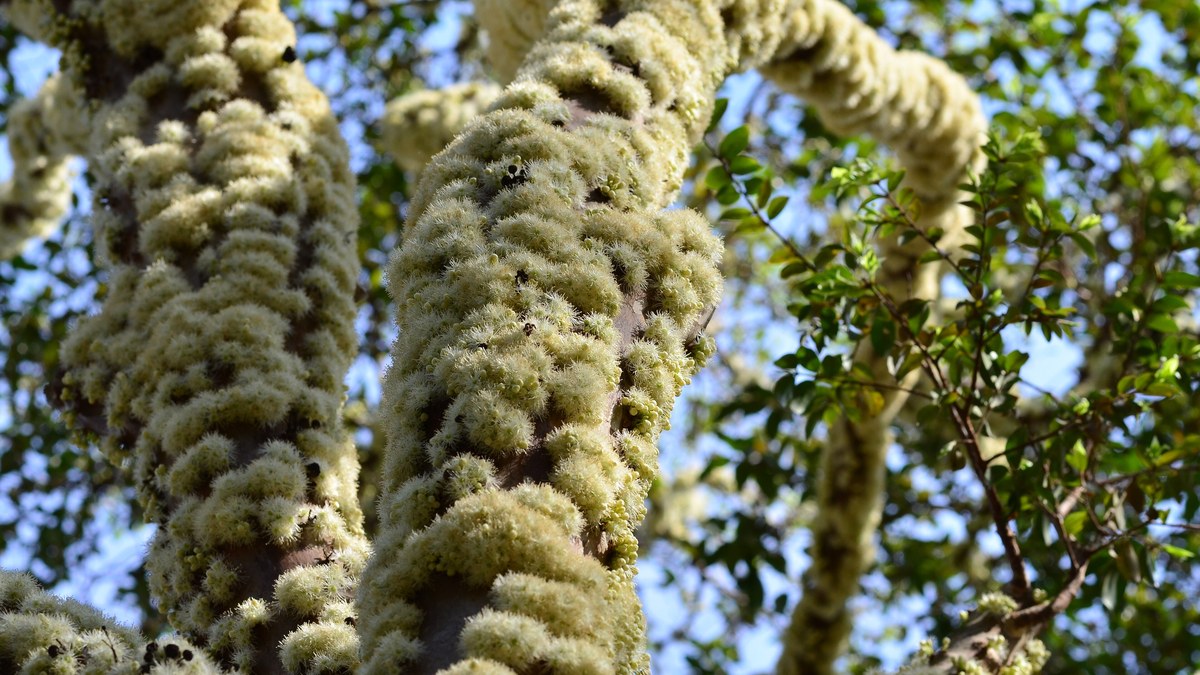
At flowering time, the trunk of the jabuticaba tree (jabuticabeira in Portuguese) looks as if it were covered in cotton. Small white flowers burst straight from the bark, from the base of the tree to the thickest branches, and weeks later they give way to the black berries that every Brazilian knows. This way of flowering has a name, cauliflory, and research from the Luiz de Queiroz College of Agriculture (Esalq), part of the University of São Paulo (USP), in Piracicaba, helped explain where those flowers come from and what makes the tree decide it is time to bloom.
What cauliflory is
In most fruit trees, flowers appear at the tips of new branches, among the leaves. In cauliflorous plants, flowers and fruits form on the trunk and on older woody branches. The jabuticaba tree (Plinia cauliflora, which carries the phenomenon in its own scientific name, along with close species of the same genus) is the most famous example in Brazil. It belongs to the myrtle family, the same family as guava, pitanga and rose apple.
The Amazon has its own illustrious example. Cacao (Theobroma cacao), native to the region, is also cauliflorous. Cacao flowers and fruits grow straight from the trunk and thick branches, just as they do on the jabuticaba tree.
What the USP research found
The work was the doctoral thesis of researcher Girlaine Pereira Oliveira, defended in 2018 at Esalq. She followed plants of the ‘Sabará’ variety, one of the best-known varieties of the fruit, in the experimental field of the school’s Department of Plant Production, in 2016 and 2017. The study combined morphological and anatomical analyses of the reproductive buds, the influence of environmental factors on flowering and fruit set, and the tracking of the physical and chemical characteristics of the fruit until ripening.
According to the thesis, the buds that give rise to the flowers form after intense shedding of the bark and result from the activity of cells of the vascular cambium, the layer of tissue that makes the trunk grow in thickness. In other words, the flowers are not stored ready-made under the bark. The renewal of the trunk itself creates the structures from which they will sprout.
Part of these results was published in 2019 in the scientific journal Scientia Horticulturae, in an article on the origin and development of the reproductive buds of the ‘Sabará’ jabuticaba tree. It was signed by Girlaine Pereira Oliveira, Jéssika Angelotti-Mendonça, Francisco André Ossamu Tanaka, Simone Rodrigues da Silva and João Alexio Scarpare Filho.
Cold and drought set off the bloom
The research also looked at what makes the buds wake up. According to the work, environmental factors such as a drop in temperature and water stress, meaning a lack of water in the soil, are linked to the induction of sprouting in the flower buds. In the plants followed in Piracicaba, flowering was concentrated mainly in the first half of August, after the coldest and driest period of the year.
This helps explain a common scene in backyards: the jabuticaba tree spends weeks quiet and then, suddenly, the whole trunk wakes up white. The tree responds to the end of a phase of cold and drought, and the bloom arrives all at once. In other words, the signal is a change in conditions rather than a date on the calendar: the plants respond to what they have just been through.
Why flower on the trunk, and a tree that asks for patience
Cauliflory is much more common in tropical forests than in temperate regions. Among the explanations discussed in botany is easier access for the animals that pollinate the flowers and disperse the seeds, such as bats, birds and mammals that move along the trunk and through the understory. Another is support for heavy fruit, which stays firmer attached to thick wood than to thin branches. The hypotheses do not exclude each other, and the weight of each one changes from species to species.
Anyone who plants a jabuticaba tree from seed usually waits a long time for the first harvest. According to the Brazilian Institute for Consumer Defense (Idec), some trees can take up to a decade to bear fruit. That is why basic research on how and when the plant flowers matters to those who want to expand commercial cultivation of the fruit, which still has little scientific literature, as the thesis itself records.
There is a quiet lesson in the finding as well. A tree that looks to the eye as if it flowers by magic is following a sequence: the bark sheds, the cambium goes to work, cold and dry weather arrive, and the buds open. Understanding that sequence is the first step toward managing it in an orchard.
In short
Cauliflory: flowers and fruits that grow on the trunk and on older woody branches.
Examples: the jabuticaba tree, in Brazil, and the cacao tree, native to the Amazon.
What Esalq/USP showed: the flower buds form after the bark sheds, from the vascular cambium, and sprouting is induced by cold and lack of water.
When it blooms: in the plants followed in Piracicaba, mostly in the first half of August.
Who did the work: doctoral researcher Girlaine Pereira Oliveira, at Esalq, following ‘Sabará’ plants in 2016 and 2017.
Reporting: Revista Amazônia newsroom / Amazonia Mag

Editor · Amazonia Mag
Anne Silva is the editor of Amazonia Mag, the English-language edition of Revista Amazônia. She curates, translates and adapts the outlet's science and environment coverage for an international audience, reporting on Amazon wildlife, flora, rivers, climate and research. Every story she edits is grounded in peer-reviewed studies, official data and on-the-ground reporting from the Revista Amazônia newsroom in Belém, Pará, Brazil. More by Anne Silva →