
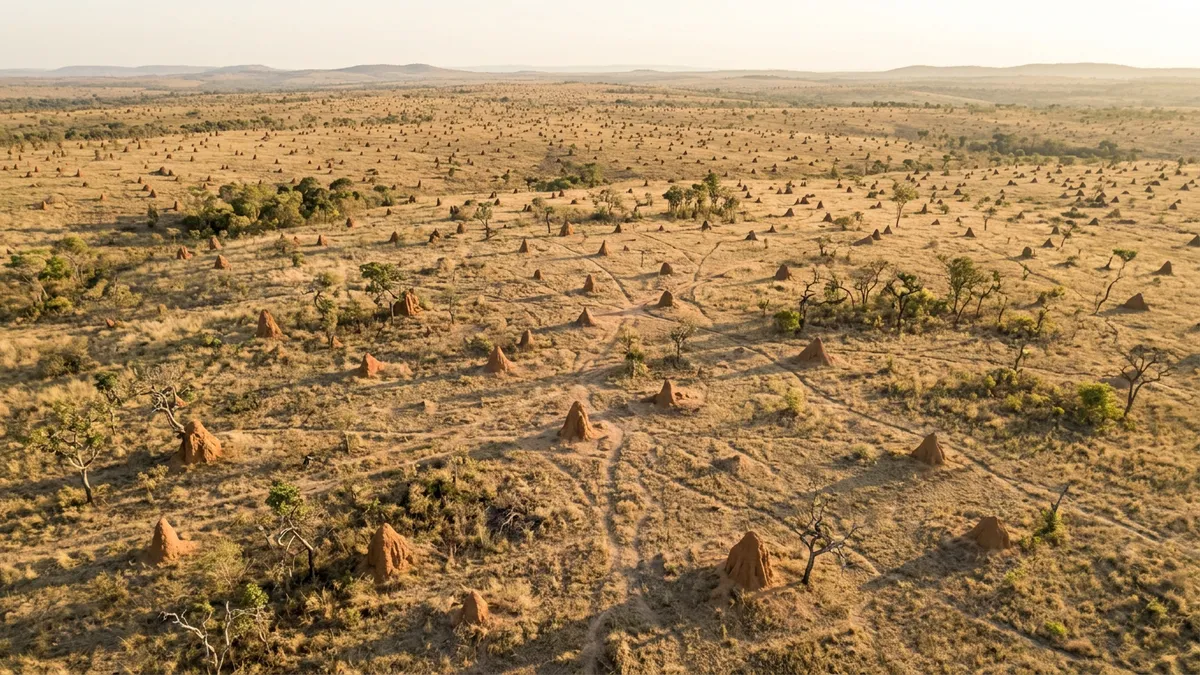
From above, the ground looks covered with thousands of dots arranged at regular intervals. Down on the surface, each dot is a mound of earth built by termites. Between them runs a network of underground tunnels that connects different parts of the field and keeps working thousands of years after the landscape began to take shape. Its sheer scale makes the whole set one of the largest works of animal engineering known.
The scene is in the interior of Brazil, in an area of open vegetation tied to seasonal environments. The field can be recognized in satellite images because the mounds repeat over huge stretches, with shapes and spacing that do not match an isolated construction. The mounds are the work of the termite Syntermes dirus. The story gained scientific attention in 2018, when the age of the system was estimated at roughly four thousand years. The most important fact is not the survival of any single termite, but the continuity of an architecture kept up across many generations.
A whole landscape built by tiny invertebrates
The mound that can be seen on the surface is only the outer part of a larger system. Termites remove particles from the soil, carry plant material and reorganize the ground to open chambers, passages and areas for circulation. The workers have pale bodies and mandibles adapted to cutting and carrying materials. Soldiers, in turn, defend the colony, while reproductive individuals secure the formation of new generations. This division of tasks lets the work go on even when part of the colony dies.
That organization is what sets the field apart from a random collection of piles of earth. The building work is spread out, and this lets the colonies tap resources scattered over the land, especially dry leaves, roots and other plant remains available during the season. Instead of concentrating all activity in a single structure, the termites occupy a wide and connected surface. The result is a work produced by collective behavior, with no central plan drawn up by any one individual.
Four thousand years does not mean one intact mound
The estimate of four thousand years describes the antiquity of the field and of its formation processes, not the age of any individual colony. Termites have much shorter life cycles, and colonies go through renewal, expansion, partial abandonment and reoccupation. Over time, new generations can keep paths open, rebuild mounds and change stretches of the underground network. The landscape therefore preserves a continuity of construction, not the permanence of the same animals.
The ancient date also calls for care in how it is read. The estimate speaks for the system as a whole, but it does not turn each mound into a piece frozen in time. Some parts may be older, while others were repaired or rebuilt later. What remains clear is that the present distribution is the product of a long history of occupation and upkeep, and that the activity seen today belongs to recent generations of termites.
What satellite images can reveal
Satellites do not show the tunnels directly. What appears in the images is the surface pattern formed by the repetition of mounds over a wide area. The regularity, the concentration and the contrast between the earth of the mounds and the surrounding vegetation make it possible to recognize the field at a scale that would be impossible for someone observing only on foot. Orbital photography turns an underground construction into a readable drawing on the Brazilian landscape.
The system covers an area so large that its size only becomes obvious when the mounds are viewed together. Estimates linked to the field point to tens of millions of structures spread over thousands of square miles (thousands of square kilometers), although the exact count varies with the method and with the limits used. Each mound is relatively small next to the total extent, but the sum makes up one of the largest works of animal engineering known. The comparison does not depend on crediting termites with human intelligence. It rests on measuring the area, the persistence and the repetition of the work.
An active network that also reshapes the ecosystem
The tunnels change the way water, air and organic matter move through the soil. By digging, the termites bring particles from deeper layers up to the surface and create spaces that can make it easier for water to soak in. The material piled up in the mounds also alters local conditions of moisture and nutrients. These changes produce microenvironments that differ from the surrounding ground, with effects on roots, low-growing plants and other organisms that use the soil.
The image of the field therefore points to a long-lasting environmental transformation. It is not only a set of homes, but an infrastructure that reorganizes the space where the colonies live and feed. Still, the data do not allow anyone to say that all the mounds are occupied at the same time, or that every original tunnel remains intact. Current activity confirms that the process continues, while the age reveals its historical depth.
Seen from space, the landscape is a reminder that a work can last through millennia without depending on a single builder, only on the repetition of simple tasks by successive generations.
Reporting: Natália Santos / Amazonia Mag

Editor · Amazonia Mag
Anne Silva is the editor of Amazonia Mag, the English-language edition of Revista Amazônia. She curates, translates and adapts the outlet's science and environment coverage for an international audience, reporting on Amazon wildlife, flora, rivers, climate and research. Every story she edits is grounded in peer-reviewed studies, official data and on-the-ground reporting from the Revista Amazônia newsroom in Belém, Pará, Brazil. More by Anne Silva →