
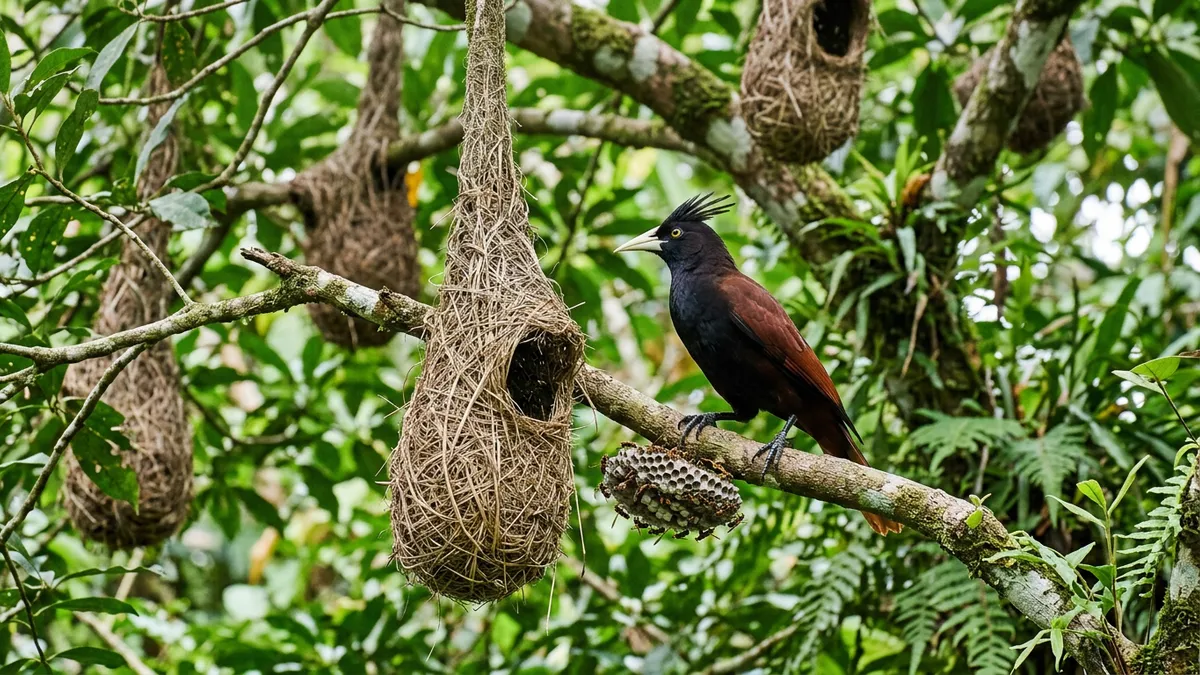
The crested oropendola (Psarocolius decumanus), known in Brazil as japu, hangs its woven, pouch-shaped nest close to a colony of wasps and takes advantage of the insects’ defensive reaction against animals that come near. The association creates a living barrier around the nest, one that can drive off monkeys and predatory birds that might otherwise reach eggs or chicks.
In the same tree, the colony can gather dozens of oropendola nests, placed among the nests of the insects. The bird does not control the wasps and takes no part in building their colony. Its strategy consists of choosing a position next to them, combining the hanging structure of the nest with the territorial behavior of the insects to lower the risk of attack.
How closeness to the wasp nest works
The mechanism depends on the distance between the oropendola’s nest and the wasp colony. When a monkey or a predatory bird moves along the branches and gets close to the nests, its presence can trigger a defensive response from the insects. The wasps leave their shelter and charge at the intruder, which tends to back off to avoid the stings. The protective effect does not come from any direct action by the oropendola, but from turning a risk for the predator into an obstacle it tries to avoid.
The association also works because the oropendola’s nest hangs in the air instead of resting on a fork or inside a cavity. The elevated, pendant position makes it harder for animals that have to keep their balance to reach the pouch. Near the wasp nest, the predator faces two problems at once: a structure that sways and insects defending their own colony. The combination makes the nest safer without the bird having to attack the invader.
The oropendola builds a long pouch from plant fibers, interlacing and fastening the material until it forms an enclosed structure with an entrance at the top. The hanging shape keeps the contents of the nest away from the branch and narrows the way in to a single opening. For a predator moving through the tree, it is not enough to find the nest: it has to reach the pouch, hold its balance and locate the entrance.
This design also creates a physical separation between the place where the bird lands and the space occupied by the eggs or chicks. The pouch can swing with the wind and with the weight of animals, which makes approaching it less simple for an intruder. The elongated shape is part of the oropendola’s own building method, while the choice to hang it near the wasps adds a behavioral layer of defense. The result is protection made of architecture and ecological association together.
Why the oropendola picks a tree with wasps
The choice of a nesting site directly affects the survival of the brood. An oropendola that builds far from a wasp colony still has the height and the woven pouch on its side, but it lacks the insects’ reaction to keep certain intruders away. By occupying a tree where wasps keep their colony, the bird adds to its nest a defense that stays active even when the adults are away looking for food.
The strategy is especially useful against animals able to climb along the branches, such as monkeys, and against birds that can land in the tree or reach the structure in flight. These predators do not have to be attacked by the oropendola to give up. The presence of the wasps changes the cost of the approach and can stop the attempt before the intruder touches the nest. The choice of place is therefore not a detail of construction: it is part of the bird’s reproductive behavior.
The oropendola neither tames nor commands the wasps
The relationship between the oropendola and the wasps does not mean the bird controls the insects, or that it sees them as animals trained for its protection. The wasps defend their own colony, their nests and the resources tied to it. The oropendola simply benefits from a response that would already exist in the face of any animal the insects consider a threat.
This difference matters for understanding the mechanism without attributing human intention to the behavior. The oropendola does not need to lead the wasps to the nest, feed the colony or point out who should be attacked. The advantage arises from the overlap of two separate interests. The wasp protects its territory, and the oropendola finds nearby a condition that makes it harder for predators to reach the brood. It is an ecological association based on shared space and an indirect benefit for the bird.
Dozens of nests in a single tree
Dozens of oropendola nests in one tree change the scale of this association. Instead of one bird choosing an isolated protected spot, a set of hanging pouches forms in the same environment, close to the wasp colony. The concentration makes the tree a breeding site used by many individuals, and it means the defense of the insects can benefit several structures around them.
The nests remain separate units, each with its own opening and its own inner space, but they share the conditions of the same branch or the same crown. If a predator approaches one pouch, its movement may carry it near others. The presence of many nests also shows how important that place is for the reproduction of the species. The protection does not remove every risk, but it adds a common barrier to an area occupied by many oropendola families.
A defense that links birds, insects and forest
The case shows how one nesting decision can connect animals from very different groups. The oropendola depends on fibers and on its ability to weave the pouch, while the wasps depend on the organization of the colony and the defense of their shelter. Monkeys and predatory birds, for their part, supply the pressure that gives the association its value. The result is a web of relationships in which the behavior of one animal changes the opportunities of the others.
In the forest, this kind of interaction also helps explain why a tree can matter for more than the food or support it offers. It supplies branches for building, room for a wasp colony and spots where many nests can be hung. The oropendola’s choice makes use of all these conditions together. The defense of the chicks thus depends not only on the shape of the nest but on the structure of the community that occupies the tree and on the behavior of the animals that move through its crown.
The oropendola’s nest shows that protection in nature does not always look like a fight. Sometimes it lies in the choice of a branch, in the right distance from a colony and in the ability to use a defense that belongs to another species. The wasps keep acting for their own reasons, while the bird turns their presence into safety for its brood. Among woven fibers and insects on alert, the forest shows that survival can also mean finding the right neighbor.
Reporting: Natália Santos / Amazonia Mag

Editor · Amazonia Mag
Anne Silva is the editor of Amazonia Mag, the English-language edition of Revista Amazônia. She curates, translates and adapts the outlet's science and environment coverage for an international audience, reporting on Amazon wildlife, flora, rivers, climate and research. Every story she edits is grounded in peer-reviewed studies, official data and on-the-ground reporting from the Revista Amazônia newsroom in Belém, Pará, Brazil. More by Anne Silva →