
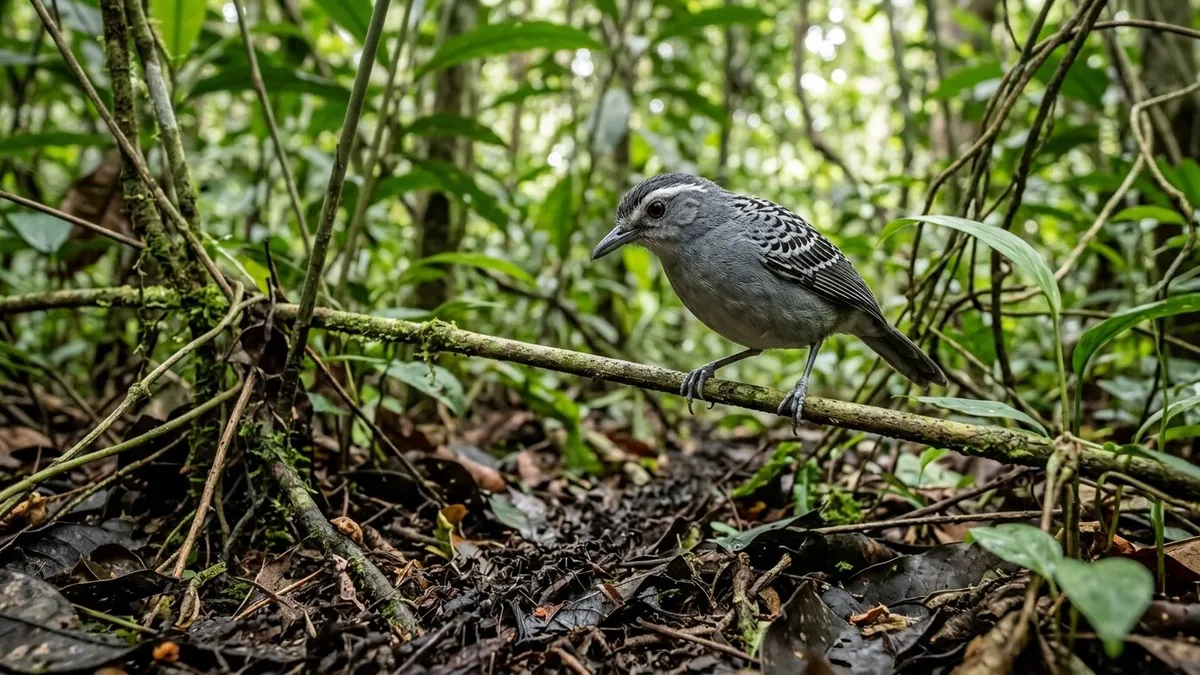
The antbird does not need to catch an army ant to benefit from its passage through the forest. It follows the moving column and snatches the insects, spiders and other small animals that try to escape the advancing predators. The mechanism depends on the collective movement of the ants, which sweep across the leaf litter and the low vegetation and flush out prey that was hiding.
This behavior turns the bird’s territory into a moving strip of opportunity. Instead of searching for each prey item alone among leaves, branches and roots, the antbird stays close to the swarm and uses the flight that the swarm provokes. While it follows the column, the pair also sings in duet, keeping in touch through the forest and coordinating their presence around the available food.
The ant column works like a capture net
Army ants advance in great numbers and explore their surroundings continuously. As they cross the layer of leaves, low trunks and patches of vegetation, they disturb animals that were sitting still or hidden. Small arthropods may run, jump or try to reach shelter, but that movement makes them far more visible to birds that follow the swarm.
The antbird positions itself near the column and watches the points where the escape happens. It does not rely on the ant as its main prey. It relies on the effect that the collective presence of the ants has on the community of small animals. The benefit comes from a momentary change in the environment: the swarm exposes prey that would be hard to find under normal conditions, and the bird takes advantage of that window without having to turn over the whole leaf litter by itself.
Antbirds are adapted to moving among low branches, leaves, vines and the areas close to the forest floor. Their foraging combines short moves with pauses to scan the surroundings. That strategy fits the passage of the ants, because the bird can follow the front of the column, change perches and drop quickly when a fleeing prey item appears.
The bill can grab different kinds of small animals, while the legs and feet help the bird hold on to thin branches and uneven surfaces. Capture does not require a long chase. In many cases it is enough to spot the movement, advance a short distance and return to a lookout point. The efficiency lies in the combination of visual attention, mobility close to the ground and the opportunity created by the activity of the ants.
The moment of flight decides when the bird strikes
The antbird does not follow the column at random. It tends to concentrate on the stretches where the movement of the ants provokes the largest number of reactions among animals on the ground and in the vegetation. A prey item that runs out of the leaf litter or tries to cross a branch can be noticed more easily than an animal that is motionless, camouflaged or protected in a crevice.
When the column moves away, the availability of exposed prey also drops. For that reason the following has to be relatively close and continuous. The bird can advance together with the ants, alternating observation points and short dashes. The behavior reduces the time spent searching, but it demands attention to the pace of the swarm and to the direction the group takes inside the forest.
The territory stops being fixed while the bird forages
In a conventional search, an animal covers an area and looks for food in places where it expects to find prey. When an antbird follows army ants, the point of reference changes. The bird does not depend only on a permanent spot, such as a tree or a clearing. The source of opportunity advances through the forest, and the bird adjusts its movements to the position of the column.
This moving territory does not mean that the antbird abandons its home range or wanders without direction. The pair keeps using a known region, but explores different parts of it as the swarm moves. The relationship creates an overlap between the space of the ants and the foraging space of the bird. The result is a flexible strategy in which the movement of another animal temporarily changes the food value of each stretch of forest.
The duet helps the pair stay together
Antbirds form pairs that sing in duet, a behavior that is especially useful when individuals move through dense foliage. The voices allow one animal to locate the other even when trunks, leaves and vines block the view. While the swarm is being followed, this communication helps keep the two birds coordinated as each one watches a different part of the column.
The duet should not be mistaken for a call meant to attract the ants or to make prey run. The movement of the insects happens regardless of the bird’s voice. The role of the song lies in communication between the members of the pair and in keeping contact within the territory. The strategy combines a feeding opportunity produced by another species with a form of cooperation that belongs to the bird itself.
An interaction that reorganizes the forest
The passage of army ants briefly changes the distribution of small animals in the forest. Prey that was hidden is displaced, while other animals look for shelter in leaves, branches or higher parts of the vegetation. The antbird takes part in this scene as an opportunistic predator, capturing some of the animals that become visible as the column advances.
This relationship shows that the working of the forest does not depend only on direct encounters between predator and prey. The movement of one species can create opportunities for another, even when the ant itself is never eaten. By following the swarm, the antbird turns a collective movement into the main signal of where to look. Instead of staying tied to one spot, its foraging follows a temporary change in the landscape, and it shows how the behavior of one species can reorganize the access of others to food.
The value of this strategy lies less in the strength of the antbird than in its ability to perceive an opportunity created by another animal. The swarm advances, the forest answers with quick movements and the bird adjusts its path. The pair, held together by their duets, turns this passing event into a routine of searching. In the forest, food does not always appear where the predator expects it. Sometimes it shows up when an entire community moves and makes visible what had been hidden before.
Reporting: Natália Santos / Amazonia Mag

Editor · Amazonia Mag
Anne Silva is the editor of Amazonia Mag, the English-language edition of Revista Amazônia. She curates, translates and adapts the outlet's science and environment coverage for an international audience, reporting on Amazon wildlife, flora, rivers, climate and research. Every story she edits is grounded in peer-reviewed studies, official data and on-the-ground reporting from the Revista Amazônia newsroom in Belém, Pará, Brazil. More by Anne Silva →