
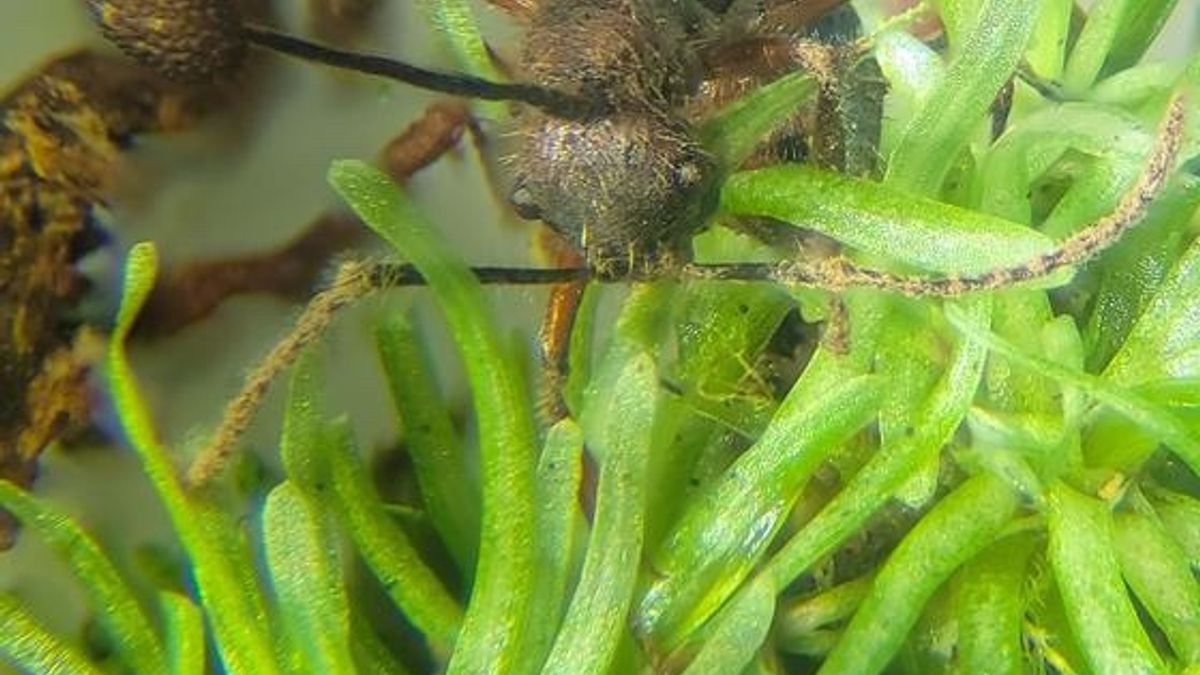
A team from Brazil’s National Institute for Amazonian Research (INPA) has found evidence that the fungus associated with so-called zombie ants can also live inside the mosses of the Amazon rainforest. The material was collected at the Adolpho Ducke Forest Reserve, north of Manaus, and analyzed by metabarcoding, a technique that identifies the DNA of different organisms in one sample. The result, published in 2026 in the scientific journal IMA Fungus, suggests that Ophiocordyceps has an endophytic phase, silent and little known, in addition to the parasitic stage that alters the behavior of ants.
A fungus does not need to be visible to be present
The finding stands out because the genus Ophiocordyceps is known mainly for its ability to infect insects. The most famous example is Ophiocordyceps unilateralis, popularly called the zombie-ant fungus. After entering the insect’s body, the fungus spreads and interferes with its muscles, leading the ant to abandon the colony and look for a suitable environment to disperse its spores.
The behavior seems straight out of a horror film, but the scientific explanation is more complex than the idea of a fungus directly controlling the brain. Studies indicate that the invader grows around the brain without necessarily enveloping it completely. The action may work through chemical compounds and through interference with the animal’s musculature.
On reaching a spot with favorable temperature and humidity, the ant clamps its mandibles onto a leaf, a twig or another surface. This final bite, known as the “death grip,” keeps the body in place after death and favors the release of spores. The place chosen, therefore, would not be random.
What the researchers found in the mosses
The genus Ophiocordyceps includes more than 350 species of fungi that parasitize different insects. The new research indicates that some lineages can also colonize mosses as endophytes, meaning that they live inside plant tissue without producing obvious outside signs.
The researchers analyzed moss samples and found genetic material of the fungus even in spots located more than 32 feet (9.7 meters) from infected ants. On its own, this does not prove that every ant deliberately seeks out colonized mosses, but it strengthens the hypothesis of an ecological connection among the insect, the fungus and the plant.
According to INPA, the researchers detected Ophiocordyceps DNA in mosses collected at the Adolpho Ducke Reserve, in Manaus, during the study published in 2026 in IMA Fungus. The full paper is titled “Metabarcoding reveals a hidden endophytic stage of the zombie-ant fungus in Amazonian mosses.” It presents the genetic analysis and the hypothesis about this hidden stage of the life cycle.
A clue about where infected ants die
Before this study, scientists had already observed that certain infected ants bite or seek out mosses. What was missing was knowing whether this behavior had anything to do with the presence of the fungus itself in the plant. The genetic analysis carried out by INPA found signs of Ophiocordyceps in moss communities of the Ducke Reserve, including when there was no parasitized ant immediately nearby.
The most likely interpretation is that the fungus can remain in plants during periods when few insects are available to infect. In that scenario, the moss would act as a kind of shelter or temporary reservoir, letting the organism get through unfavorable conditions until it finds a new host.
Metabarcoding is especially useful in environments like the Amazon, where a small sample can hold an extensive community of fungi, bacteria and other organisms.
What the discovery does not answer yet
The research does not show that the fungus turns the moss into a trap for ants, and it does not confirm that an insect can consciously identify the presence of the organism. It is also not established whether the colonization of mosses happens widely across all Ophiocordyceps species or is restricted to certain lineages and environmental conditions.
Another open question is the mechanism that would lead an infected ant to choose a plant colonized by the same fungus. There may be chemical attraction, a preference for features of humidity and temperature, or simply a combination of the insect’s behavior and the way mosses are distributed in the forest. The distance recorded in the samples also calls for new collections to estimate how often this pattern really occurs.
The next steps should expand the collection of mosses, test whether the fungus stays viable inside the plants, and investigate whether infected ants really choose these places more often. Until that data exists, the relationship remains a strong hypothesis, but not a definitive one.
Why it matters for the Amazon
The Ducke Reserve sits in one of the most important research areas of the Brazilian Amazon, close to Manaus and tied to studies of biodiversity, climate and interactions among species. A discovery of this kind widens our understanding of Amazonian fungi, a group still undersampled compared with plants and animals.
Across the states of the Legal Amazon, relationships among fungi, insects and plants may play ecological roles that remain invisible. Endophytic fungi can affect the resistance of plants, the decomposition of organic matter and the circulation of nutrients. In the case of Ophiocordyceps, understanding this network may better explain how the parasite persists and how it influences ant communities in the forest understory.
The finding also reinforces an important caution: the term “zombie” is a journalistic simplification of a biological phenomenon of behavioral manipulation. There is no evidence of risk to humans linked to the discovery, and the study deals with a relationship between fungi and insects in the Amazon environment. The interest lies in understanding how a fungus evolved to exploit different hosts and settings within an extremely diverse forest.
Reporting: Natália Santos / Amazonia Mag

Editor · Amazonia Mag
Anne Silva is the editor of Amazonia Mag, the English-language edition of Revista Amazônia. She curates, translates and adapts the outlet's science and environment coverage for an international audience, reporting on Amazon wildlife, flora, rivers, climate and research. Every story she edits is grounded in peer-reviewed studies, official data and on-the-ground reporting from the Revista Amazônia newsroom in Belém, Pará, Brazil. More by Anne Silva →