
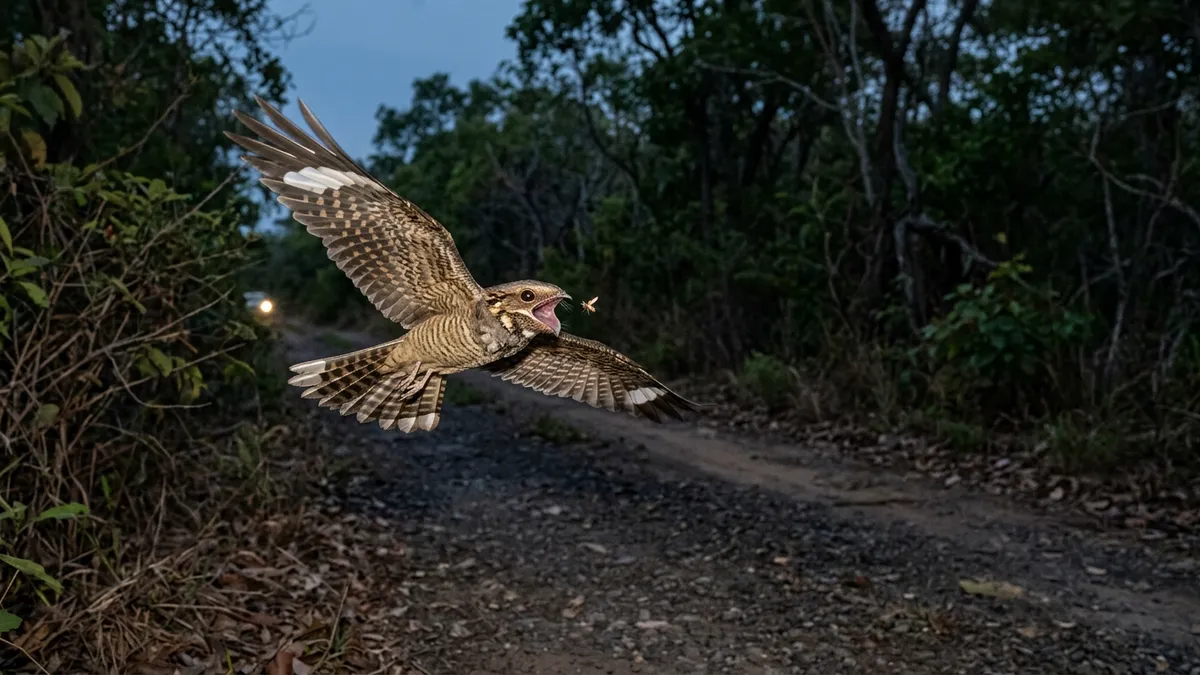
When a car’s headlights fall on a pauraque (Nyctidromus albicollis), known in Brazil as bacurau, sitting on a road, the bird’s eyes can throw the light back as a visible glow. The effect comes from the tapetum lucidum, a reflective layer associated with vision in low light. At the same time, the pauraque opens a very wide mouth and uses the bristles around it as a catching structure to reach insects during low flights.
The whole set works mainly at dusk and at night, when many insects are active and light is scarce. Instead of searching for food on the ground, the bird positions itself to intercept prey in the air. It also lays its eggs directly on the ground, without building a nest, and relies on the camouflage of its plumage and its eggs to stay discreet in its surroundings.
How the glow of the eyes helps the bird in low light
The tapetum lucidum sits behind the retina and reflects part of the light that passes through the light-sensitive cells of the eye. That light travels back through the retina, which increases the chance that it will be put to use in dim conditions. In a pauraque seen at night, the result can be perceived as a reflection of the headlight, especially when the bird’s head is turned toward the light source.
The glow does not mean that the animal produces light or that its eyes work like flashlights. It is an optical response to light coming from outside. On dark roads, the headlight creates an intense, directed condition that makes the reflection more obvious. In the natural environment, the same system is tied to the bird’s period of activity, marked by the low light of late evening and night.
A wide mouth forms a catching area in flight
The pauraque has a very large mouth opening in relation to the size of its head. This feature lets the bird reach insects while flying, without having to land after each attempt. The bristles around the mouth are usually described as a kind of net: they enlarge the area of contact and help hold the prey when it crosses the animal’s path.
Capture happens on the move. The pauraque flies low and can open its mouth as it approaches insects, using a combination of speed, wide gape and bristles. After the interception, the prey is swallowed. The mechanism differs from a careful search among leaves or from gathering food on the ground, because it depends on a quick meeting between the bird and an insect in flight.
The pauraque is a crepuscular and nocturnal bird. These periods offer little light to most observers, but they coincide with the activity of many insects. The bird can use that interval for low flights and explore open areas, edges of vegetation and other spaces where prey passes close to the ground.
Vision adapted to low light and a mouth prepared for aerial captures work together. The eye helps detect the surroundings and movement, while the mouth and bristles take part in the final stage of the capture. The choice of hour also lowers the bird’s exposure to intense light, which is not part of the natural conditions in which its hunting behavior developed.
Low flight brings the bird close to the insects
Flying near the ground puts the pauraque in the band where many insects can be intercepted. The bird does not need to climb to great heights to look for food. Staying close to the surface, it combines short displacement, an open mouth and continuous observation of the space ahead to catch prey that crosses its path.
This behavior also explains why a pauraque can be seen on roads or in clearings at night. The animal lands or moves about in open areas, where its silhouette blends into the surroundings and there is room to take off. A headlight, however, makes its eyes more visible to the observer and does not turn the bird into a luminous animal.
The ground replaces the nest during breeding
The pauraque lays its eggs directly on the ground, without building a structure of twigs, fibers or leaves. The strategy cuts the investment in a visible nest and keeps reproduction integrated with the environment where the bird lives. Instead of depending on a construction to hide the eggs, the animal uses camouflage to make them harder to detect.
The eggs and the plumage show patterns that can blend with dry leaves, soil and other elements of the terrain. This resemblance matters because laying on the ground leaves the eggs exposed to the space around them. Discretion requires the bird to stay unobtrusive and the site not to be disturbed in a way that draws attention to the brood.
Camouflage links hunting and protection in the same habitat
The life of the pauraque brings together two behaviors that depend on discretion. At night, the bird hunts insects in fast, low flights. During the breeding season, it stays associated with the ground and relies on the camouflage of its eggs and of its own body. In both cases, appearance reduces how easily the animal is located in its surroundings.
By catching flying insects, the pauraque takes part in the feeding relationships of the ecosystem and turns aerial prey into energy for its own survival. By using the ground without building a nest, it occupies a reproductive space different from the one used by birds that nest in trees. The glow of the eyes seen in a headlight is only the most noticeable part of a set of adaptations aimed at life at night.
The pauraque shows how a bird can depend on discreet solutions to live between the end of the day and the dark. The reflection in its eyes draws attention for an instant, but the full mechanism lies in the combination of vision, mouth, flight and camouflage. On the road, that glow also calls for care: recognizing the presence of the animal is the first step toward reducing dangerous encounters between vehicles and nocturnal wildlife.
Reporting: Natália Santos / Amazonia Mag

Editor · Amazonia Mag
Anne Silva is the editor of Amazonia Mag, the English-language edition of Revista Amazônia. She curates, translates and adapts the outlet's science and environment coverage for an international audience, reporting on Amazon wildlife, flora, rivers, climate and research. Every story she edits is grounded in peer-reviewed studies, official data and on-the-ground reporting from the Revista Amazônia newsroom in Belém, Pará, Brazil. More by Anne Silva →