
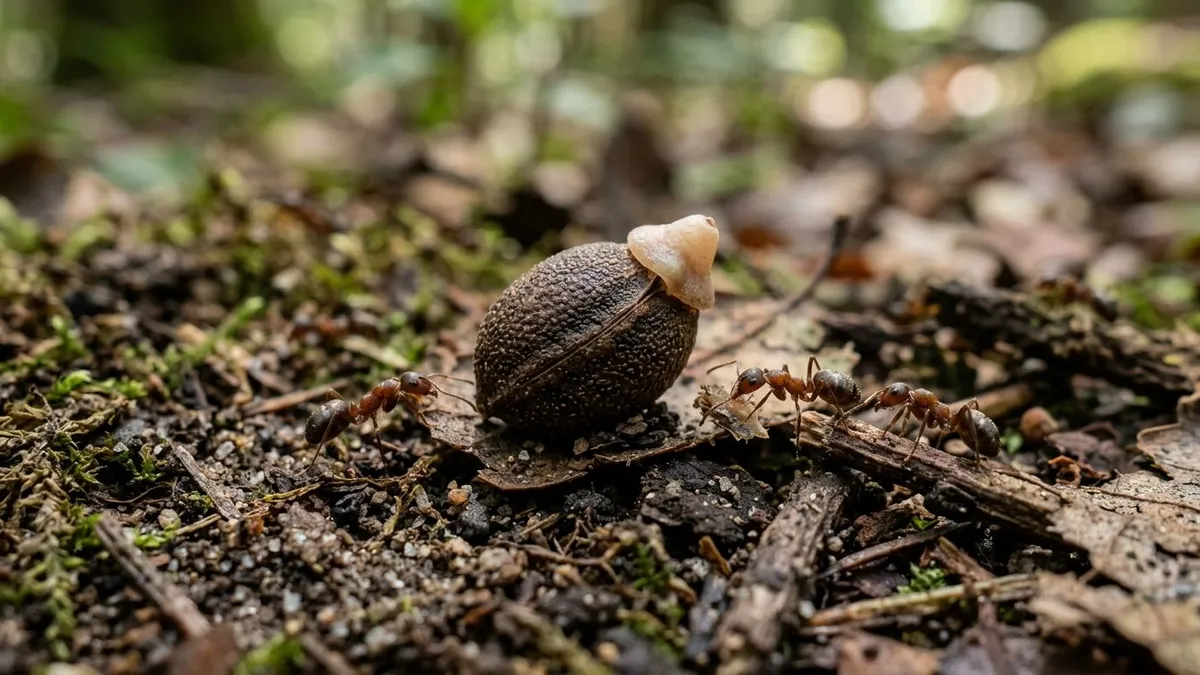
Stick insects of the species that use this strategy protect their eggs by imitating seeds. Females produce eggs fitted with a lipid-rich appendage known technically as the capitulum, which copies the elaiosome found on the seeds of many tropical plants. The resemblance, both in shape and in chemistry, draws foraging ants that walk through the leaf litter in search of food.
When the ants find eggs scattered on the forest floor, they pick them up and carry them into their underground nests. In the protected environment of the nest, the colony eats the nutritious appendage, and the hardened shell of the egg suffers no structural damage. The result is a stable microclimate and an efficient physical barrier against predators and parasitic insects, all the way until the nymphs hatch.
How the egg copies a seed and ends up in the nest
The outer structure of a stick insect egg shows highly specialized evolutionary adaptations. The chorion, the outer layer that covers the embryo, is as rigid as the coat of a hard seed. It carries grooves and ridges that make the egg harder for visual predators to pick out. At the upper end of the egg sits the capitulum, a fleshy bump made of lipids and carbohydrates, developed specifically to serve as a food attraction for the social insects that live in the soil of tropical forests.
Beyond its shape, the capitulum is described as giving off volatile chemical compounds that trigger an immediate collecting response in ants. When the workers detect these smell-based signals, they recognize the structure as a usable food source for the larvae of the colony. The egg is then picked up without being punctured, which shows how well the outer shell withstands the mechanical handling of the ants’ mandibles during the trip to the deep galleries of the soil.
The way ants carry the eggs into their nests follows the same pattern they use to collect seeds with an elaiosome. They carry the eggs through the leaf litter over considerable distances, which shields the embryos from direct sunlight, from drying out and from being trampled by large animals. Once inside the nest, the egg is taken to chambers set aside for processing food, where the colony carefully removes only the outer fatty portion.
After the capitulum has been eaten completely, the egg loses its appeal as food for the ants, but it stays intact thanks to the toughness of its outer wall. The workers then discard the egg in waste chambers or in disused storage areas inside the nest. These underground spots keep humidity and temperature steady, creating ideal conditions for the stick insect embryo to develop, far from the sharp temperature swings recorded on the surface of the forest vegetation.
A wall against parasitic wasps
The main threat to stick insect eggs left on vegetation comes from tiny parasitic wasps. These wasps use their ovipositor to pierce the shell of eggs laid on leaves or twigs, placing their own eggs inside the host so that their larvae can feed on the growing embryo. The death rate caused by such parasites can reach high levels when eggs stay exposed in the canopy.
Transport by ants changes this pattern of predation sharply, because it moves the eggs into the soil. Parasitic wasps are not equipped to dig into the ground or to enter active ant nests without being attacked in force by the defending ants. An egg that remains in an underground chamber has a complete biological shield, which removes the wasps’ access to it and raises considerably the rate of successful embryonic development in the species.
Hatching and the climb to the surface
Once the incubation period is over, which can last for months depending on environmental conditions, the nymph breaks through the operculum, the lid of the egg, while still underground. The young stick insect comes out with a flexible, elongated body suited to moving through tight spaces. Emerging inside the waste chamber of an ant nest means the nymph must reach the surface quickly to avoid prolonged contact with the residents of the nest.
Newly hatched nymphs move with agility. Once outside, the nymph climbs the nearest vegetation right away to feed on young leaves and begin its tree-dwelling life cycle.
Losing a leg and growing it back
On vegetation, during the young and adult phases, the stick insect faces new challenges from birds, lizards and small mammals. As a secondary defense, the insect can practice autotomy, which means voluntarily shedding one of its legs when a predator grabs it. The separation happens at a predetermined fracture point in the joint of the limb, preventing excessive loss of hemolymph, the insect’s blood, and allowing the individual to escape quickly.
Unlike many adult insects, stick insect nymphs can regenerate lost limbs through successive molts of the exoskeleton, a process known as ecdysis. With each change of skin, a new limb develops internally and emerges gradually larger, until it reaches the proper functional size. This regeneration makes sure that the accidental loss of legs during youth does not permanently compromise movement or reproductive success in adulthood.
Ants, stick insects and the forest floor
The interaction among stick insects, ants and vegetation shows how complex food webs can be in Brazilian biomes. By carrying the eggs away, ants practice a form of seed dispersal known as myrmecochory, which extends the distribution range of the eggs and helps maintain stick insect populations in areas under severe environmental pressure. The organic matter left behind when the consumed eggs are discarded also enriches the soil around the ant nests.
The reproductive strategy of the stick insect shows how natural selection shapes solutions that tie together organisms from distinct kingdoms and niches. The match between the shape of the egg, the behavior of the ants and the resistance to parasitic wasps keeps alive a lineage adapted to the challenges of forest life. Understanding these dynamics widens our view of the fragility and richness of ecological connections, and it reinforces the value of preserving habitats where these processes keep going without interruption.
Reporting: Natália Santos / Amazonia Mag

Editor · Amazonia Mag
Anne Silva is the editor of Amazonia Mag, the English-language edition of Revista Amazônia. She curates, translates and adapts the outlet's science and environment coverage for an international audience, reporting on Amazon wildlife, flora, rivers, climate and research. Every story she edits is grounded in peer-reviewed studies, official data and on-the-ground reporting from the Revista Amazônia newsroom in Belém, Pará, Brazil. More by Anne Silva →