
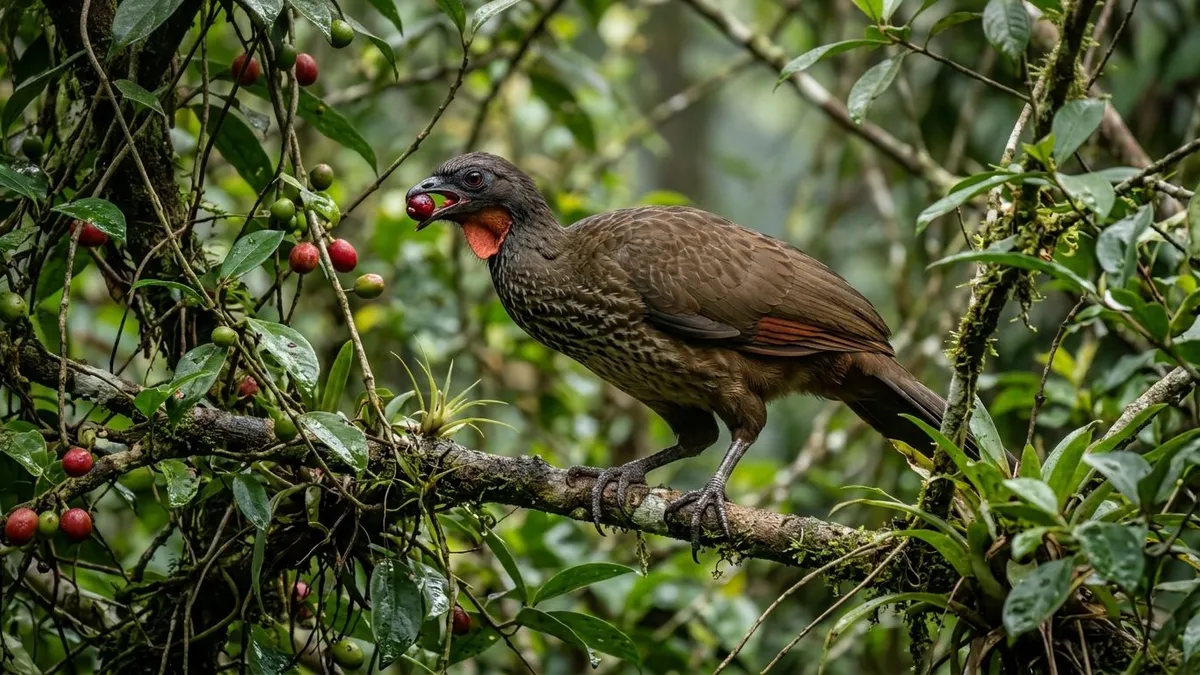
The jacu swallows fruit whole because its digestive tract does not crush seeds. After passing through the digestive system, many of them stay intact and are dropped at another point in the forest, where they may find conditions to germinate. That turns a fruit-eating bird into a long-distance seed disperser.
The routine starts before the sun warms the forest. The jacu tends to call at dawn, moves between trees in search of food and can carry seeds away from the plant that produced the fruit. Hunting and habitat fragmentation weaken this ecological service by shrinking both the bird’s populations and the natural routes between forest patches.
The fruit passes whole through the digestive system
When it feeds, the jacu can swallow whole fruits, especially those that fit the size of its bill and throat. The pulp is processed and used as food, but the seed does not go through a crushing stage like the one that happens in animals that break or chew hard structures. The relatively short digestive tract helps the passage to be quick, so the hard part of the fruit crosses the system without being destroyed.
That does not mean every swallowed seed stays viable or that every fruit ends up as a new plant. Germination depends on the plant species, the condition of the seed, moisture, light, soil and the absence of seed predators. Even so, a seed that remains physically whole is more likely to arrive in a state that allows it to take part in regeneration. By separating the seed from the pulp, digestion can also reduce the amount of substances that would make germination harder next to the mother plant.
The jacu uses its bill to reach, grip and pull fruit, not to grind each seed before swallowing. The bird handles food with quick movements and can swallow whole units, depending on size and consistency. Afterward, the digestive system separates the most useful components, absorbing nutrients from the pulp and moving the undigested material to the exit of the intestinal tract.
This anatomy is not a machine built only for dispersal. The jacu has to get energy to fly, call, look for mates and escape predators. Dispersal appears as a consequence of how it feeds. The seed travels with the animal and is released along with organic waste that can enrich the spot where it lands. That combination of transport, deposit and available nutrients creates an opportunity that would not exist if the fruit simply fell under the original crown.
The bird chooses where to land, not where the seed sprouts
The movement of the jacu between trees is shaped by the supply of fruit, the presence of shelter, the need to avoid threats and the social relations of the species. When it lands on another tree or inside a forest fragment, the bird can drop seeds a considerable distance from the plant they came from. The animal does not pick a planting site, but its movements widen the area that the seeds reach.
This behavior matters especially for plants whose fruits are eaten by animals and for trees that need mobile dispersers. A seed left far from the crown can escape the concentration of predators, fungi and competitors that builds up next to an adult tree. It can also reach clearings, edges and stretches in recovery, as long as the environment offers moisture and suitable conditions. Distance alone does not guarantee a seedling, but it widens the set of places where germination can happen.
The jacu turns feeding into an advantage for the forest
In the relationship between the jacu and plants, the bird receives food and the trees gain a means of transport for their offspring. This is the result of an ecological association, not of deliberate cultivation. Plants that produce attractive fruit can be visited by different animals, and the jacu contributes especially when it moves between separate areas or uses distant trees during the same feeding period.
The dispersed seeds also help to maintain the diversity of plant species in a landscape. A forest does not depend only on new trees being born under existing crowns. It needs seeds arriving in clearings, along margins and in places where old individuals have died. When the bird carries seeds over longer distances, it reduces the concentration of offspring in a single spot and favors the gradual occupation of available space. This effect is stronger when the animal keeps access to continuous areas of vegetation.
Calls at dawn reveal a social routine
Dawn is a period marked by the calls of jacus. The sound can take part in communication between individuals and in organizing the day’s activity, although the call is not a dispersal mechanism in itself. The bird begins to move in search of food, uses different trees and can follow routes that connect places for resting, feeding and shelter.
This routine helps explain why protecting the jacu does not depend only on protecting a single fruit tree. The animal needs a landscape that can support its movements, with different food sources through the year and enough vegetation to reduce its exposure. If the forest is divided into small fragments, the jacu can lose paths, foraging areas and safe places to perch. Fewer movements mean, in turn, fewer seeds carried and shorter distances.
Hunting and fragmentation interrupt seed transport
Hunting directly affects jacu populations and reduces the number of individuals available to disperse seeds. Habitat fragmentation works in another way, by separating trees and cutting the continuity of vegetation. Even when some animals remain in the landscape, roads, open areas and settlements can limit the routes between fragments. The result is a smaller network of seed transport, especially for plants that depend on larger birds.
Protecting the jacu means conserving more than the bird on its own. It is necessary to keep forest areas, restore connections between fragments and reduce hunting pressure. Protecting fruit trees also sustains the food that lets the bird stay in the landscape. When these elements come together, the jacu keeps flying between different points, carrying intact seeds beyond the shade of the original tree.
The jacu shows that the regeneration of a forest can start with a simple movement: the flight of a bird looking for food. A seed does not need to be planted by a human hand to change places, and the animal does not need to act like a farmer to fill an essential role. Each fruit it swallows connects the tree that produced it to a new stretch of forest. Preserving that relationship means recognizing that the continuity of the forest also depends on quiet routines, repeated at dawn and spread across the whole landscape.
Reporting: Natália Santos / Amazonia Mag

Editor · Amazonia Mag
Anne Silva is the editor of Amazonia Mag, the English-language edition of Revista Amazônia. She curates, translates and adapts the outlet's science and environment coverage for an international audience, reporting on Amazon wildlife, flora, rivers, climate and research. Every story she edits is grounded in peer-reviewed studies, official data and on-the-ground reporting from the Revista Amazônia newsroom in Belém, Pará, Brazil. More by Anne Silva →