
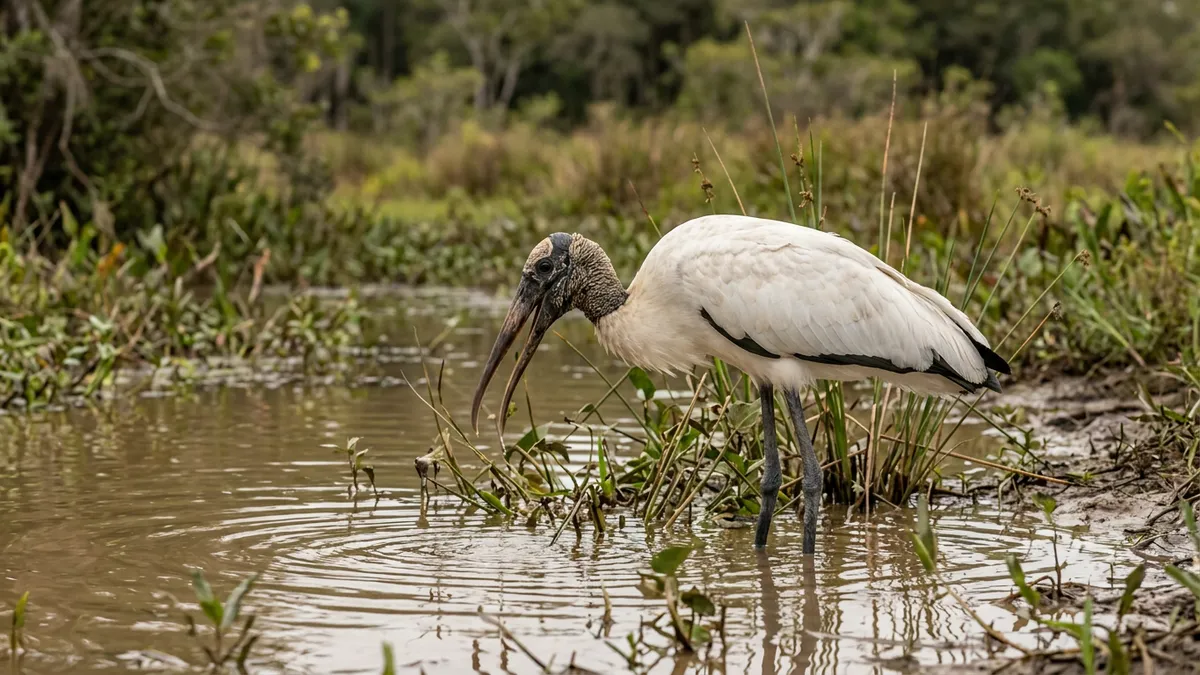
The wood stork (Mycteria americana), known in Brazil as cabeça-seca, keeps its bill open under the water and waits for a fish to touch its sensitive structures. When it feels the contact, it snaps the two halves of the bill shut in a fraction of a second, catching the prey without relying on sight through the whole movement. This tactile reflex is among the fastest ever measured in birds, and it lets the species fish in shallow, murky water or in water choked with vegetation.
The strategy works together with other adaptations. The bare head and neck reduce the buildup of organic debris during feeding, while soaring flight uses thermals to cut the energy spent on travel. The wood stork thus combines perception through touch, body hygiene and flying efficiency to exploit flooded environments, where the availability of fish changes as the water gathers or recedes.
The open bill turns touch into capture
While fishing, the wood stork puts its bill into the water and can hold it partly open while moving its head through places where fish are present. The bird does not have to follow each prey visually until the last instant. The contact of the animal with the inside of the bill triggers an automatic closing that is quick and coordinated. The movement joins tactile perception and jaw muscles in a single capture sequence.
This technique differs from a strike launched from above. Instead of locating the prey, lining up the bill and lunging, the wood stork creates a detection zone around its own mouth. Any fish that brushes the sensitive surfaces can set off the reflex. Murky water and the shade of submerged plants, which make vision difficult, stop being such important obstacles to fishing success.
The wood stork’s bill is long, robust and adapted to catching aquatic animals. Its shape lets the bird reach fish in thin sheets of water and hold the prey when the jaws close. Sensitivity does not depend only on the tip: tactile structures spread through the inner region help the bird sense the contact before the fish escapes.
The reflex also demands coordination among nerves, muscles and joints. The stimulus produced by the touch runs quickly through the nervous system and triggers the closing of the jaws. Because the movement happens with the head partly or fully underwater, the bird has less need to correct the position of its bill after detecting the prey. The result is a capture based on contact, not on a long chase in the water.
The bare head helps during feeding
The head and neck of the wood stork have little or no feather cover, a feature that is easy to see when the bird dips its bill and part of its head to fish. This absence works as a hygienic adaptation. Fish remains, mud and water rich in organic matter come into direct contact with the skin, without being trapped in a dense layer of feathers that would have to be cleaned over and over.
Feeding in flooded areas exposes the bird to a mix of water, sediment and biological waste. Keeping the region free of feathers makes cleaning easier after fishing and prevents fragments from staying stuck near the mouth and eyes. The trait does not make the animal immune to contaminants or infections, but it reduces a practical difficulty for an animal that uses its head as part of its capture equipment. In this case, the body is adjusted to the feeding method.
The reflex allows fishing without chasing the prey
Fish can change direction quickly when they sense a bird approaching. The wood stork’s technique sidesteps that escape: the bird keeps its bill open and lets the fish cover the distance needed to touch the inner surface. Since the closing is triggered by contact, the interval between detection and capture is very short.
This mechanism is especially useful when the water has poor visibility or when there are many obstacles on the bottom. The bird can look for prey in shallow environments, with vegetation and suspended sediment, without launching its whole body at each attempt. The method saves movement and lowers the chance of a disorderly chase. The advantage lies not in catching any animal that is available, but in turning a brief encounter into a capture before the prey can react.
Soaring flight links feeding areas
The wood stork spends part of the day in aquatic environments, but it may have to cover distances between feeding, resting and breeding areas. To do so, it uses thermals, columns of warm air that rise from heated ground. By gaining altitude inside these currents, the bird can glide for longer periods, flapping its wings less than it would in continuous flight.
This behavior reduces the energy cost of travel over floodplains, flooded fields, riverbanks and other open environments. The saving matters for a species that looks for food repeatedly and can follow changes in the water level. When a stretch dries out or stops concentrating fish, the wood stork can look for another place without spending the energy of a flight based only on wingbeats. Efficient capture and economical travel are parts of the same way of life.
The wood stork’s fishing moves the food web of flooded areas
By catching fish, the wood stork takes part in the relationships between predators and aquatic organisms. Its feeding removes individuals from a community subject to fast changes in depth, current and concentration of prey. The bird is itself part of the food web of flooded environments.
The presence of a wood stork also points to areas able to offer shallow water and accessible food, although a single observation is not enough to judge the condition of an environment. The fishing mechanism shows how physical changes in a habitat affect animal behavior: if the water becomes too deep, dries up quickly or loses its natural circulation, the technique can become less efficient. Preserving the dynamics of flooding keeps not only the landscape but also the conditions that let the bird use its bill as a sensor.
The wood stork shows that a capture can depend more on touch than on pursuit or strength. Its open bill creates the opportunity, the reflex closes the trap and the bare head goes with the routine of a bird that wades in to eat. Above it, soaring flight uses warm air to connect different points of the environment. The whole is a reminder that adaptations do not work alone: the efficiency of a species is born from the combination of body, behavior and landscape.
Reporting: Natália Santos / Amazonia Mag

Editor · Amazonia Mag
Anne Silva is the editor of Amazonia Mag, the English-language edition of Revista Amazônia. She curates, translates and adapts the outlet's science and environment coverage for an international audience, reporting on Amazon wildlife, flora, rivers, climate and research. Every story she edits is grounded in peer-reviewed studies, official data and on-the-ground reporting from the Revista Amazônia newsroom in Belém, Pará, Brazil. More by Anne Silva →