
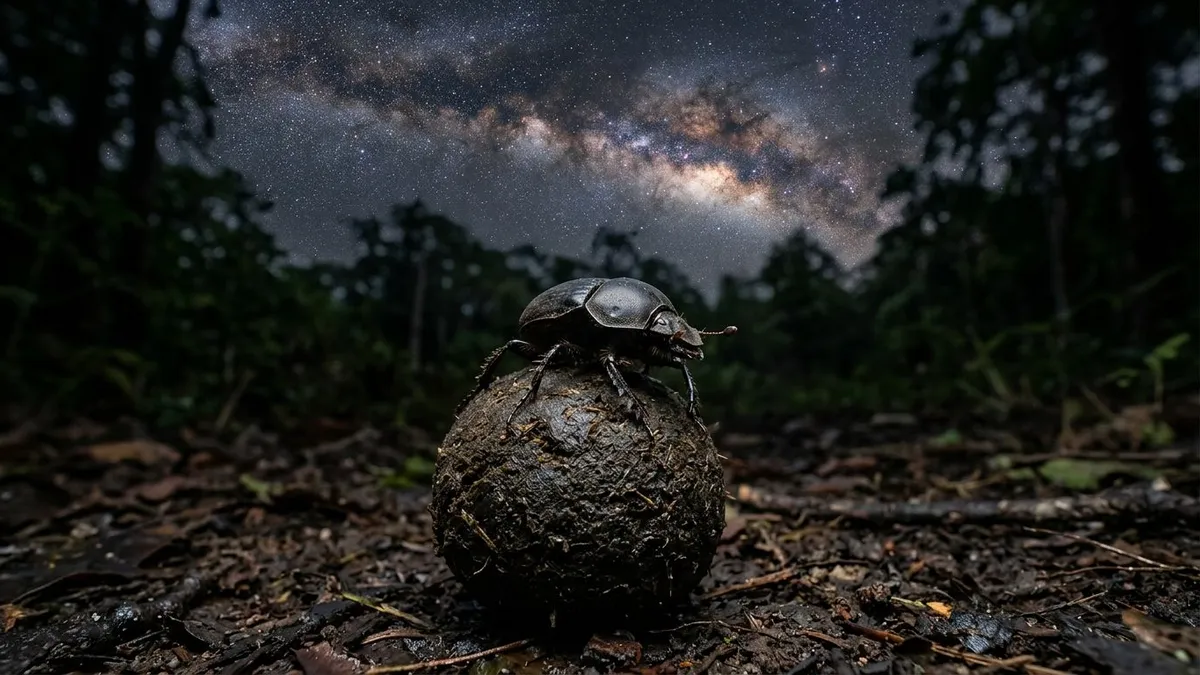
The dung beetle runs one of the most unusual navigation strategies in the animal kingdom: it uses the glowing band of the Milky Way as a compass at night. When it finds a source of mammal dung, the insect quickly shapes a ball of organic material and has to leave the spot as fast as it can, before competitors of its own species steal the prize. To get away along the quickest route, the invertebrate holds a perfectly straight line, even in the darkness.
This behavior depends on the beetle’s ability to read the light of the night sky. Before starting its walk, the beetle climbs on top of the newly formed ball and turns its body around its own axis. That movement works as the calibration of a biological guidance system. It lets the animal register the position of the galaxy and keep its heading, without drifting, along the whole journey across the forest floor.
A band of light as a compass
The navigation begins the moment the faint light of the galaxy reaches the beetle’s eyes. Many animals orient by isolated points of light, such as a single star or the moon. This insect works differently: it processes the continuous strip of brightness that crosses the sky. That luminous streak comes from the stars packed into the galactic disk, and it gives the beetle a steady directional cue for the entire walk.
With that cue in hand, the dung beetle fixes a constant angle between its path on the ground and the orientation of the galactic band overhead. If the animal keeps that angle unchanged while it moves, the geometry guarantees that its route is a straight line. This simple physics removes the risk of walking in circles, a common mistake for animals without visual references. It also saves energy and sharply reduces the time the beetle spends in an area where the danger is highest.
Eyes built for dim light, a dance on the ball and a heavy load
The compound eyes of the dung beetle carry cellular adaptations that allow them to detect very low light intensities. This lets the insect’s nervous system tell the contrast of the Milky Way apart from the dark background of the night sky, even on nights when there is no moonlight at all.
The so-called dance on the dung ball is the point where this eye structure meets the animal’s neurobiology. By turning a full 360 degrees on top of the mass, the beetle sweeps its gaze across the horizon and records how the brightness varies from one direction to another. That reading creates an instant mental map in the invertebrate’s brain. Once the beetle climbs down to push the ball with its hind legs, it holds on to that spatial information and uses it to correct its heading at every step.
The galactic navigation is triggered right after the beetle finishes making its ball. A heap of dung on the ground creates an environment of extreme competition, with dozens of individuals showing up within minutes. To secure the resource, the beetle uses its serrated front legs to cut away organic matter and its curved hind legs to model a cohesive sphere, one that can be rolled efficiently over the surface of the terrain.
The load can reach up to fifty times the body weight of the beetle itself. Moving such a bulky mass takes considerable physical effort, and the insect travels head down, pushing the food with its hind legs while its front legs rest on the ground. Because the animal cannot see the way ahead during this backward movement, the sky becomes the only reliable guide for advancing in a direction perpendicular to the point of origin.
Racing away from thieves
The need to keep a straight path is a direct answer to the pressure of theft by other beetles in the same area. At the main pile of organic matter, physical confrontations are frequent, and larger beetles often take finished balls from smaller individuals. If the beetle that built the ball made turns, or accidentally returned to the starting point, the chance of losing its food to a rival would rise significantly.
Navigating by the Milky Way ensures that the distance from the center of competition grows at the maximum possible rate for each unit of time. By moving the ball to a safe, isolated zone in the forest, the insect can bury the resource without interference from opportunistic competitors. This highly optimized behavior reduces deaths caused by fighting and maximizes the efficiency of the collecting effort, turning work into reproductive success and individual survival.
Food for adults, cradle for the young
A dung ball carried off successfully plays a double role in the life cycle of the species. It feeds the adults, and it serves as an incubation chamber for the offspring. Owning a large, well shaped ball defines the hierarchy at mating time. Males able to produce and carry big balls quickly attract the attention of females, which often climb onto the load and ride along to the place where the material will be buried.
After the burial in an underground tunnel dug into moist soil, the female lays a single egg inside the protected mass of organic matter. The buried ball provides a microclimate with controlled humidity and concentrated nutrients, so the developing larva has enough food to grow until it completes its metamorphosis. Without efficient astronomical navigation during the nighttime transport, the reproductive cycle of the beetle would often be cut short by the loss of its resources.
Small engineers of the forest soil
The constant hauling of dung balls by these insects has a direct impact on the ecological dynamics of tropical land ecosystems. By scattering and burying large amounts of organic matter that piles up on the surface, dung beetles speed up the decomposition of mammal droppings. The process puts essential nutrients, such as nitrogen and phosphorus, back into the deeper layers of the soil, making vital minerals available for the roots of local vegetation to absorb.
Beyond the chemical enrichment, the systematic digging of underground galleries to bury the balls changes the physical structure of the ground. It promotes aeration and increases the capacity of the soil to take in rainwater. Removing dung quickly from the surface also reduces the spread of disease vectors and parasites that affect mammals. In this way, the mechanics of the beetle’s astronomical navigation directly supports the renewal and balance of the ecosystem.
The link between the microcosm of the forest and the scale of the galaxy shows how complex the adaptations are that sustain life on Earth. The dung beetle demonstrates that even modest organisms, tied to organic waste, depend on refined mechanisms of physical perception to fulfill their ecological role. Protecting the night environment from light pollution, and preserving the integrity of biomes, is essential so that these small engineers of the soil can keep reading the maps printed on the night sky to move the life beneath our feet.
Reporting: Natália Santos / Amazonia Mag

Editor · Amazonia Mag
Anne Silva is the editor of Amazonia Mag, the English-language edition of Revista Amazônia. She curates, translates and adapts the outlet's science and environment coverage for an international audience, reporting on Amazon wildlife, flora, rivers, climate and research. Every story she edits is grounded in peer-reviewed studies, official data and on-the-ground reporting from the Revista Amazônia newsroom in Belém, Pará, Brazil. More by Anne Silva →