
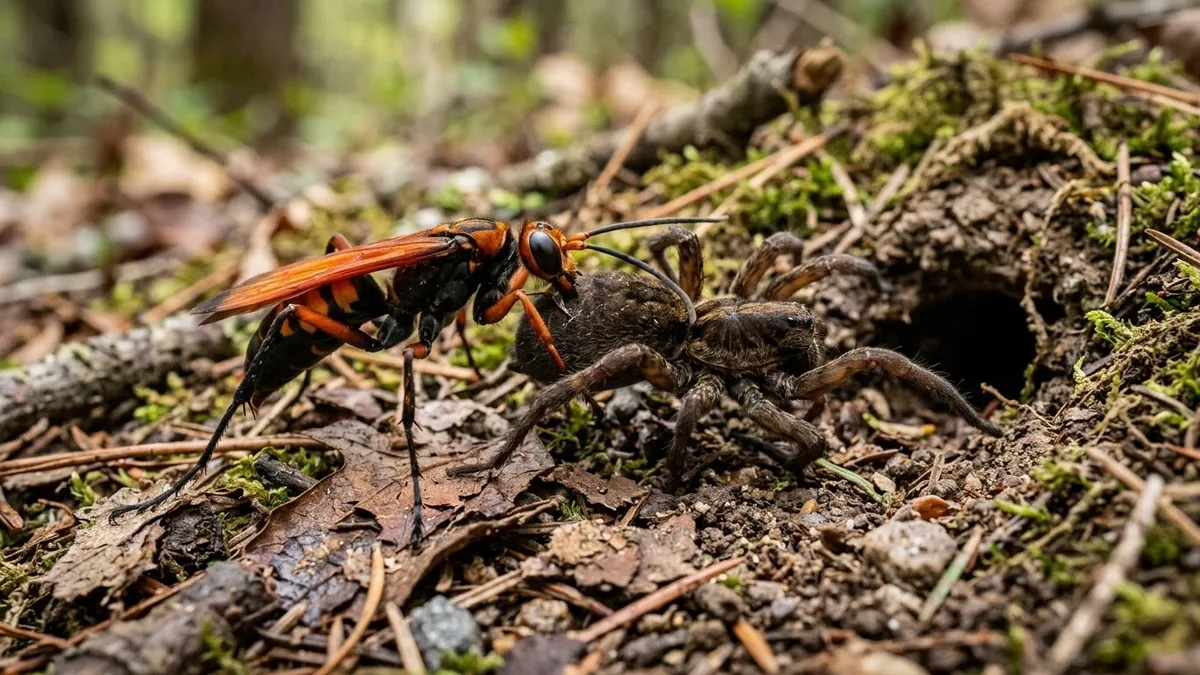
The scene begins on the ground, when a spider wasp meets a spider that may be several times heavier than it is. Instead of killing the prey, the wasp uses its sting to paralyze the spider’s movements. The spider stays alive, but it no longer walks, reacts or escapes. That difference changes the whole purpose of the attack.
The body is not treated as an immediate meal for the adult. It is a fresh reserve for the next generation. The wasp then faces a problem of scale: the prey is larger and far heavier, yet it has to reach the burrow. What follows is a chain of actions in which every step prepares the next one.
The sting stops the spider without killing it
Spider-hunting wasps belong to a group known for the specialized use of the stinger. This device, which serves as a defense and also as a hunting tool, injects venom into the prey during the encounter. The legs help grip and reposition the spider, while the jaws can assist in handling the body and preparing the site.
The mechanism does not rely on a bite that tears the prey apart, nor on a web that wraps it. It relies on interrupting movement. The wasp has to reach a vulnerable region of the spider and deliver the venom precisely enough to shut down motor activity. The result is a prolonged immobilization, not a quick death.
Because the spider stays alive, its tissues remain available to the larva once the egg hatches. The sting therefore does two jobs at once: it lowers the risk of a struggle during transport and it keeps the prey usable for longer. It is a hunting strategy aimed at the development of the offspring, not at feeding the adult wasp. To the spider, the predator is not just bigger or stronger. It combines stinger, venom and pulling power to turn an active animal into a load that can be carried to a shelter.
A larger body becomes a load dragged to the burrow
After paralyzing the spider, the wasp has to move it. The transport is done by dragging, with the wasp pulling the body across the ground. Its legs brace against the terrain to produce traction, and the spider’s body is shifted bit by bit instead of being carried through the air. This matters because dragging reduces the demand for lift, although it does not remove the effort.
The route can require changes of direction, pauses and corrections when the prey catches on stones, leaves or uneven ground. Each advance brings the wasp closer to the shelter where the egg will be laid. The behavior shows that the strength of the animal lies not only in the size of its body, but in the combination of posture, grip and persistence during the trip.
The burrow works as protection for both the prey and the future larva. It keeps the paralyzed body from being fully exposed to other predators and offers a more controlled space for development. The wasp places the spider inside and lays a single egg tied to it. The number matters: there is no brood spread over several bodies, but one larva assigned to one specific reserve.
A single egg turns the spider into food for the larva
Transport also explains why the spider has to arrive alive. If it were eaten or destroyed during the capture, it would lose part of its value as food for the offspring. By dragging the whole prey, the wasp preserves a concentrated source of tissue. The burrow ends up holding three elements of the life cycle: protection, food and the starting point for the larva.
Inside the burrow, the egg begins the stage that the attack only prepared. When the larva develops, it finds a spider that is alive but motionless, available as food. The larva eats gradually, from the inside out, using the prey’s tissues over the course of its own growth.
This process differs from how the adult feeds, since the adult does not depend on the captured spider. The larva needs a relatively stable source of nourishment, while the adult wasp only makes sure that source is in the right place. The spider, which once moved and hunted, now sustains the development of another animal. Capture, paralysis, transport, egg laying and consumption come together in one reproductive strategy. Having a single egg also limits the food to one offspring instead of dividing the prey among several larvae.
Risk, scale and what varies
Choosing a spider larger than the wasp raises the amount of food available, but it also makes the capture riskier. The wasp has to approach prey equipped to react and then move a body that cannot be lifted easily. The sting solves the main obstacle, and the dragging solves the problem of weight.
How long the paralysis lasts, how far the burrow is and which tissues are consumed first all vary among species of hunting wasps and their prey. The central mechanism, however, stays clear: the spider is not killed at the moment of the sting, it is moved while still alive and it serves as food for a single larva. The strategy turns a physical disadvantage into a sequence of coordinated actions.
The adult feeds on nectar, and the capture takes part in ecological balance
Once the egg is laid, the adult wasp has no need to eat the spider. Its food is mainly nectar, taken from flowers and used as an energy source for flying, searching for prey and other activities. This split between the adult’s diet and the larva’s food keeps the prey from being shared between two stages of the life cycle. The captured spider is reserved for juvenile development, while the wasp looks for carbohydrates in its surroundings.
While visiting flowers, the adult may also carry pollen between floral structures, although how much it does so depends on the species and the local context. The same wasp seen dragging a spider on the ground may, at another moment, be on vegetation in search of nectar. The cycle links two nearby environments: the ground, where the prey is found, and the flowers, where the adult gets its energy.
As predators of spiders, these wasps take part in the relationships that regulate populations of other arthropods. That does not mean a single capture controls spider numbers on its own, or that the effect is the same in every habitat. The wasp species, the availability of prey, the presence of shelter and local conditions all shape the outcome. Even so, the mechanism offers a concrete reflection on small lives: strength, venom and behavior do not act alone. Together, they allow a smaller animal to turn a larger prey into shelter, food and the continuity of its own cycle.
Reporting: Natália Santos / Amazonia Mag

Editor · Amazonia Mag
Anne Silva is the editor of Amazonia Mag, the English-language edition of Revista Amazônia. She curates, translates and adapts the outlet's science and environment coverage for an international audience, reporting on Amazon wildlife, flora, rivers, climate and research. Every story she edits is grounded in peer-reviewed studies, official data and on-the-ground reporting from the Revista Amazônia newsroom in Belém, Pará, Brazil. More by Anne Silva →