
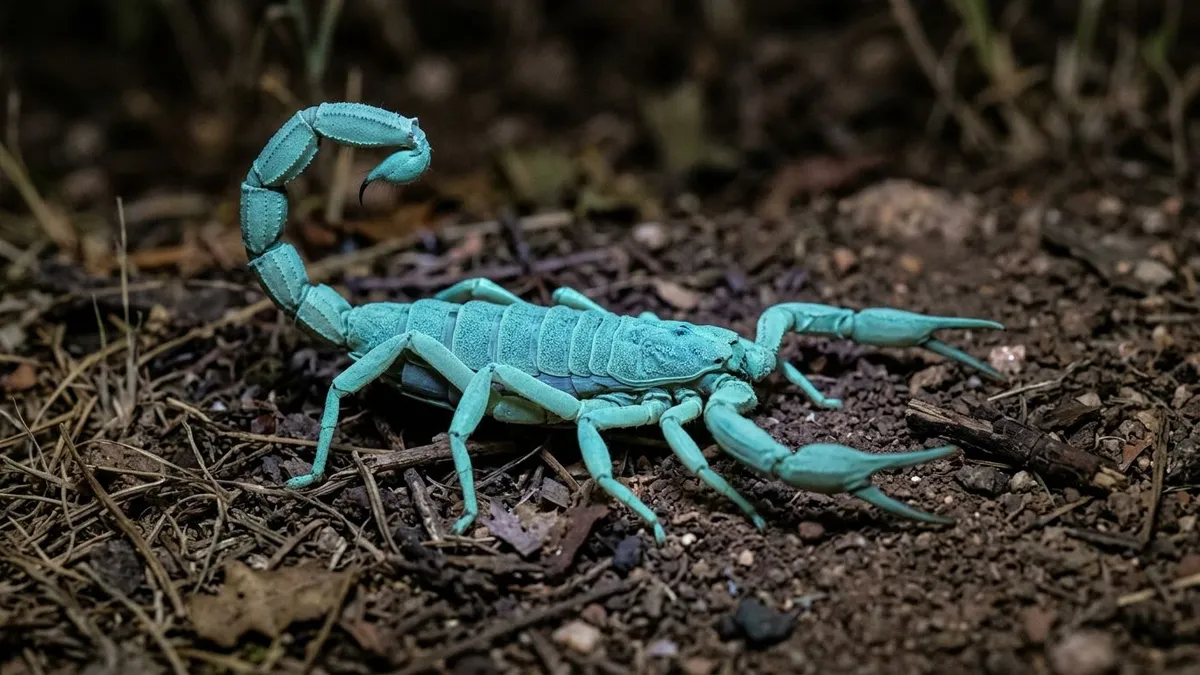
In the dark, a beam of ultraviolet light can make a scorpion appear with a visible glow that does not exist under ordinary lighting. The effect does not come from an internal lamp or a light-producing organ. It happens in the cuticle, the rigid layer that covers the arachnid’s body and forms part of its exoskeleton. Substances in that structure absorb ultraviolet radiation and give back part of the energy as visible light, a phenomenon known as fluorescence.
The result is a silhouette that stands out for anyone watching the animal with the right equipment. The glow is a well-documented physical mechanism, but it does not settle the central biological question: what advantage, if any, does it give the animal itself?
The glow appears when ultraviolet light strikes the cuticle
Fluorescence is not a light the scorpion makes. It is a response of the material. The cuticle receives radiation that the human eye cannot see and returns part of it at wavelengths we can. Without the ultraviolet source, the effect disappears.
The intensity can vary with the species, the age, the condition of the cuticle and the environment, so the glow should not be treated as an identical trait in every scorpion. What can be said with confidence is the optical mechanism. What remains open is its meaning.
The scorpion belongs to the arachnid group and pairs its fluorescent cuticle with specialized sensory structures. On the underside of the body, the pectines (comb-like appendages with numerous teeth) touch the ground. They help the animal perceive chemical signals, vibrations and features of the surface, information used while moving and exploring the surroundings.
This combination creates an animal that does not depend on a single sense to find shelter, read the terrain or interact with other individuals.
Fluorescence is not ultraviolet vision
The glow should not be confused with the ability to see ultraviolet light. Fluorescence happens when the cuticle receives suitable radiation, but that does not prove the scorpion sees its own emission or that it consciously uses the light to send a message. The distinction matters because a property that is visible to an observer may have arisen for a different function, or may have no direct adaptive function at all.
In the same way, the fact that a cuticle fluoresces shows how the material reacts to ultraviolet light. It does not show which evolutionary pressure was responsible for the property.
Three hypotheses try to explain one trait
One possibility is that fluorescence takes part in protection from sunlight. The cuticle is exposed to the environment, and the compounds responsible for the glow may absorb part of the ultraviolet radiation. This hypothesis treats the observed emission as a consequence of an interaction between the outer covering and the radiation, with a possible protective effect.
Another idea is that the phenomenon helps the scorpion detect the presence or intensity of light. Since many scorpions have habits tied to nighttime activity, a change in ambient radiation could supply information about when to come out, stay hidden or look for shelter. Even so, the existence of a response to light does not demonstrate, by itself, that fluorescence is a working sensor.
It is also possible that the glow influences encounters between individuals and plays some part in communication. That hypothesis remains open and requires specific behavioral evidence.
Telling the hypotheses apart would mean comparing species, ages, environments and behaviors, and checking whether individuals respond consistently to the glow or to changes in radiation. Correlation must also be separated from cause. A scorpion may be more active under a certain light condition without fluorescence being the reason. The same goes for communication: seeing two animals in the same space does not prove that one is using the emission to pass information to the other.
For that reason, the most accurate wording is that the function of fluorescence still lacks consensus. Science knows the optical mechanism, but it is still investigating the ecological meaning.
The same animal, away from ultraviolet light, lives on the ground
While the cuticle draws attention because of its glow, reproduction shows a more concrete side of scorpion biology. After gestation, the female gives birth to young that climb onto her back and stay there during an early phase of development. Carrying them protects the newborns while they still depend on the mother’s body to stay together and cross the environment.
This image also helps avoid a common mistake: the young should not be confused with eggs attached to the back. They are juvenile scorpions with the basic shape of the animal, and they leave that position as they advance in development. Reproduction therefore offers an observable sequence of gestation, birth and carrying of the young, but it should not be automatically linked to fluorescence. These are different characteristics, even though they belong to the same life cycle.
What the glow does and does not tell you
In Brazil, where scorpions live in a range of environments, ultraviolet light can be used to locate individuals during field observations or monitoring work. The glow, however, does not replace correct identification of the species, and it does not guarantee that the animal is harmless. Fluorescence alone says nothing about the risk of a sting, the behavior or the distribution of each population.
Fluorescence is a known biological trait, while its function sits among hypotheses of sun protection, light detection and communication. What remains is a precise scientific question: the scorpion carries on its body a measurable optical response, but the evolutionary sense of that response still has to be demonstrated. Until then, watching the glow is only the beginning of the investigation.
Reporting: Natália Santos / Amazonia Mag

Editor · Amazonia Mag
Anne Silva is the editor of Amazonia Mag, the English-language edition of Revista Amazônia. She curates, translates and adapts the outlet's science and environment coverage for an international audience, reporting on Amazon wildlife, flora, rivers, climate and research. Every story she edits is grounded in peer-reviewed studies, official data and on-the-ground reporting from the Revista Amazônia newsroom in Belém, Pará, Brazil. More by Anne Silva →